




01. Edit your form online
Type text, add images, blackout confidential details, add comments, highlights and more.

Type text, add images, blackout confidential details, add comments, highlights and more.

Draw your signature, type it, upload its image, or use your mobile device as a signature pad.

Send it via email, link, or fax. You can also download it, export it or print it out.
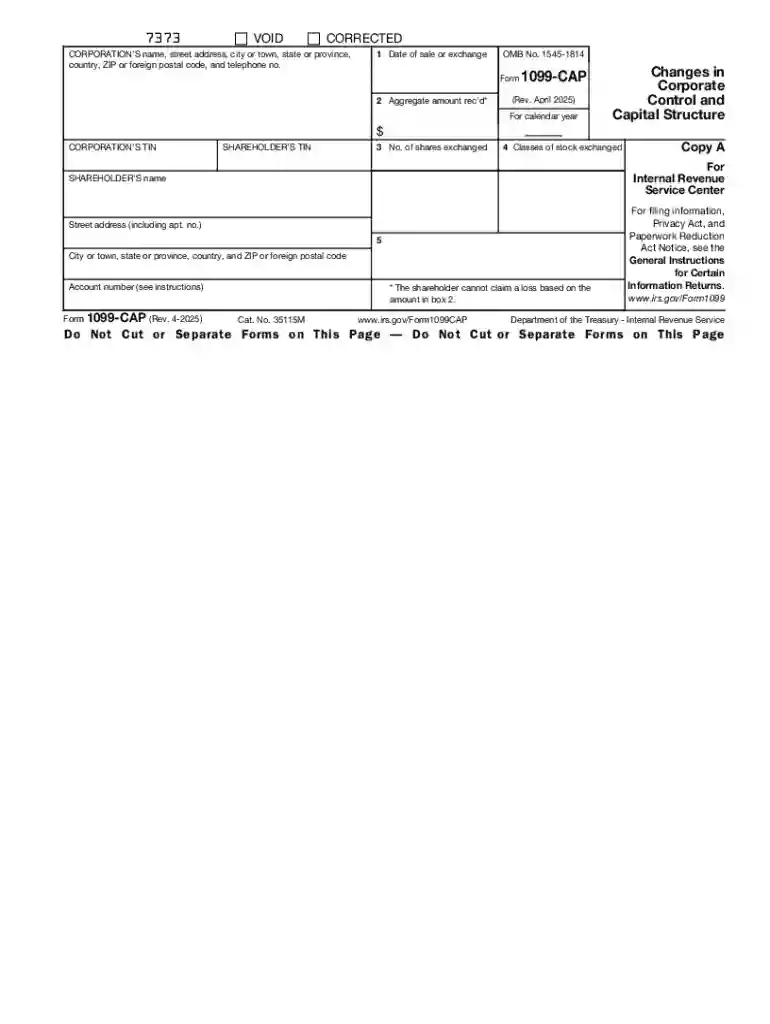
Form 1099-CAP (Rev April 2025) is a tax form issued by corporations to report changes in corporate control and capital structure to the Internal Revenue Service (IRS) and shareholders. This form plays a critical role when a substantial shareholder equity event, such as a merger or acquisition, results in the substantial alteration of a company's ownership structure. Shareholders receive this form to understand their tax obligations concerning any gains or changes resulting from such transactions, although it does not allow for the reporting of capital losses.
Corporations use the Form 1099-CAP to inform shareholders and the IRS about transactions leading to changes in ownership or capital structure. For shareholders, this form is crucial for computing any potential tax due on benefits received due to these corporate changes. Specifically, shareholders should:
The Internal Revenue Service mandates the use of Form 1099-CAP for corporations undergoing volume transactions altering control. It is vital for compliance that:
Corporations must issue Form 1099-CAP to shareholders by January 31 annually. The form must be submitted to the IRS by February 28, or March 31 if filed electronically. Meeting these deadlines is critical in avoiding penalties and ensuring shareholders can properly report related tax obligations.
Failure to accurately complete or submit Form 1099-CAP can result in penalties for corporations, including fines per incorrectly filed or missing form. The IRS imposes penalties that increase with the duration of delinquency. Additionally, shareholders may face challenges in tax reporting, potentially leading to unfavorable audits or assessments.
At DocHub, your data security is our priority. We follow HIPAA, SOC2, GDPR, and other standards, so you can work on your documents with confidence.





Feb 23, 2023 Instructions for Forms 1099-A and 1099-C. Instructions for Form 1099-B. Instructions for Form 1099-CAP. Instructions for Form 1099-DA.Read more
by KDL Thomas 2024 Cited by 4 Part. IV offers a concrete proposal for quarterly information returns for platform workers (a new Form 1099-ES), including how to best design these returns.Read more


