
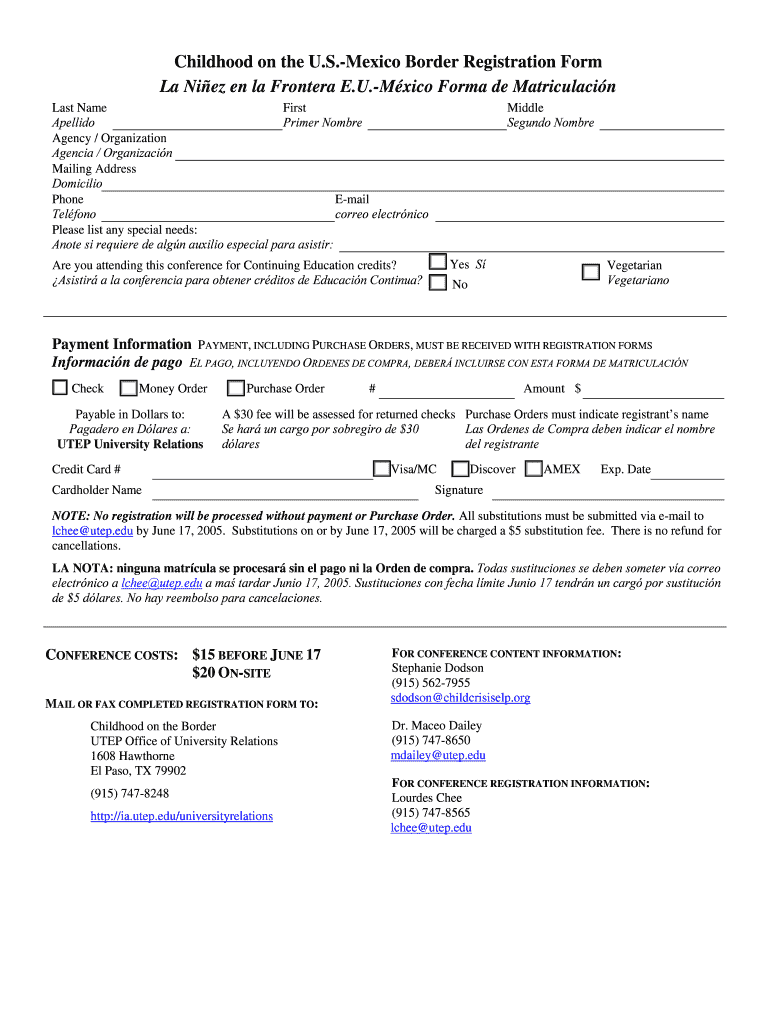







Definition and Meaning
The "Childhood on the U.S.-Mexico Border La Niñez en la E.U.-México" refers to a form or document, likely used for engaging with an event or conference centered on discussions about childhood experiences along the U.S.-Mexico border. This form likely serves as a medium to frame academic, social, and policy-oriented dialogues around the unique challenges and conditions faced by children in this border region. It embodies a bilingual approach to including perspectives from both U.S. and Mexican sides, emphasizing a culturally and linguistically inclusive methodology. The document might facilitate exchanging ideas between educators, policymakers, and researchers.
Cultural and Linguistic Inclusivity
- Bilingual Format: Reflects bilingual sessions, indicating inclusivity for both English and Spanish-speaking participants.
- Focus on Childhood: Concentrates on issues affecting young populations living on or near the border, such as education, healthcare, and socio-economic challenges.
How to Use the Childhood on the U.S.-Mexico Border La Niñez en la E.U.-México
Utilizing this form effectively involves understanding its role in registering for relevant events or expressing interest in participating in related discussions.
- Registration: Likely required for participation in a conference focused on border issues.
- Information Submission: Users may need to provide personal details for contact or logistic coordination.
- Panel Participation: Interests or expertise areas might be included for panel planning or speaker selection.
Completing the Form
- Personal Details: Ensure accuracy and completeness for seamless registration.
- Session Selection: Indicate preferred panels or topics, if applicable.
Steps to Complete the Childhood on the U.S.-Mexico Border La Niñez en la E.U.-México
Filling out the form likely demands attention to detail to meet registration requirements or event participation criteria. Here’s a structured approach:
- Gather Necessary Information: Compile personal and professional details required by the form.
- Access the Form: Identify the form's location, possibly on a conference or academic website.
- Fill Out Personal Details: Enter accurate personal information such as name, contact details, and affiliations.
- Select Sessions or Tracks: If the event offers various topics or sessions, choose those of interest to ensure a tailored experience.
- Review Submission: Double-check details to avoid errors, leading to a smooth registration or application experience.
- Submit the Form: Follow submission instructions carefully, whether online or through physical mail, and retain a copy for records.
Key Elements of the Childhood on the U.S.-Mexico Border La Niñez en la E.U.-México
Understanding and addressing critical components within the form is crucial for proper usage:
- Personal Information Section: Comprehensive data entry section for participant identity verification.
- Session Preferences: Options may exist to indicate interest in specific topics, helping organizers tailor the event to participants' interests.
- Comments or Remarks Field: Space for additional notes or special accommodations.
Example Sections
- Professional Background: Information about the participant's work and expertise.
- Childhood Issues Focus: Selection of issues like education, healthcare, or socio-cultural dynamics for focused discussions.
Who Typically Uses the Childhood on the U.S.-Mexico Border La Niñez en la E.U.-México
This form likely attracts a range of professionals interested in border region issues, including:
- Educators involved in cross-border teaching initiatives.
- Policy Makers aiming to develop effective border region policies.
- Researchers studying socio-economic impacts on border childhood experiences.
- NGO Representatives working in humanitarian sectors on both sides of the border.


Common User Scenarios
- Academic Professionals hoping to present research or engage in dialogues.
- Government Officials seeking insights from academia and NGOs for policy development.
- Non-profit Leaders interested in the latest discussions and networking.
Important Terms Related to Childhood on the U.S.-Mexico Border La Niñez en la E.U.-México
Understanding specialized terms ensures clear communication and effective engagement with the form and related discussions.
- Cross-Border Education: Educational systems and challenges linking institutions across the U.S. and Mexican borders.
- Bicultural Integration: Incorporating cultural aspects from both countries in dialogues and policies.
- Transnational Childhoods: Experiences of children navigating two national identities or systems.
Legal Use of the Childhood on the U.S.-Mexico Border La Niñez en la E.U.-México
Legally, the form might function under academic or organizational statutes to promote an informed and structured event.
- Authorization: Use under legal frameworks set by conference organizers or institutions.
- Compliance: Participants must adhere to data protection laws, ensuring information security and privacy.
Regulations and Permissions
- Data Privacy Laws such as GDPR compliance for participants from respective regions.
- Intellectual Property: Consideration for published or shared academic work.
Examples of Using the Childhood on the U.S.-Mexico Border La Niñez en la E.U.-México
Practical application scenarios exemplify the form’s role in facilitating various engagements.
- Conference Registration: An academic researcher submits to present findings on border childhood education.
- Panel Organization: A policymaker submits to join a panel, discussing innovative educational practices.
- Networking Platform: An NGO worker uses the form to connect with others tackling similar border issues.
Each example reflects the form's utility in fostering collaboration, knowledge-sharing, and policy development within the unique context of the U.S.-Mexico border.




