01. Edit your form online
Type text, add images, blackout confidential details, add comments, highlights and more.

Type text, add images, blackout confidential details, add comments, highlights and more.

Draw your signature, type it, upload its image, or use your mobile device as a signature pad.

Send it via email, link, or fax. You can also download it, export it or print it out.
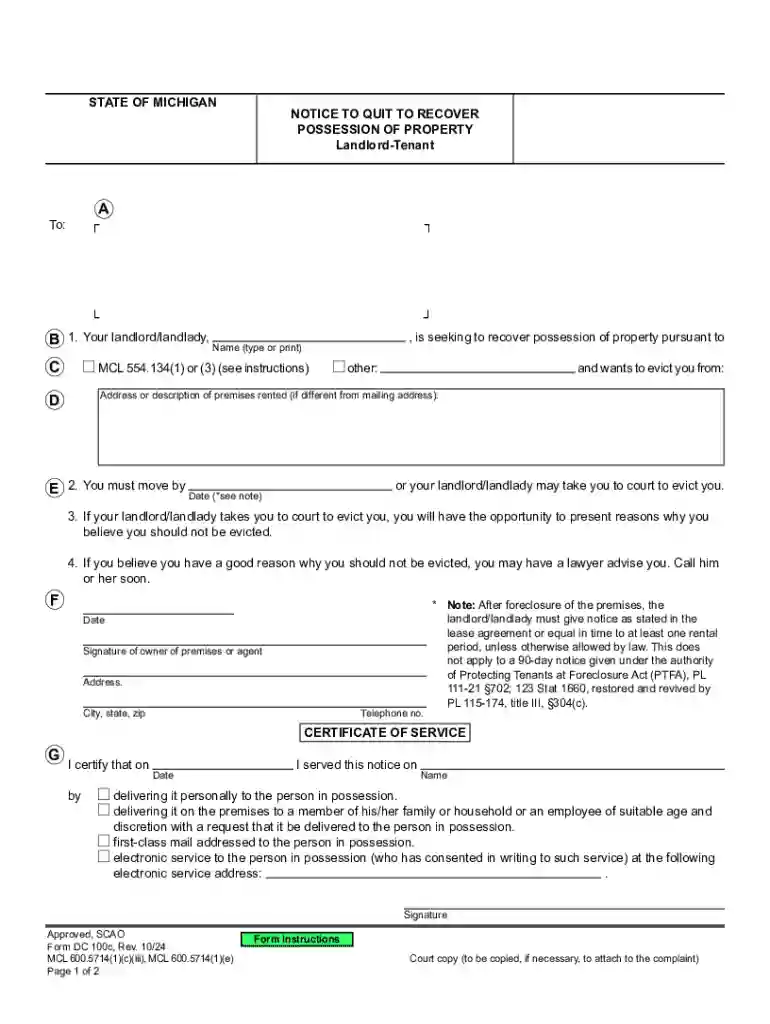
The State of Michigan Notice to Quit to Recover Possession is a legal document used by landlords to inform a tenant of their intent to reclaim possession of a rental property. It serves as the initial step in the eviction process, providing official notice to the tenant and establishing a timeline for when the tenant must vacate the premises. This document is pivotal in ensuring landlords adhere to Michigan's legal framework for evictions, helping avoid unlawful eviction procedures.
In Michigan, the Notice to Quit outlines the specific reason for eviction, such as non-payment of rent or violation of lease terms, and states the deadline by which the tenant must leave the property. This legal notice is crucial, as it also informs tenants of their right to contest the eviction in court, offering a fair chance to address grievances or misunderstandings.
To effectively use the State of Michigan Notice to Quit to Recover Possession, landlords must ensure that the document is correctly filled out and served to the tenant in compliance with state laws. This involves detailing the exact reasons for issuing the notice, whether it is due to non-payment of rent, breach of lease agreement, or other legal grounds.
The process includes:
By following these steps, landlords maintain legal compliance and uphold tenants' rights.
Obtaining the State of Michigan Notice to Quit to Recover Possession is straightforward, with several methods available:
Choosing the right source depends on the landlord’s comfort level with legal procedures and the need for specific legal advice.
Completing the State of Michigan Notice to Quit involves several precise steps to ensure accuracy and legality:
Through these steps, the notice forms a solid legal foundation for potential court proceedings.
The State of Michigan Notice to Quit to Recover Possession holds significant legal weight, as it is a prerequisite for initiating any formal eviction procedure. It protects landlords from claims of unlawful eviction and provides tenants an opportunity to rectify the situation or contest the notice in a legal setting. Additionally, the notice is a critical element in the documentation required by Michigan courts should the eviction process escalate to a judicial hearing.
Several key elements must be included in the State of Michigan Notice to Quit to ensure it meets legal standards:
Including these elements prevents misunderstandings and supports legal compliance.
Michigan has specific rules governing how and when a Notice to Quit must be served, which vary depending on the reason for eviction:
Landlords must familiarize themselves with these rules to prevent legal challenges or delays in the eviction process.
Real-life scenarios where the State of Michigan Notice to Quit to Recover Possession is used include:
These examples demonstrate the document's flexibility and importance in maintaining proper landlord-tenant relations.
By choosing detailed and diverse blocks of content, this compilation provides a comprehensive overview of the State of Michigan Notice to Quit to Recover Possession, catering to landlords and tenants alike with practical, actionable information.
We've got more versions of the State of Michigan Notice To Quit To Recover Possession form. Select the right State of Michigan Notice To Quit To Recover Possession version from the list and start editing it straight away!
At DocHub, your data security is our priority. We follow HIPAA, SOC2, GDPR, and other standards, so you can work on your documents with confidence.