







Definition & Meaning
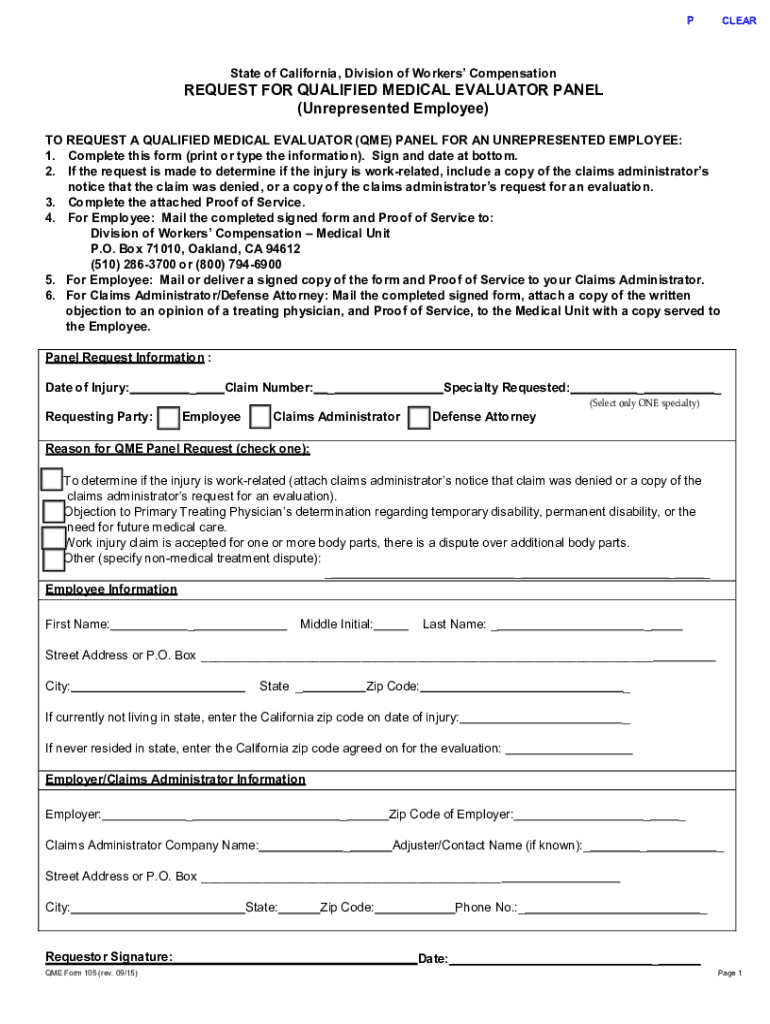
The "Request for Qualified Medical Evaluator Panel (Unrepresented Employee)" is a formal document utilized in the State of California's workers’ compensation process. It is specifically designed for unrepresented employees who need to request an impartial evaluation of their medical condition by a panel of qualified medical evaluators (QMEs). This form serves as an essential tool for addressing disputes over the medical aspects of a worker’s compensation claim, such as the extent of an injury or the necessity for treatment. By completing this form, employees seek an unbiased evaluation to guide the resolution of their claim.
How to Use the Request for Qualified Medical Evaluator Panel
Unrepresented employees can use this form to initiate a request for a QME panel. To properly utilize this document:
-
Complete Personal and Contact Information: Enter the employee's full name, address, and contact details to ensure that the Division of Workers’ Compensation (DWC) can reach the applicant.
-
Detail the Injury: Provide specific information about the injury, including the date the injury occurred and the body parts affected.
-
State the Dispute: Clearly articulate the nature of the disagreement concerning the medical treatment or evaluation.
-
Sign and Date: Ensure the form is signed and dated, signifying the truthfulness and accuracy of the provided information.
How to Obtain the Request for Qualified Medical Evaluator Panel
To obtain the form, employees can visit the website of the Division of Workers’ Compensation or directly contact their local DWC office. Additionally, physical copies are typically available at workers' compensation offices throughout California. An unrepresented employee may also request the form through mail or, in some cases, have it provided by their employer or treating physician.
Steps to Complete the Request for Qualified Medical Evaluator Panel
-
Gather Relevant Information: Collect all necessary information concerning the claim, including any correspondence from the employer or insurance carrier, medical records, and previous evaluations.
-
Fill Out Identification Sections: Input your personal information, claim number, employer details, and insurance carrier information.
-
Outline Medical Disputes: Specify the medical issues being contested, whether regarding diagnosis, treatment plans, or other health-related concerns.
-
Select Preferred Specialty: Indicate the medical specialty you believe is most appropriate for addressing the dispute given your specific injury or condition.
-
Submit Proof of Service: Include the Proof of Service section to verify the date and method of how the form was sent to other parties involved.
-
Review and Submit: Double-check all entered information for accuracy before submitting. Send it according to the prescribed method, whether online, via mail, or in person.
Who Typically Uses the Request for Qualified Medical Evaluator Panel
This form is primarily used by employees in California who are not represented by an attorney in their workers' compensation claims. These are individuals who need a neutral party to assess disputes over their medical conditions or treatment. Employers and insurance carriers may also refer to this form when coordinating the evaluation process, ensuring the engagement of an impartial third-party QME.


Key Elements of the Request for Qualified Medical Evaluator Panel
- Employee Information: Full name, contact details, and employment specifics.
- Employer and Insurance Carrier Details: Identifying information of the employer and corresponding insurance carrier.
- Injury Details: Date and description of the injury, including affected body parts.
- Reason for the Request: A concise explanation of the medical dispute at hand.
- Medical Specialty: Selection of the appropriate specialty for evaluation based on the injury.
- Proof of Service: Confirmation of when and how the form was shared with other involved parties.
State-Specific Rules for the Request for Qualified Medical Evaluator Panel
The form is regulated by California state laws, particularly within the framework of the workers’ compensation system. California mandates specific timelines for filing, which vary depending on the nature of the request and parties involved. It's critical that employees adhere to these state-specific regulations to avoid delays or rejections in the processing of their form. Amendments to state laws or procedural rules may also impact how and when the form should be filed.
Filing Deadlines / Important Dates
- Initial Filing Deadline: Employees must initiate a request for a QME panel within a specified timeline after a disputed medical issue has been identified, typically determined by state-specific regulations.
- Response Deadline: Once filed, the DWC has a defined period within which to respond with a QME panel list.
- Scheduling Deadlines: After receiving the QME panel list, claimants must schedule evaluations promptly to comply with state-mandated deadlines.
Examples of Using the Request for Qualified Medical Evaluator Panel
Numerous scenarios illustrate the need for this form. For instance, an unrepresented employee may experience persistent discrepancies between the recommended medical treatment by their doctor and the insurance company’s approval. In this case, pursuing a QME evaluation through this form would provide an impartial assessment to guide resolution. Another scenario might involve conflicting medical opinions about work-related injuries, requiring a QME panel to objectively determine the extent of injury and appropriate treatment plan.


