




01. Edit your form online
Type text, add images, blackout confidential details, add comments, highlights and more.

Type text, add images, blackout confidential details, add comments, highlights and more.

Draw your signature, type it, upload its image, or use your mobile device as a signature pad.

Send it via email, link, or fax. You can also download it, export it or print it out.
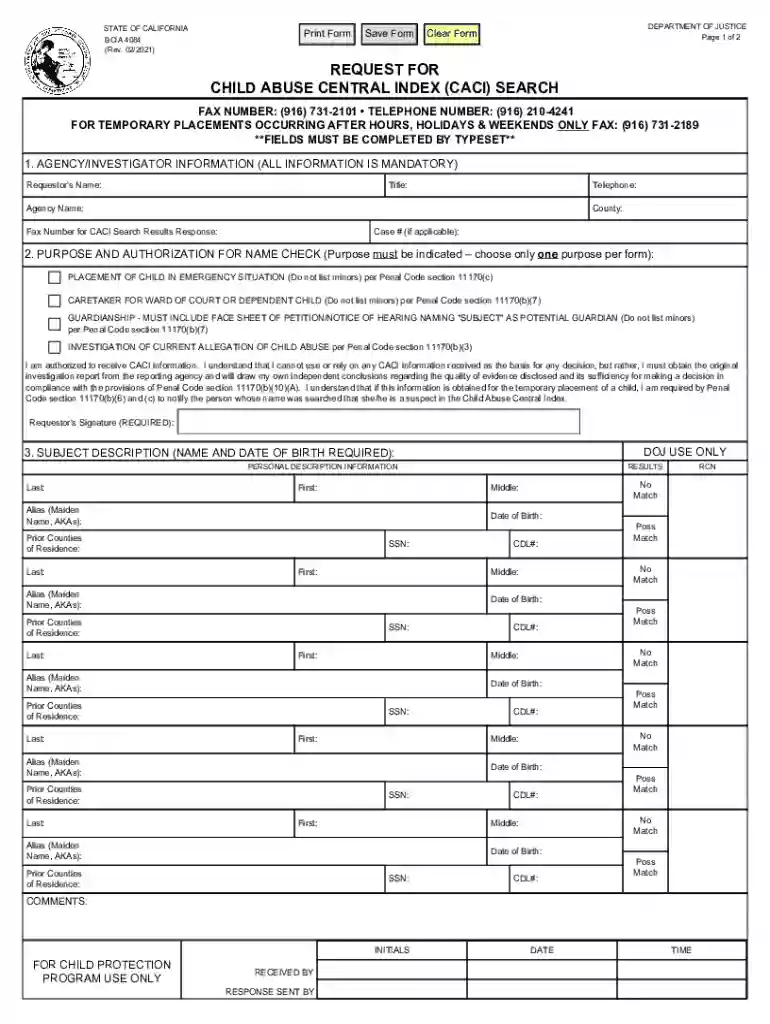
The BCIA 4084 Request for Child Abuse Central Index (CACI) Search is a form issued by the California Department of Justice. It serves as a formal request to search the Child Abuse Central Index for records related to child abuse investigations. The index acts as a database containing reports of suspected child abuse, associated investigations, and outcomes from across the state. CACI search requests are crucial for agencies responsible for child welfare and protection, as it assists in making informed decisions regarding the safety and placement of children.
Gather Required Information: Before filling out the form, ensure you have the necessary information at hand, including details about the individual being checked and the requesting agency.
Section One - Requestor Details: Include the name, agency, and contact information of the person making the request. This ensures that the results are communicated correctly.
Section Two - Person Being Checked: Provide accurate personal details of the individual whose records are being searched.
Purpose of Request: Clearly state the purpose of requesting this search. This often includes child placements or investigation of abuse allegations.
Authorization and Signatures: Ensure all required authorizations are complete, including any necessary signatures from the agency or individuals involved.
Requestor Information: Detailed knowledge about the requesting entity, ensuring they meet eligibility for accessing sensitive information.
Individual Being Checked: Accurate personal identification information ensures precise data retrieval from the database.
Purpose and Justification: Clear articulation of the reason behind the search, demonstrating compliance with legal and procedural requirements.
Compliance with Penal Code: Adherence to relevant sections of the California Penal Code governing child abuse investigations. This guides user actions and maintains legal integrity.
The primary users of the BCIA 4084 form are government agencies and authorized non-governmental organizations involved in child welfare and protection. This includes:
Child Protective Services (CPS): Uses the form to assess the safety of prospective foster and adoptive homes.
Law Enforcement Agencies: Engage in investigations requiring access to historical data related to child abuse cases.
Legal Professionals: Attorneys representing cases where child welfare history could influence proceedings.


It is essential to follow legal protocols when accessing child abuse records. The form’s use should strictly be in accordance with the provisions of the California Penal Code. Any misuse of this form, such as unauthorized access or dissemination of information, could result in legal penalties and loss of access privileges.
The BCIA 4084 is governed by the legal framework specific to California. This includes the confines within which records can be searched and used. Understanding these state-specific legal requirements is crucial for compliance and ensuring the right to access these sensitive records is not revoked.
Online Submission: This method provides quick processing times, often recommended for urgent checks.
Mail: Traditional but slower, suitable for comprehensive checks without immediate deadlines.
In-Person: Offers a more personal approach, useful for complex cases needing direct submission and consultation.
To accompany the BCIA 4084, the following documents may be needed:
Proof of Identity: Verification of the individual being checked to avoid identity confusions.
Agency Authorization: A formal letter or documentation authorizing the request for a CACI search.
Purpose Statement: Detailed description or supporting documents that justify the search's necessity.
Failure to comply with the regulations surrounding the use of the BCIA 4084 form can result in severe consequences. These include:
Revocation of Access: The agency or individual may be barred from future access to CACI records.
Legal Action: Prosecution for unauthorized use of personal data, leading to possible fines or imprisonment.
Civil Penalties: Those affected by misuse could seek compensation for damages incurred due to improper data handling.
We've got more versions of the BCIA 4084 Request for Child Abuse Central Index (CACI) Search BCIA 4084 Request for Child Abuse Cent form. Select the right BCIA 4084 Request for Child Abuse Central Index (CACI) Search BCIA 4084 Request for Child Abuse Cent version from the list and start editing it straight away!
At DocHub, your data security is our priority. We follow HIPAA, SOC2, GDPR, and other standards, so you can work on your documents with confidence.

No information is available for this page.
This form is used by authorized government agencies to submit substantiated child abuse or severe neglect case information to the CACI. BCIA 4084 CACI Inquiry


