




01. Edit your ciwa ar assessment online
Type text, add images, blackout confidential details, add comments, highlights and more.

Type text, add images, blackout confidential details, add comments, highlights and more.

Draw your signature, type it, upload its image, or use your mobile device as a signature pad.

Send ciwa ar scoring via email, link, or fax. You can also download it, export it or print it out.
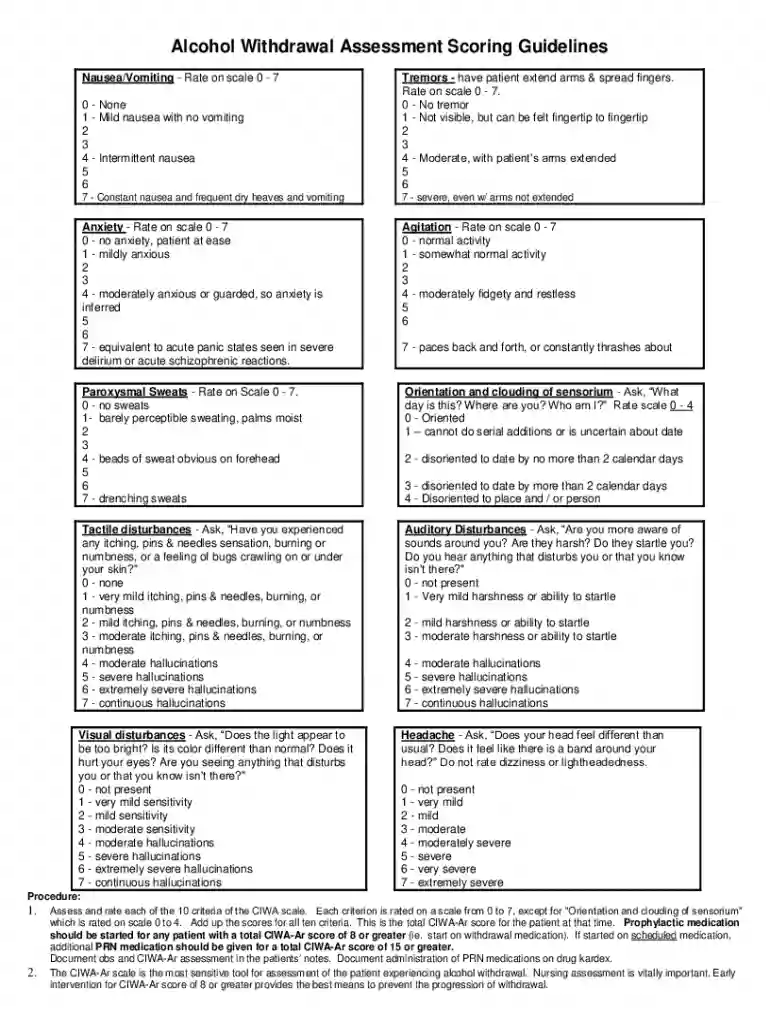
The Alcohol Withdrawal Assessment Scoring Guidelines (CIWA-Ar) refer to a standardized clinical tool used to evaluate the severity of alcohol withdrawal symptoms in individuals who have become physically dependent on alcohol. The CIWA-Ar scale is specifically designed to systematically assess various symptoms associated with alcohol withdrawal, including nausea, tremors, anxiety, and tremors. By quantifying the severity of each symptom using a scoring system, healthcare professionals can determine the appropriate level of intervention required to manage withdrawal and prevent complications.
The term "CIWA-Ar" stands for the Clinical Institute Withdrawal Assessment for Alcohol, revised. It provides a comprehensive framework to help clinicians make informed decisions regarding medical treatment and intervention, ensuring the safety and well-being of patients experiencing alcohol withdrawal.
To use the CIWA-Ar scale effectively, healthcare providers follow a structured procedure that involves observing and rating individual withdrawal symptoms. Here's a step-by-step approach:
Symptom Evaluation: Healthcare professionals assess each withdrawal symptom separately. This includes observing physical signs such as tremors and sweating, as well as asking patients about their experiences of anxiety, agitation, and any hallucinations.
Scoring System: Each symptom is scored on a scale typically ranging from zero (absence of symptoms) to seven (severe symptom presentation). For instance, nausea and vomiting might be scored based on frequency and intensity.
Total Score Calculation: After assessing all relevant symptoms, the scores for each are summed to obtain a total CIWA-Ar score. This score helps determine the severity of the withdrawal and guides the course of treatment.
Guidance for Intervention: Based on the total score, healthcare providers decide on the necessary medical interventions. Low scores may require minimal intervention, while higher scores might necessitate pharmacological treatment to mitigate withdrawal risks.
Continuous Monitoring: The CIWA-Ar assessment may be repeated periodically to monitor changes in the patient's condition and adjust the treatment plan as needed.
Several critical components and symptoms are assessed using the CIWA-Ar scoring system:
Nausea and Vomiting: Clinicians evaluate the frequency and severity of nausea and vomiting, which are common in withdrawal scenarios.
Tremors: Observations focus on the presence and intensity of any tremors or shaking commonly seen in withdrawal phases.
Anxiety and Agitation: The emotional state of the patient is assessed, with attention given to signs of anxiety and any agitated behavior.
Paroxysmal Sweats: Sudden and intense episodes of sweating are documented to gauge severity.
Sensory Disturbances: Auditory, visual, and tactile disturbances are symptoms of delirium and are closely monitored.
Headache and Orientation: Headaches and the patient's ability to remain oriented in time and place are assessed.
Each of these elements contributes to the overall CIWA-Ar score, allowing for precise management of withdrawal symptoms.
Using the CIWA-Ar scale is essential for several reasons:
Improved Patient Outcomes: Structured assessment allows for timely interventions, reducing the risk of severe withdrawal symptoms such as seizures.
Objective Measurement: The scoring provides an objective method to measure symptom severity, enhancing clinical decision-making.
Consistency in Care: Standardized assessments ensure that all healthcare providers use the same criteria, enhancing the consistency of care across different clinical settings.
Reduced Complications: Early recognition and treatment of severe symptoms help prevent complications such as delirium tremens.
The CIWA-Ar scale is widely used by medical professionals working in various settings:
Emergency Room Staff: Initial assessments and management of acute withdrawal symptoms in emergency settings.
Addiction Treatment Centers: Clinicians in rehabilitation centers use the scale to monitor patients during detoxification.
Inpatient and Outpatient Clinics: Physicians and nursing staff use it to manage patients with alcohol use disorders.
By providing a standardized measurement tool, professionals across different healthcare settings can deliver consistent and effective care.


The CIWA-Ar is used within the legal framework designed to provide safe and effective care for individuals experiencing alcohol withdrawal. Legal regulations ensure that patients undergoing withdrawal receive evidence-based treatment, minimizing harm and ensuring compliance with healthcare standards.
Key legal considerations involve:
Confidentiality: Patient assessments must adhere to privacy laws, protecting individual health information.
Compliance with Medical Standards: Use of the CIWA-Ar supports adherence to medical guidelines and best practices for managing alcohol withdrawal.
Following a systematic approach is crucial for accurate CIWA-Ar scoring:
Patient Admission and Initial Evaluation: Gather comprehensive patient history, including alcohol consumption patterns and previous withdrawal experiences.
Symptom Identification: Evaluate each symptom using structured questions and observation to ensure accurate scoring.
Documentation: Clearly document scores for each symptom to provide a detailed record of the assessment process.
Intervention Planning: Use total score to guide medical interventions and determine if additional support or medication is necessary.
Follow-up and Monitoring: Regularly reassess the patient using the CIWA-Ar to track symptom progression and adjust the care plan accordingly.
The CIWA-Ar tool is applicable in real-world scenarios:
Case Study 1: A patient presents to the ER with signs of acute withdrawal. Using the CIWA-Ar, clinicians determine a score indicating mild withdrawal, opting for observation and supportive care without medication.
Case Study 2: In an inpatient facility, a patient undergoing detoxification is scored periodically. A high CIWA-Ar score leads to administering benzodiazepines to manage severe anxiety and prevent seizures.
Example in Practice: A primary care physician uses the CIWA-Ar during follow-up visits for patients who are gradually reducing alcohol intake, ensuring withdrawal symptoms don't escalate.
These scenarios illustrate the versatility of the CIWA-Ar tool in various clinical environments, contributing to successful management of alcohol withdrawal.
We've got more versions of the ciwa ar assessment form. Select the right ciwa ar assessment version from the list and start editing it straight away!
At DocHub, your data security is our priority. We follow HIPAA, SOC2, GDPR, and other standards, so you can work on your documents with confidence.




by H McManis 2023 The CIWA-Ar and the CIWA-Ad appear to be the golden scales most commonly used when assessing patients withdrawal symptoms (Littlefield, 2019).Read more
The CIWA-Ar has added usefulness because high scores, in addition to indicating severe withdrawal, are also predictive of the development of seizures andRead more


