01. Edit your form online
Type text, add images, blackout confidential details, add comments, highlights and more.

Type text, add images, blackout confidential details, add comments, highlights and more.

Draw your signature, type it, upload its image, or use your mobile device as a signature pad.

Send it via email, link, or fax. You can also download it, export it or print it out.
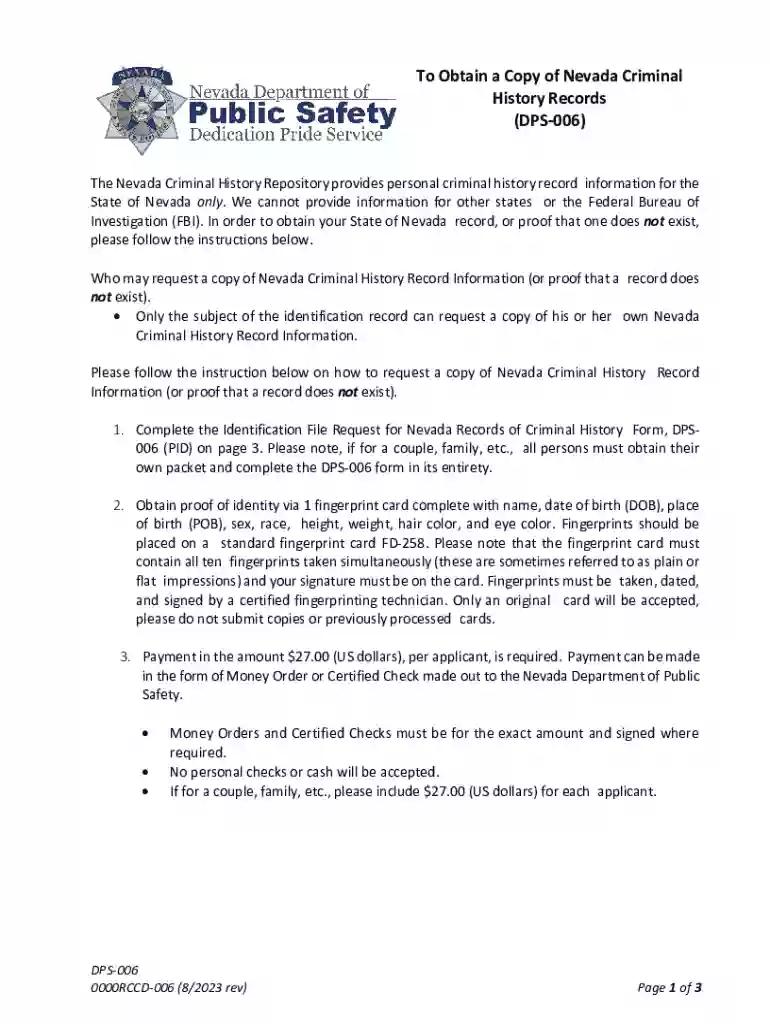
Nevada criminal history records are vital documents that detail an individual's criminal activity within the state. These records are maintained by the Nevada Criminal History Repository, which is the central database for all criminal records in Nevada. Understanding what these records contain and their purpose is essential for individuals seeking to access their own records. Typically, a criminal history record will include arrests, charges, dispositions, and any correctional supervision details. This information can be crucial for background checks, employment applications, or personal reference.
To obtain your Nevada criminal history record, you must follow a structured process involving several specific steps. The process ensures that only authorized individuals, primarily the record holders themselves, can access these sensitive documents.
Obtaining and using your criminal history record can have legal implications. It is primarily used for personal purposes, ensuring the information is accurate and up-to-date. However, in some cases, organizations may require a copy for employment or licensing purposes. Understanding the permissible uses of these records is crucial to avoid any legal issues.
Nevada has specific regulations governing access to criminal history records, emphasizing privacy and security. Only authorized individuals or entities may request and receive criminal history records.
Only certain individuals are eligible to request a Nevada criminal history record. Primarily, the focus is on the individual whom the record concerns, ensuring that personal data remains secure and private.


Understanding the terminology associated with Nevada criminal history records can aid in navigating the request process more effectively.
There are generally two ways to submit your criminal history record request: by mail or, in some instances, online. The preferred method depends on the specific requirements set forth by the Nevada Department of Public Safety.
Each block provides comprehensive information, ensuring you understand how to access, use, and manage your Nevada criminal history record effectively.
We've got more versions of the How to Get Your Nevada Criminal History Record Easily form. Select the right How to Get Your Nevada Criminal History Record Easily version from the list and start editing it straight away!
At DocHub, your data security is our priority. We follow HIPAA, SOC2, GDPR, and other standards, so you can work on your documents with confidence.