Definition & Meaning
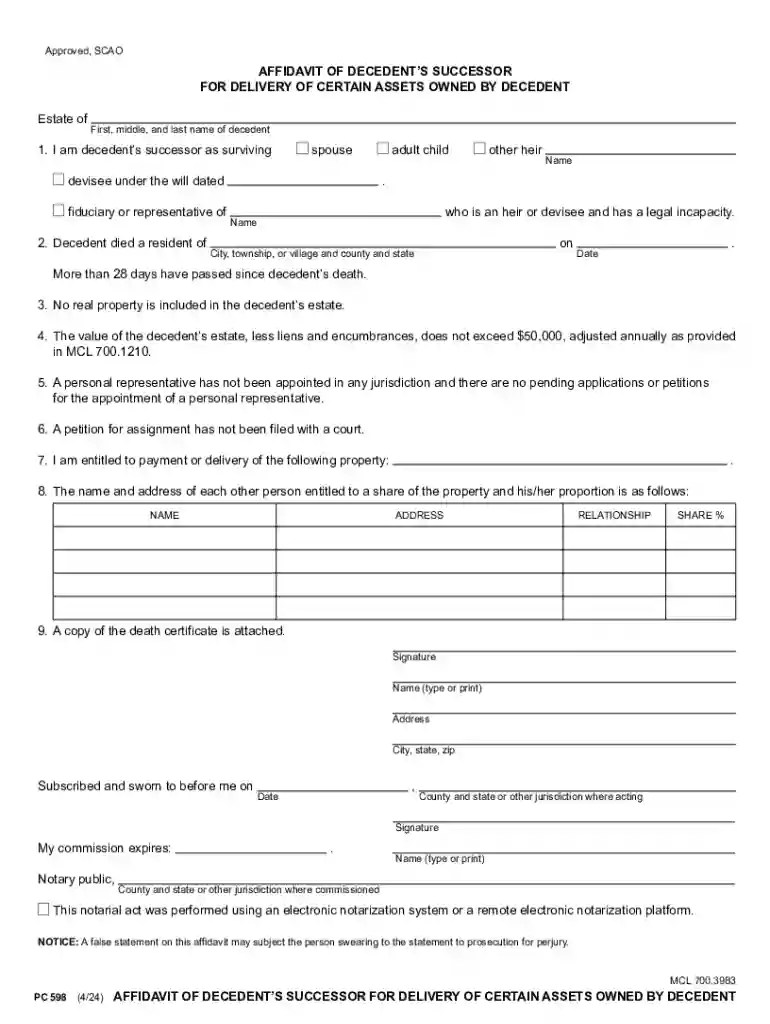
The PC 598, Affidavit of Decedent's Successor for Delivery of, is a legal document utilized to request the transfer of a deceased individual's assets to their legal successor without involving real property. It acknowledges the death of the decedent and asserts the claim of the successor concerning the estate. This form confirms that the estate's value does not exceed a specific threshold, typically $50,000, enabling a simplified asset transfer process under certain circumstances.
Key Elements
- Decedent Verification: Confirms the passing of the estate owner.
- Asset Limitation: Ensures that the estate is within the allowed monetary limit, excluding real property.
- Successor Information: Provides details on the successor's relationship to the decedent.
- Notarial Requirement: Mandates notarization of the affidavit.
How to Use the PC 598, Affidavit of Decedent's Successor for Delivery of
Utilizing the PC 598 form involves preparing and presenting the necessary documentation to facilitate the legal transfer of assets. This includes:
- Gathering Essential Information: Collecting details about the decedent, their estate, and the related successors.
- Notarization: Ensuring the affidavit is notarized to meet legal requirements.
- Submission to Relevant Authorities: Providing the completed form to financial institutions or entities holding the decedent’s assets for effective transfer processing.
Practical Examples
- Use in Banks: A successor may submit the form to a bank to access accounts held by the deceased.
- Transfer with Minimal Estate: Beneficiaries use this form when an estate doesn't require a full probate process due to its low value.
Steps to Complete the PC 598, Affidavit of Decedent's Successor for Delivery of
Filling out the PC 598 form correctly is crucial for its acceptance. Here's a step-by-step guide:
- Identification of Parties: Clearly state the names of the deceased and the successor.
- Acknowledgment of Death: Include a certified copy of the death certificate.
- Estate Details: Enumerate the assets within the estate, maintaining the stipulation that no real property is involved.
- Successor’s Relationship: Describe the nature of the relationship with the decedent.
- Signatures: Ensure all necessary parties sign the form, and a notary public authenticates it.
Required Documents
To complete the affidavit effectively:
- Death Certificate: A certified copy is essential.
- Proof of Identity: Identification for the successor.
- List of Heirs: Documentation if there are multiple successors involved.
- Estate Inventory: A detailed list of the decedent's personal property, ensuring it falls under the monetary threshold.
Legal Use of the PC 598, Affidavit of Decedent's Successor for Delivery of
This form is primarily used to simplify the asset transfer process for estates that do not qualify for extensive probate proceedings. It serves as a legal declaration, facilitating a streamlined transfer process by legally recognizing the successor's claim.
State-Specific Rules
While the fundamental principles are consistent, certain states may have specific variations in the use and acceptance of this affidavit. It’s crucial to consult legal guidance in the respective state where the document will be used.
State-by-State Differences
Although the PC 598 is a widely recognized form, its implementation can vary. States may have:
- Different Valuation Caps: The maximum estate value may differ.
- Additional State Forms: Some states might require supplementary documentation.
- Unique Procedure Mandates: Variability in notarization or filing techniques could exist.
Examples of Using the PC 598, Affidavit of Decedent's Successor for Delivery of
Real-World Scenarios
- Small Estate Handling: A family utilizes the affidavit to access the decedent's bank account, alleviating the need for probate.
- Automobile Ownership Transfer: Use to reassign vehicle ownership without court intervention when the total estate value is below the statutory limit.
Edge Cases
- Multiple Successors: All legal heirs may need to sign waivers if the estate has multiple beneficiaries.
Form Submission Methods (Online / Mail / In-Person)
The submission of the PC 598 can vary based on individual entity requirements:
- Online Submissions: Some institutions might accept electronic submissions, especially if integrated with document management solutions like DocHub.
- Mail: Traditional submission through postal services is accepted where documentation is required in hard copy.
- In-Person: Direct submission to financial institutions, especially where physical verification is mandated.
Who Typically Uses the PC 598, Affidavit of Decedent's Successor for Delivery of
The form is widely used by:
- Family Members: Successors or family members dealing with an individual's estate post-mortem.
- Estate Executors: Those responsible for administering the estate of the deceased.
- Legal Representatives: Attorneys assisting clients in expediting the asset transfer process for minor estates.