




01. Edit your form online
Type text, add images, blackout confidential details, add comments, highlights and more.

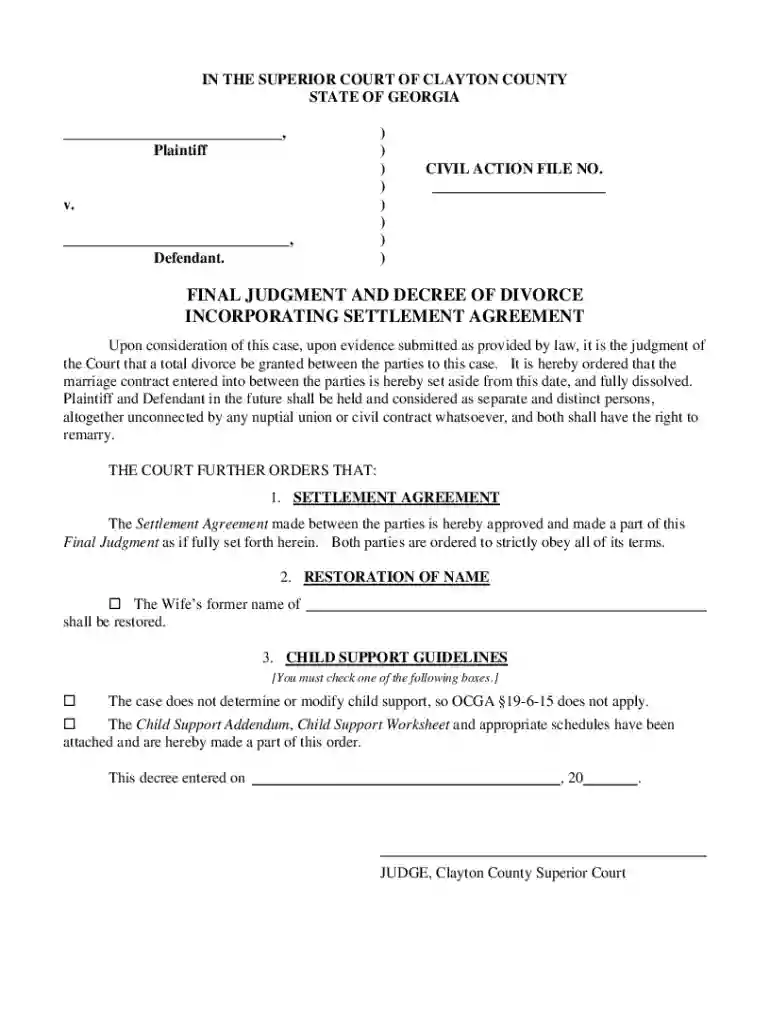
Type text, add images, blackout confidential details, add comments, highlights and more.

Draw your signature, type it, upload its image, or use your mobile device as a signature pad.

Send it via email, link, or fax. You can also download it, export it or print it out.
The Final Judgment and Decree of Divorce with Minor Children is a legal document that formally ends a marriage in the United States, taking into account considerations for any children involved. It is issued by a court when a marriage is dissolved and outlines the terms agreed upon by both parties. This document not only affirms the termination of the marital relationship but also addresses issues such as child custody, visitation rights, and child support arrangements. It serves as a binding legal framework governing the responsibilities and rights of both parents concerning their minor children post-divorce.
Gather Required Documents: Before filling out the decree, both parties need to collect necessary documents, such as financial statements, current custody agreements, and any previous court orders related to the divorce.
Consult Legal Counsel: Although it's possible to fill out this decree independently, consulting with a family law attorney ensures that all legal requirements are properly met, especially regarding child custody and support.
Prepare the Settlement Agreement: Both parties work together, possibly through mediation, to agree on the terms of child custody, support, and visitation. This agreement becomes part of the decree.
Fill Out the Decree: Using the settlement agreement as a guide, fill out the Final Judgment and Decree form, ensuring all sections related to children are completed fully.
Submit for Court Approval: File the document with the court for review. Attend any court hearings if required, where a judge will evaluate the terms to ensure they are in the children's best interest.
Finalization: Once the judge approves and signs the decree, it becomes a legally enforceable court order.
Custody Arrangements: Specifies whether joint or sole custody is granted, detailing the living arrangements and decision-making responsibilities for the children's upbringing.
Visitation Schedules: Outlines a detailed visitation schedule that accommodates both parents' and children's availability, including provisions for holidays and special occasions.
Child Support: Defines the financial contributions required from the non-custodial parent, based on state guidelines or mutual agreement, ensuring it covers basic needs like education, healthcare, and extracurricular activities.
Modification Clauses: Includes statements on how changes to the decree can be requested, underlining that any modifications need court approval to become effective.
Parental Responsibilities: Details the division of significant child-rearing responsibilities, such as education, healthcare decisions, and extracurricular activities oversight.
Different states have unique regulations and guidelines regarding divorce and child custody, which can influence how a Final Judgment and Decree is structured.
Georgia Example: In Georgia, the process includes guidelines set forth by the Superior Court and mandates adherence to local child support calculators to determine financial responsibilities.
California: Emphasizes mediation as a preliminary step before court proceedings, focusing on reaching a mutually agreeable custody arrangement.
Texas: Has specific guidelines for custodial parent designations, using terms like "managing conservatorship" to describe custody arrangements.
Enforcement: Upon signing by a judge, the decree serves as a legally binding document enforceable by law. Any violation, such as disregarding custody or support terms, can lead to legal penalties.
Modifications: Provides a legal avenue to request changes to custody or support agreements if significant changes in circumstances occur, subject to court approval.
Reference for Disputes: Acts as a primary reference in any legal disputes involving the ex-spouses that concern child custody or support.
When preparing for a divorce decree involving minor children, several essential documents may be required:
Financial Statements: Joint financial statements that outline both parties' incomes, assets, and liabilities.
Previous Court Orders: Any past orders related to the marriage, custody, or child support.
Child Support Worksheets: Necessary for jurisdictions that provide standardized calculation forms to determine appropriate support levels.
Online Filing: Many states allow the decree to be completed and filed online through court-provided portals, streamlining the process and reducing paperwork.
In-Person Submission: In cases where online filing is unavailable, submitting the decree at the local county courthouse may be required, often involving multiple copies for court records.
Mail Filing: For those unable to file in person, some jurisdictions accept forms mailed directly to the courthouse, although this can slow down processing times.
Failure to adhere to the terms outlined in the Final Judgment and Decree can result in serious legal consequences:
Contempt of Court: Any deliberate non-compliance with court orders can lead to being held in contempt, potentially resulting in fines or jail time.
Loss of Custody or Visitation Rights: Continued violations, especially concerning custody arrangements, can lead to losing custody or having visitation rights significantly restricted.
Financial Penalties: Accrued support arrears due to non-payment can result in wage garnishments, liens on property, and other financial repercussions.
Real-world scenarios help illustrate how these decrees impact post-divorce life:
Shared Custody Implementation: For parents who amicably co-parent, the decree facilitates easy scheduling and clear guidelines, leading to fewer disputes and smoother child-rearing cooperation.
Enforcement of Child Support: In instances where the non-custodial parent misses payments, the custodial parent can use the decree to enforce payment, ensuring financial stability for the child.
Modification Requests: A parent who relocates for a job may request a decree modification to change visitation terms while maintaining compliance with state regulations.
We've got more versions of the Final Judgement and Decree of Divorce With Minor Children form. Select the right Final Judgement and Decree of Divorce With Minor Children version from the list and start editing it straight away!
At DocHub, your data security is our priority. We follow HIPAA, SOC2, GDPR, and other standards, so you can work on your documents with confidence.



The agreement further provided that plaintiff was to have the custody of the two minor children of the parties; that defendant would pay plaintiff $200 perRead more
1. Use this form only if you and the Defendant have signed a Stipulation and Settlement. Agreement (With Minor Children) and you want the Court to incorporateRead more


