







Definition and Meaning
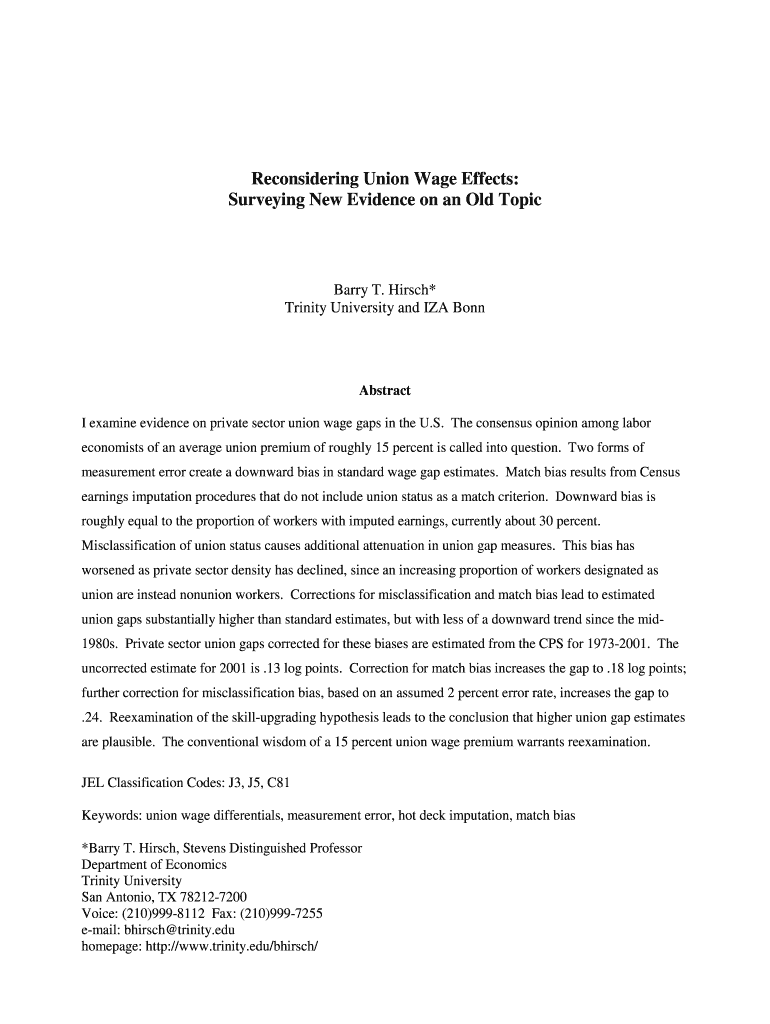
Reconsidering Union Wage Effects at Georgia State University explores the disparities in wage gaps within the private sector union workforce in the United States. This research challenges the common perception that union wage premiums stand firmly at an average of 15%. Instead, it identifies significant errors in measurement such as earnings imputation and union status misclassification, which have historically led to an understatement of standard wage gap estimates. Corrected assessments in the study propose a higher union wage gap, nearing 24%, suggesting a need to reevaluate the accepted understanding of union wage impacts.
How to Use Reconsidering Union Wage Effects - Georgia State University
Utilizing this document involves understanding its implications on existing wage gap assessments and its suggestions for policy and union negotiations. Researchers and economists can use the findings to adjust economic models that factor in union wage effects, while policymakers might reconsider legislative measures concerning labor unions and wage negotiations. Academics can employ this document as a foundational text in courses focusing on labor economics or union studies, ensuring the content is integrated into both theoretical and practical discussions.
Key Elements of the Research
Key components of this research include the identification of measurement errors in union wage gap studies and the correction of these errors to reveal a more accurate wage gap. This process includes:
- Match Bias: Addressing errors arising from earning imputation, which occurs when incomplete data is filled in, leading to skewed results.
- Misclassification: Correcting instances where individuals are wrongly classified as union or non-union, which impacts wage gap calculations.
- Methodological Adjustments: Presenting corrected estimates to showcase a more realistic view of the union wage gap.
Steps to Complete the Form
Understanding the study requires comprehensively reviewing each section and analyzing the empirical evidence presented. Stakeholders should engage in several steps to fully utilize the study:
- Set Objectives: Define the purpose of using the document, whether it’s for research, policy adjustments, or academic discourse.
- Review Data: Analyze the corrected estimates and methodology used for calculations.
- Compare Findings: Measure these findings against pre-existing models or assumptions regarding union wage effects.
- Implement Changes: Apply insights from the document to relevant economic, educational, or policy frameworks.
Who Typically Uses the Research
This document is primarily utilized by:
- Economists: To refine models that incorporate union wage differentials.
- Policymakers: To inform labor relations legislation and collective bargaining processes.
- Academics: As teaching material within labor economics, providing a contemporary viewpoint on union impacts.
- Labor Unions: To support negotiations by drawing on corrected estimates that reflect their actual impact on wages.


Importance of Reconsidering Union Wage Effects
This research is crucial as it delivers a more accurate representation of how unions influence wages. By correcting long-standing biases and errors in union wage gap calculations, it presents a more robust foundation for understanding labor market dynamics. The insights gained are instrumental for shaping fair labor policies and ensuring that union contributions to wage arrangements are properly recognized.
State-Specific Rules Regarding Wage Studies
While the research positions itself at a national level, it’s important for stakeholders to consider state-specific labor laws and union dynamics that might influence wage effects differently. Each state's legislation on unions and labor markets may alter the implications of the findings, necessitating localized assessments.
Penalties for Non-Compliance
Ignoring the corrected insights from this study could result in continuation of inaccurate wage policies, potentially leading to:
- Informed Misjudgments: Economists and policymakers might perpetuate outdated models.
- Ineffective Legislation: Policies may fail to adequately address the true financial impact unions have on wages, leading to potential disputes.
- Negotiation Disadvantages: Labor unions could face challenges in negotiations if armed with inaccurate data, affecting their bargaining power.
Digital vs. Paper Versions
This research, like many academic studies, is accessible in digital format, aiding in wider distribution and ease of access for researchers and policymakers. Digital versions also support integration with analytical tools that facilitate deeper examination and visualization of its findings, although traditional paper versions remain relevant for those who prefer physical copies for archival purposes.




