Long-Term Care Acute Gastroenteritis Surveillance Line List and Outbreak Summary 2026

Get Form
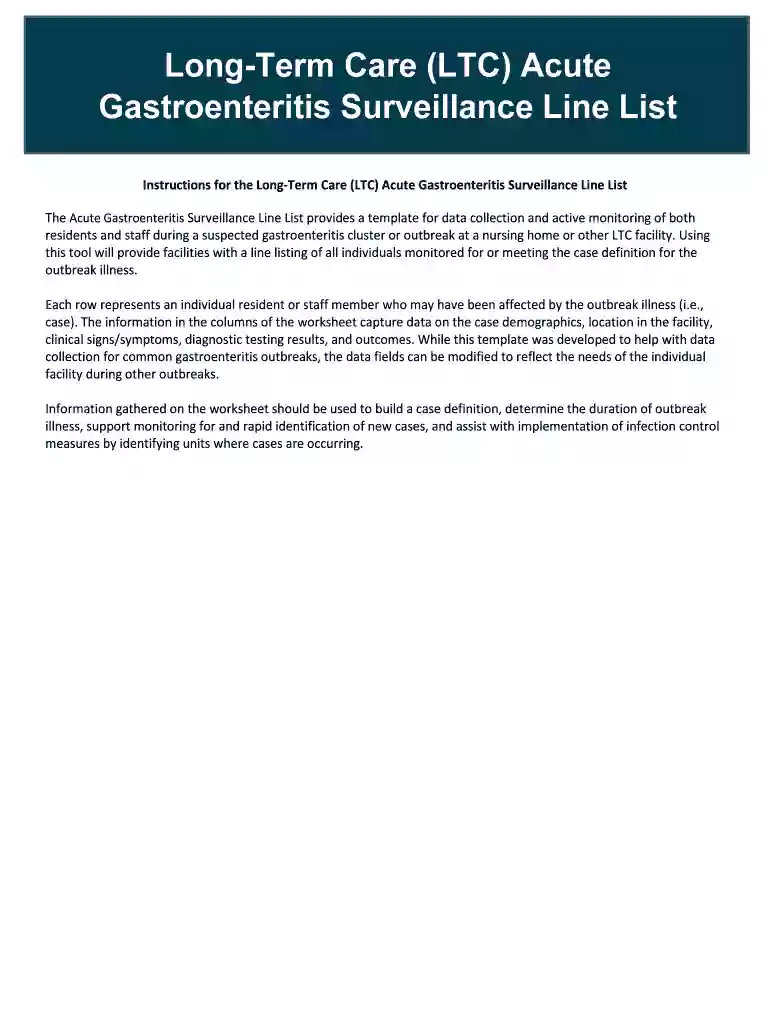
Long-Term Care Acute Gastroenteritis Surveillance Line List and Outbreak Summary Preview on Page 1

Here's how it works

01. Edit your form online
Type text, add images, blackout confidential details, add comments, highlights and more.

02. Sign it in a few clicks
Draw your signature, type it, upload its image, or use your mobile device as a signature pad.

03. Share your form with others
Send it via email, link, or fax. You can also download it, export it or print it out.

Definition & Meaning

The Long-Term Care Acute Gastroenteritis Surveillance Line List and Outbreak Summary is a structured document designed for tracking and managing gastroenteritis outbreaks in long-term care facilities. It is pivotal for capturing data regarding the affected individuals, monitoring outbreak progress, and implementing effective infection control strategies. By documenting case specifics such as demographics, symptoms, and diagnostic outcomes, the form plays an essential role in outbreak investigation and response.

How to Use the Long-Term Care Acute Gastroenteritis Surveillance Line List and Outbreak Summary

Understanding how to use this document involves several steps:

  1. Data Collection: Begin by detailing case demographics, including age, gender, and room number.
  2. Symptom Tracking: Record onset and duration of symptoms like vomiting or diarrhea.
  3. Diagnostic Information: Note any lab tests conducted and their results.
  4. Outbreak Analysis: Use the collected data to identify trends and assess the severity of the outbreak.
  5. Response Measures: Implement infection control practices based on the findings to contain the outbreak.

Each step is essential for a comprehensive approach to managing a gastroenteritis outbreak within a facility.

Steps to Complete the Long-Term Care Acute Gastroenteritis Surveillance Line List and Outbreak Summary

Completing the form effectively requires a systematic approach:

  1. Gather Initial Information: Collect preliminary data from affected residents and staff.
  2. Fill Out Resident Details: Input basic details, including names and identifying information.
  3. Document Symptoms: Record specific symptoms and their timelines for each case.
  4. Add Diagnostic Results: If tests were conducted, ensure results are accurately recorded.
  5. Summarize Findings: In the Outbreak Summary section, provide an overarching view of the situation, including infection rates and control measures taken.

Adhere to these steps to ensure all necessary data is recorded for outbreak management.

Who Typically Uses the Long-Term Care Acute Gastroenteritis Surveillance Line List and Outbreak Summary

This form is primarily utilized by health care professionals within long-term care facilities, such as:

  • Nurse Managers: Overseeing the completion of the form to ensure accurate data collection.
  • Infection Control Specialists: Analyzing the data to implement effective control measures.
  • Public Health Officials: Reviewing the form to monitor public health trends and support response efforts.

These roles highlight the significance of the form in maintaining public health standards and ensuring swift response to gastroenteritis outbreaks.


decoration image ratings of Dochub

Key Elements of the Long-Term Care Acute Gastroenteritis Surveillance Line List and Outbreak Summary

The form is comprised of several critical components:

  • Case Demographics: Information such as age, gender, and room location.
  • Symptom Documentation: Detailed records of symptoms, including duration and severity.
  • Diagnostic Testing: Results from any medical tests conducted.
  • Outbreak Summary: A comprehensive review of the situation, including actions taken and outcomes.

These elements must be meticulously documented to provide a complete picture of the outbreak and guide effective management measures.

Important Terms Related to the Long-Term Care Acute Gastroenteritis Surveillance Line List and Outbreak Summary

Understanding the terminology used within this document is vital:

  • Gastroenteritis: An inflammation of the stomach and intestines, often causing vomiting and diarrhea.
  • Outbreak: A sudden increase in cases of gastroenteritis within the facility.
  • Infection Control: Measures implemented to prevent the spread of the infection.
  • Surveillance: Continuous monitoring of cases to inform response strategies.

Familiarity with these terms ensures proper completion of the form and effective communication during outbreak management.

Legal Use of the Long-Term Care Acute Gastroenteritis Surveillance Line List and Outbreak Summary

The legal implications of using this form include:

  • Confidentiality: Ensuring all patient data is securely stored and access is restricted to authorized personnel only.
  • Compliance: Adhering to state and federal guidelines for disease reporting and management.
  • Documentation: Providing a legal record of actions taken during the outbreak, which may be required for audits or investigations.

Proper adherence to these legal requirements is essential to protect both the facility and its residents.

Digital vs. Paper Version

Choosing between digital and paper formats has distinct advantages:

  • Digital Version: Allows for real-time updates and easy sharing among stakeholders, with the additional benefit of data analytics capabilities.
  • Paper Version: Offers a tangible record that can be used in areas with limited digital access, though it may slow down data collection and analysis.

Facilities must weigh these factors to determine the most effective method for their specific needs.

be ready to get more

Complete this form in 5 minutes or less

Get form

Got questions?

We have answers to the most popular questions from our customers. If you can't find an answer to your question, please contact us.
Contact us
Youre most likely to get viral gastroenteritis when you eat or drink contaminated food or water. You may also be likely to get gastroenteritis if you share utensils, towels or food with someone who has one of the viruses that cause the condition. Many viruses can cause gastroenteritis, including: Noroviruses.
An outbreak of gastroenteritis is where 2 or more people in a facility become ill with vomiting or diarrhoea within 24 hours of each other.
Management of Gastroenteritis Outbreaks Following effective hand hygiene and cough etiquette. Correct use of personal protective equipment (PPE) Correct and safe use and disposal of sharps. Disinfection of shared equipment. Frequent and thorough environmental cleaning. Appropriate linen handling.
Identifying an outbreak If you have two or more cases of diarrhoea or vomiting reported in the same week, occurring in either guests or members of staff, it is likely that there is an outbreak of viral gastroenteritis linked to the premises.
When should I seek medical care for gastroenteritis? Inability to keep fluids down, signs of dehydration. Symptoms last longer than five days. Fever lasts more than three days or is higher than 104 degrees Fahrenheit (40 degrees Celsius). Severe abdominal pain or a rigid, distended abdomen.

Security and compliance

At DocHub, your data security is our priority. We follow HIPAA, SOC2, GDPR, and other standards, so you can work on your documents with confidence.
Learn more
ccpa2
pci-dss
gdpr-compliance
hipaa
soc-compliance
be ready to get more

Complete this form in 5 minutes or less

Get form

People also ask

Acute gastroenteritis is a common infectious disease syndrome, causing a combination of nausea, vomiting, diarrhea, and abdominal pain. There are more than 350 million cases of acute gastroenteritis in the United States annually and 48 million of these cases are caused by foodborne bacteria.

Related links