




01. Edit your form online
Type text, add images, blackout confidential details, add comments, highlights and more.

Type text, add images, blackout confidential details, add comments, highlights and more.

Draw your signature, type it, upload its image, or use your mobile device as a signature pad.

Send it via email, link, or fax. You can also download it, export it or print it out.
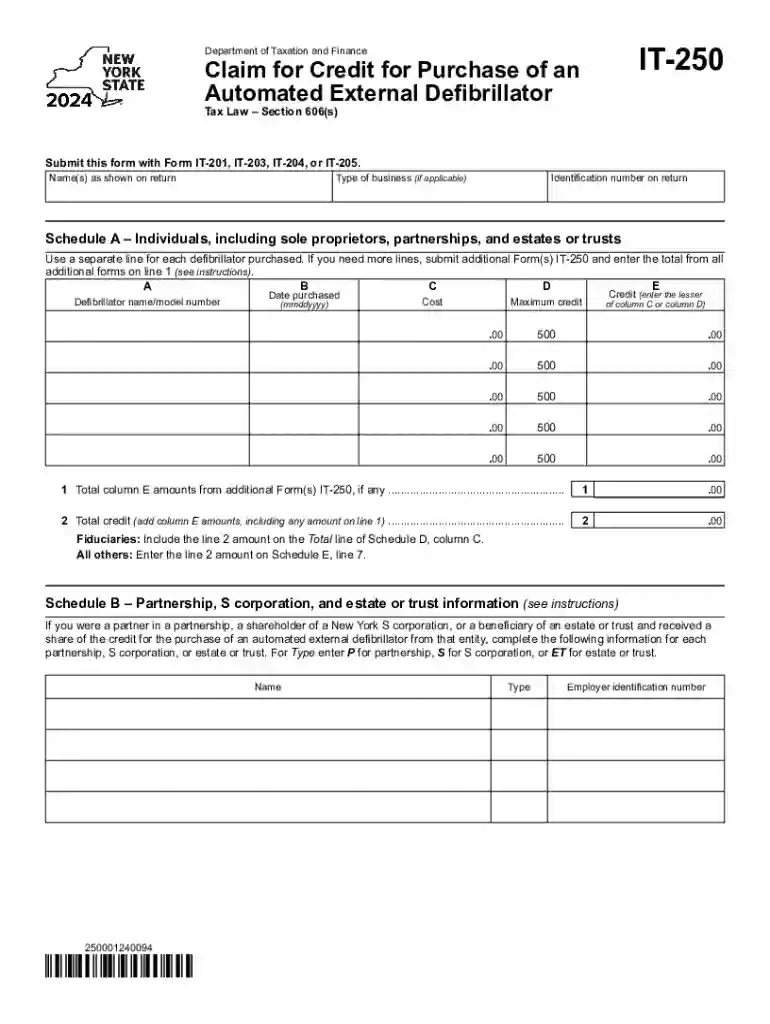
The IT-250 form is initiated by the Department of Taxation and Finance in New York, specifically aimed at enabling taxpayers to claim a credit for the purchase of Automated External Defibrillators (AEDs). This form is applicable for the tax year 2024. The AED tax credit is instituted under Section 606(s) of the New York Tax Law, facilitating individuals, businesses, and fiduciaries to report and manage tax credits for investing in life-saving equipment that can aid in cardiac emergencies.
Understanding the eligibility criteria is vital to ensure compliance and correctness in claiming this credit. Typically, eligible entities include individuals, partnerships, S corporations, and fiduciaries who have incurred expenses for purchasing AEDs. The equipment must meet New York State regulations to qualify for the tax credit, and proof of purchase is usually necessary to substantiate the claim.


Using the IT-250 form effectively involves several steps. These steps ensure the accurate completion of the form, maximizing the chances of a successful credit claim. Here's a step-by-step process:
Completing the IT-250 form requires attention to detail to ensure all sections are correctly filled. Below is an in-depth process to guide through each essential step:
Adherence to deadlines is crucial to avoid late submission penalties. The filing deadline for the IT-250 form typically aligns with the general tax filing deadline, which is around mid-April. It's essential to confirm the exact date for the 2024 tax year and ensure submission before the due date to claim the credit without any issues.
Submitting the IT-250 form necessitates accompanying documents to substantiate the credit claim:
These documents verify the purchase and are mandatory to support the tax credit claim.
Failure to comply with the rules and requirements associated with the IT-250 form can lead to penalties. These may include:
Ensuring thorough and correct form submission prevents such repercussions.
Form IT-250 allows for various submission methods to accommodate different taxpayer preferences:
Each method has its strengths, and taxpayers should choose based on their comfort and access to resources.
We've got more versions of the Form IT-250 Claim for Credit for Purchase of an Automated External Defribrillator Tax Year 2024 form. Select the right Form IT-250 Claim for Credit for Purchase of an Automated External Defribrillator Tax Year 2024 version from the list and start editing it straight away!
At DocHub, your data security is our priority. We follow HIPAA, SOC2, GDPR, and other standards, so you can work on your documents with confidence.
by CG Assembly 2022 Office of sudden cardiac arrest management - created - public access defibrillators - sudden cardiac arrest data - coordinator - outDocHub campaign - automated
Dec 12, 2025 You may claim this credit for each automated external defibrillator you purchased during the tax year. unit, or $500.


