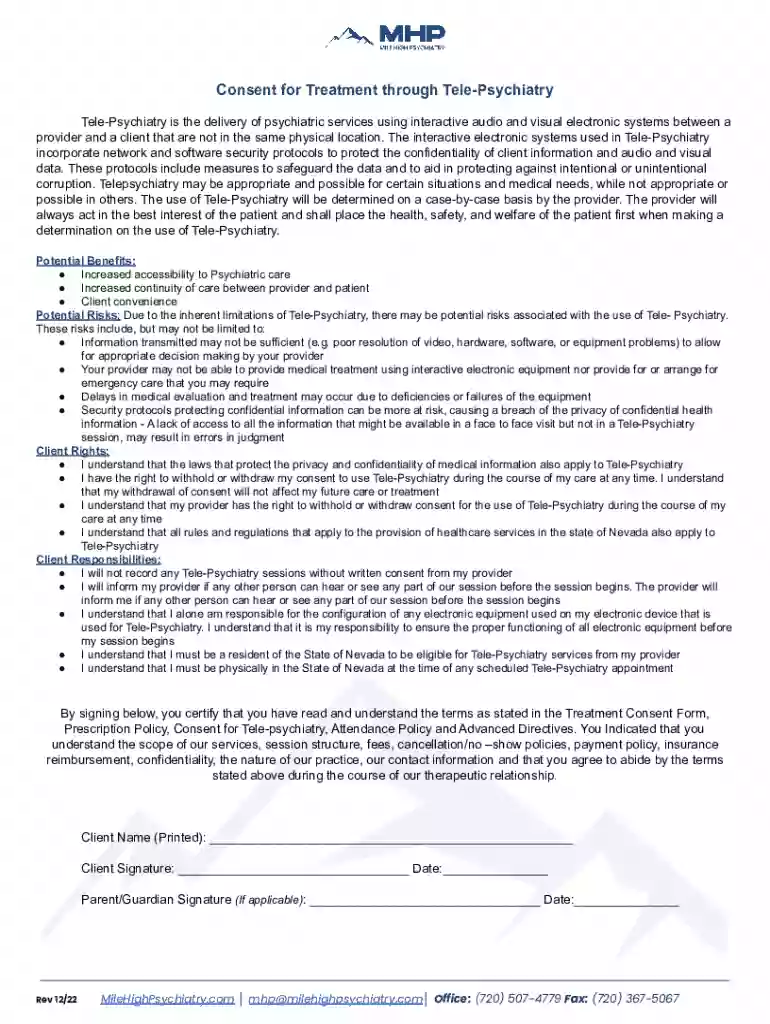
TELEPSYCHIATRY PATIENT CONSENT FORM 2026

Get Form
TELEPSYCHIATRY PATIENT CONSENT FORM Preview on Page 1

Here's how it works

01. Edit your form online
Type text, add images, blackout confidential details, add comments, highlights and more.

02. Sign it in a few clicks
Draw your signature, type it, upload its image, or use your mobile device as a signature pad.

03. Share your form with others
Send it via email, link, or fax. You can also download it, export it or print it out.

Definition and Importance of Telepsychiatry Patient Consent Form

A Telepsychiatry Patient Consent Form is a legal document used to obtain a patient’s agreement to participate in telepsychiatry services. Telepsychiatry, a subset of telemedicine, allows patients to receive psychiatric care remotely via digital communication technologies like video conferencing. This form outlines several critical elements, including the definition of telepsychiatry, the potential benefits and risks, and the patient's rights and responsibilities. Understanding this form is crucial for ensuring informed consent and maintaining ethical standards in remote psychiatric care.

  • Benefits of Telepsychiatry: Telepsychiatry can increase access to mental health services, especially for individuals in rural or underserved areas. It often results in more flexible scheduling for patients and providers.
  • Risks Involved: Potential risks include privacy concerns, technical issues during sessions, and the limitation of non-verbal communication cues.
  • Patient Rights and Responsibilities: Patients have the right to confidentiality, to understand the qualifications of their providers, and to receive information about the protocol for emergencies during a session.

How to Use the Telepsychiatry Patient Consent Form

Using the Telepsychiatry Patient Consent Form involves a series of steps aimed at ensuring both the provider and the patient have a clear understanding of the telepsychiatry sessions. The form must be completed and signed before commencing any telepsychiatry services.

  1. Review the Form Thoroughly: Both parties should review the form together to ensure understanding. The provider should explain each section of the form, highlighting key areas such as consent withdrawal and emergency protocols.
  2. Confirm Patient Understanding: Verify that the patient comprehends the responsibilities and risks associated with telepsychiatry. Include discussions about security measures and the technological requirements needed for sessions.
  3. Obtain Signatures: Once all sections are understood, the patient must provide a legally binding signature. This can be done electronically for convenience and efficiency.

Key Elements of the Telepsychiatry Patient Consent Form

Key elements of this consent form serve to protect both the patient and the healthcare provider, ensuring a mutual understanding and agreement on various aspects of the telepsychiatry service.

  • Confidentiality and Security Protocols: Details the use of encrypted communication platforms to protect patient information.
  • Technology Requirements: Specifies the need for a stable internet connection and compatible digital devices such as a computer, tablet, or smartphone.
  • Informed Consent Details: Clearly outlines what the patient is consenting to, including potential risks and the scope of treatment.

Steps to Complete the Telepsychiatry Patient Consent Form

Completing this form systematically ensures no critical sections are overlooked and that the consent is valid and comprehensive.

  1. Personal Information: Collect and verify the patient’s name, contact details, and health insurance information.
  2. Telepsychiatry Service Description: Provide a detailed explanation of telepsychiatry, including the expected processes and competencies of providers.
  3. Confidentiality Agreement: Have patients read and acknowledge the confidentiality policies in place.
  4. Review and Finalize: The healthcare provider should review the form with the patient, ensuring clarity before the patient signs the form electronically or in paper form.

Legal Use and Compliance with Telepsychiatry Patient Consent Form

This consent form is a vital legal tool ensuring compliance with healthcare regulations and ethical practices within telepsychiatry.

  • Legal Requirements: Must comply with federal and state regulations, including the Health Insurance Portability and Accountability Act (HIPAA).
  • Consent Withdrawal: Clarifies the patient's right to withdraw consent at any time, with instructions on how to do so.
  • Documentation: Maintains a record of consent and all communication related to the telepsychiatry sessions for legal and medical auditing.

Who Typically Uses the Telepsychiatry Patient Consent Form

This form is especially relevant for a variety of users within the healthcare industry and specific patient demographics.

  • Healthcare Providers and Clinics: Psychiatrists, therapists, and mental health clinics offering telepsychiatry services.
  • Patients in Rural Areas: Individuals accessing psychiatric care remotely due to geographical or physical constraints.
  • Special Populations: Patients requiring flexible scheduling or those with limited access to traditional forms of psychiatric care.

By leveraging the Telepsychiatry Patient Consent Form, providers can streamline processes and provide quality care while adhering to necessary legal and ethical standards.


decoration image ratings of Dochub

See more TELEPSYCHIATRY PATIENT CONSENT FORM versions

We've got more versions of the TELEPSYCHIATRY PATIENT CONSENT FORM form. Select the right TELEPSYCHIATRY PATIENT CONSENT FORM version from the list and start editing it straight away!
Versions Form popularity Fillable & printable
2022 4.4 Satisfied (43 Votes)
be ready to get more

Complete this form in 5 minutes or less

Get form

Got questions?

We have answers to the most popular questions from our customers. If you can't find an answer to your question, please contact us.
Contact us
What Is Informed Consent? There are 4 components of informed consent including decision capacity, documentation of consent, disclosure, and competency. Doctors will give you information about a particular treatment or test in order for you to decide whether or not you wish to undergo a treatment or test.
The consent document must include the patients name, healthcare practitioners name, diagnosis, proposed treatment plan, alternatives, potential risks, complications, and benefits. Additionally, the consent document must be signed and dated by the patient (or the patients legal guardian or representative).
I consent to treatment involving the use of electronic communications to enable health care providers at different locations to share my individual patient medical information for diagnosis, therapy, follow-up, and/or education purposes.
Valid informed consent for research must include 3 major elements as follows: Disclosure of information. Competency of the patient (or surrogate) to make a decision. The voluntary nature of the decision.
Informed consent can be documented in writing or electronically before the appointment. It can also be recorded through verbal consent at the beginning of each session. If someone else is joining the visit, such as a caregiver or another provider, the additional participant must also provide consent.

Security and compliance

At DocHub, your data security is our priority. We follow HIPAA, SOC2, GDPR, and other standards, so you can work on your documents with confidence.

Learn more
ccpa2
pci-dss
gdpr-compliance
hipaa
soc-compliance
be ready to get more

Complete this form in 5 minutes or less

Get form

People also ask

Consent must be freely given, informed, specific, unambiguous, and verifiable.
How to Write a Consent Form What the participant has to do. How long they will be required for. Aim or as much of the aim that can be given without confounding the results. If there will be any negative consequences. That they can withdraw at any time. That their data will be kept confidential and anonymous.
The consent form should include the following statements: I confirm that I have had the project explained to me, and have read the participant information sheet, which I may keep for my records. I have been given the opportunity to ask questions and have had them answered to my satisfaction.

Related links