




01. Edit your form online
Type text, add images, blackout confidential details, add comments, highlights and more.

Type text, add images, blackout confidential details, add comments, highlights and more.

Draw your signature, type it, upload its image, or use your mobile device as a signature pad.

Send it via email, link, or fax. You can also download it, export it or print it out.
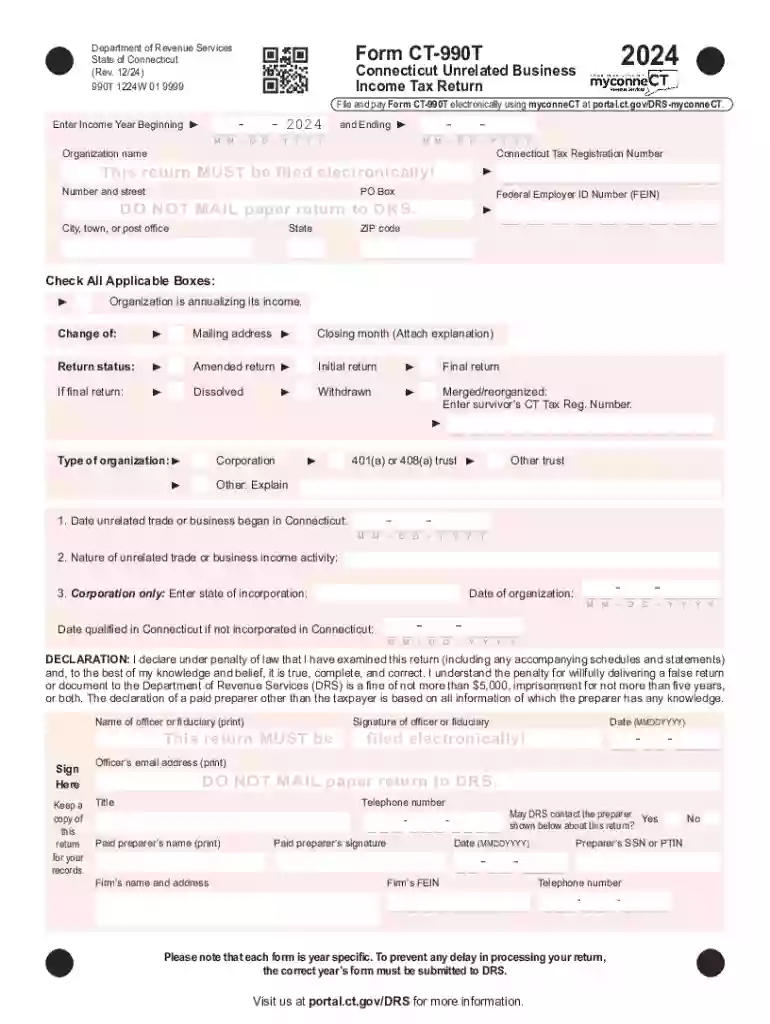
The term "Unrelated returns - CT" refers to the Connecticut Unrelated Business Income Tax Return, documented as Form CT-990T. It is designed for organizations within Connecticut that derive income from activities not substantially related to their primary exempt purposes. This type of return is specifically for calculating and declaring earnings unrelated to an entity's primary mission, which may be taxable despite the organization's general tax-exempt status. It ensures that Connecticut collects taxes on income from commercial activities even if those activities are conducted by a non-profit or tax-exempt entity.
Key components of Form CT-990T include sections devoted to organization details, income computation, tax calculations, and schedules for apportionment and operating loss carryover. The form requires organizations to outline their business activities, identify unrelated business income, and calculate the associated taxes. Moreover, there are specific areas for detailing applicable deductions, credits, and adjustments which may influence the final taxable income figure. The document must be completed carefully to ensure accuracy and compliance with Connecticut state tax laws.
Gather Necessary Documents: Collect all pertinent financial records, payroll documents, and previous tax filings needed to calculate unrelated business income.
Fill in Organization Details: Enter the organization's name, address, employer identification number (EIN), and contact information precisely.
Calculate Unrelated Business Income: Report the gross income from unrelated business activities. This involves listing revenue streams that do not align with the organization’s primary exempt purpose.
Complete Deductions and Adjustments: Include any deductions allowed under IRS guidelines, such as operational expenses directly tied to the unrelated business activities.
Calculate Tax Liability: Apply the relevant tax rate to the unrelated business taxable income (UBTI) to determine the amount owed to the state of Connecticut.
Attach Required Documentation: Provide supporting documents that justify income and deductions claimed on the form.
Submit the Form: File the completed CT-990T electronically by the stipulated deadline to avoid penalties.
The CT-990T serves a legal function by ensuring compliance with state taxation laws. Non-profit organizations often operate commercial ventures generating unrelated business income, which must be reported and taxed accordingly. This form enforces transparency and accountability, ensuring that such organizations do not unfairly benefit from tax exemptions on revenue that falls outside their exempt purpose. Legal compliance with this form is crucial to maintaining good standing with the state and avoiding penalties.
The Connecticut Department of Revenue Services requires the electronic submission of Form CT-990T by the 15th day of the fifth month following the end of the fiscal year. For most organizations, this corresponds with federal tax filing deadlines, ensuring simplicity in compliance. Missing this deadline can result in fines, interest on taxes owed, and potentially jeopardize the organization's tax-exempt status.
This form integrates with various accounting and tax software solutions, such as TurboTax and QuickBooks. These platforms facilitate the computation of unrelated business income, assist in the form filling process, and often offer e-filing options. They also provide prompts for missing information or potential errors, which helps ensure accuracy when completing CT-990T. Integration with widely-used software is essential for reducing errors and streamlining filing for Connecticut businesses.
A University Leasing its Facilities: If a university rents out its sports complex to unrelated entities when not in use, the income from these leases must be reported using Form CT-990T.
A Charity Operating a Cafeteria Open to the Public: If a non-profit organization operates a cafeteria that caters to the public, the profits from this venture are reported as unrelated business income and filed via CT-990T.
Museum Gift Shop Sales: A museum sells merchandise in a gift shop, and the profits from this activity may be considered unrelated business income, necessitating a CT-990T filing.
Failing to file Form CT-990T or improperly reporting business income can lead to significant penalties. Connecticut imposes penalties for late filing and payment of taxes, which could include a percentage of the tax owed, interest accruing daily, and additional fees. Continued non-compliance can risk the organization’s tax-exempt status and subject it to more rigorous scrutiny by state tax authorities, emphasizing the importance of timely and accurate filing.
We've got more versions of the Unrelated returns - CT form. Select the right Unrelated returns - CT version from the list and start editing it straight away!
| Versions | Form popularity | Fillable & printable |
|---|---|---|
| 2025 | 4.4 Satisfied (38 Votes) | |
| 2024 | 4.5 Satisfied (40 Votes) | |
| 2023 | 4.7 Satisfied (24 Votes) | |
| 2022 | 4.4 Satisfied (58 Votes) | |
| 2021 | 4.6 Satisfied (53 Votes) | |
| 2020 | 4.8 Satisfied (116 Votes) | |
| 2019 | 4.4 Satisfied (139 Votes) | |
| 2018 | 4 Satisfied (53 Votes) | |
| 2017 | 4.3 Satisfied (185 Votes) | |
| 2016 | 4.4 Satisfied (69 Votes) | |
| 2015 | 3.7 Satisfied (30 Votes) | |
| 2014 | 4.3 Satisfied (64 Votes) | |
| 2013 | 4.3 Satisfied (49 Votes) | |
| 2012 | 4.3 Satisfied (48 Votes) | |
| 2011 | 4.4 Satisfied (39 Votes) |
At DocHub, your data security is our priority. We follow HIPAA, SOC2, GDPR, and other standards, so you can work on your documents with confidence.



the government necessarily requires self-reporting of information from the taxpayer in the form of an income tax return.
Unrelated Business Income Tax Return. Unrelated Business Income Tax Return (Instructions) gov | Connecticuts Official State Website
Jan 13, 2020 With CT imaging, we can quickly assess key internal features and then analyze the entire fossil without potentially damaging it, said co-Read more


