




01. Edit your form online
Type text, add images, blackout confidential details, add comments, highlights and more.

Type text, add images, blackout confidential details, add comments, highlights and more.

Draw your signature, type it, upload its image, or use your mobile device as a signature pad.

Send it via email, link, or fax. You can also download it, export it or print it out.
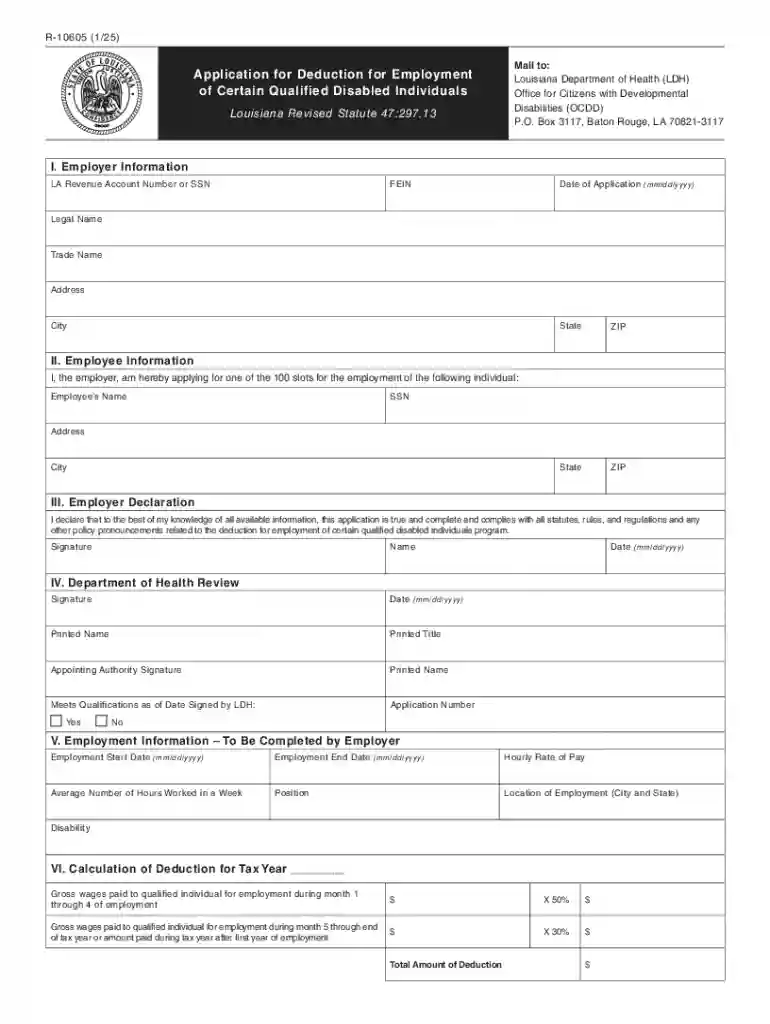
Louisiana Revised Statutes Tit 47,297.13 outlines a tax deduction program aimed at encouraging employers in Louisiana to hire qualified individuals with disabilities. This statute serves as a legislative framework that enables businesses to receive financial benefits by deducting a portion of wages paid to these employees. The intent is to support both economic growth and inclusive employment practices by providing a tangible incentive for businesses to employ individuals who may have been underserved in traditional employment markets.
Understanding the process to utilize the tax deduction under Louisiana Revised Statutes Tit 47,297.13 is crucial for employers. Businesses can claim the deduction as part of their annual state tax filings. The deduction is structured to benefit employers financially by allowing them to deduct 50% of the gross wages paid to each qualified employee during the initial four months of employment, followed by a 30% deduction for subsequent months. Employers must ensure compliance with the guidelines in the statute to claim these benefits effectively.


A manufacturing business in Baton Rouge hiring ten qualified employees with disabilities can maximize its tax benefits by calculating the wage deductions accurately. For example, if Employee A earns $3,000 monthly, the employer can deduct $1,500 for the first four months and $900 monthly thereafter. This real-world application illustrates how the statute incentivizes inclusivity while offering financial relief.
Businesses must be aware of specific laws and requirements that accompany this tax deduction under Louisiana's jurisdiction. Given that this deduction is state-specific, employers should consult state guidelines and potentially seek legal or accounting advice to ensure full compliance with Louisiana statutes.
Failure to accurately implement the deduction in accordance with Louisiana Revised Statutes Tit 47,297.13 can result in penalties. Non-compliance can include incorrect deduction calculations, improper documentation, or failure to meet deadlines—each potentially leading to financial penalties or loss of deduction privileges. Proper adherence to the legal framework is essential for employers wishing to benefit from this tax incentive.
We've got more versions of the Louisiana Revised Statutes Tit 47,297 13 Tax deduction form. Select the right Louisiana Revised Statutes Tit 47,297 13 Tax deduction version from the list and start editing it straight away!
At DocHub, your data security is our priority. We follow HIPAA, SOC2, GDPR, and other standards, so you can work on your documents with confidence.


This analysis looked at only sales, sales and services, and property taxes, which are the major sources of local revenue in North Carolina counties.
Aug 15, 2007 The Executive Department consists of fifteen (15) budget units: the Executive Office, Office of. Indian Affairs, Office of the State InspectorRead more


