Manage your tax accounts 2026

Get Form
Manage your tax accounts Preview on Page 1

Here's how it works

01. Edit your form online
Type text, add images, blackout confidential details, add comments, highlights and more.

02. Sign it in a few clicks
Draw your signature, type it, upload its image, or use your mobile device as a signature pad.

03. Share your form with others
Send it via email, link, or fax. You can also download it, export it or print it out.

Definition and Meaning of Managing Your Tax Accounts

Managing your tax accounts involves keeping accurate financial records, preparing and filing tax returns, and ensuring compliance with tax regulations. Efficient management helps individuals and businesses maintain a clear understanding of their financial obligations and streamline their interactions with tax authorities. This process can include organizing income reports, deducting eligible expenses, and systematically monitoring financial transactions. By staying organized, taxpayers can minimize the risk of errors or penalties and ensure they take full advantage of available tax deductions and credits.

How to Use the Manage Your Tax Accounts Platform

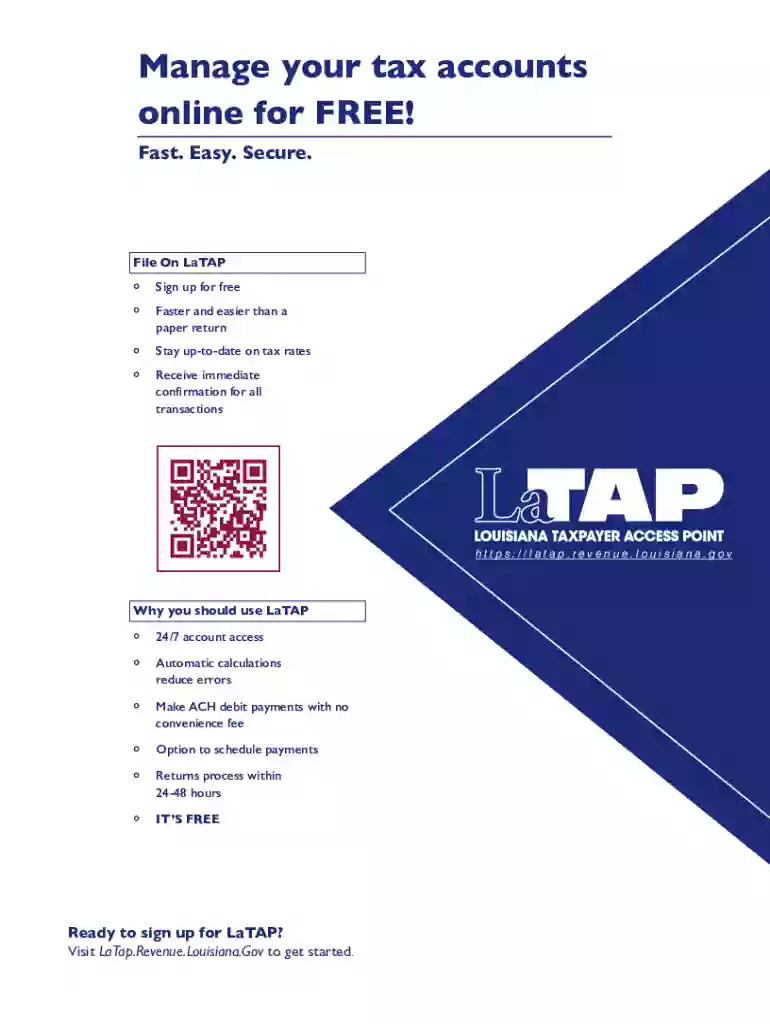
Utilizing a platform to manage your tax accounts can simplify this complex process. Online platforms like LaTAP enable taxpayers to file returns, make payments, and review their tax history electronically. To use such a platform effectively, you’ll need to create an account, link relevant financial details, and follow step-by-step instructions for inputting income, deductions, and credits. These platforms streamline tax management by providing automated calculations and reminders for important deadlines, ensuring you stay compliant with tax obligations.

Steps to Complete the Manage Your Tax Accounts Task

When completing the task of managing your tax accounts, follow these guided steps for accuracy and compliance:

  1. Gather Documentation: Collect income statements, receipts for deductible expenses, and relevant tax forms.
  2. Organize Records: Sort documents into categories such as income, expenses, and previous tax returns.
  3. Input Data: Enter information into online tax preparation software or a platform like LaTAP, taking advantage of guidance provided on deductions and credits.
  4. Review and Adjust: Carefully review entries for accuracy, making any necessary adjustments.
  5. Submit and Archive: Submit your tax return electronically if possible, and store both digital and physical copies of relevant documents for future reference.

Each step should be executed with attention to detail, ensuring compliance with federal and state tax laws.

Why Should You Manage Your Tax Accounts?

Managing your tax accounts effectively is crucial for several reasons:

  • Financial Accuracy: It ensures your financial records are accurate and reflective of your actual financial situation.
  • Avoidance of Penalties: Proper management helps avoid late fees, penalties, and interest charges from the IRS due to errors or missed deadlines.
  • Maximization of Deductions: Organized tax management allows you to claim all eligible deductions, potentially reducing your tax liability.
  • Strategic Planning: Understanding your tax obligations allows for better financial planning and cash flow management throughout the year.

By maintaining a structured approach, individuals and businesses can enhance their financial health and compliance with tax obligations.

Important Terms Related to Managing Tax Accounts

Understanding specific terminology is vital for effective tax account management. Key terms include:

  • Deductions: Expenses that can be subtracted from gross income to reduce taxable income.
  • Credits: Direct reductions of tax liability which may be refundable or non-refundable.
  • Exemptions: Specific allowances for personal or dependent claims that lower taxable income.
  • Withholding: Money withheld from an employee’s paycheck for taxes, influencing the amount owed or refunded at year-end.

Familiarity with these terms supports more informed and efficient tax account management.

IRS Guidelines for Managing Tax Accounts

The IRS provides detailed guidelines to assist taxpayers in managing their tax accounts:

  • Record Keeping: Maintain detailed and organized financial records, including income, expenses, and other relevant transactions.
  • Compliance: Adhere to IRS rules regarding filing deadlines, required forms, and acceptable expenses.
  • Audit Preparedness: Be prepared for potential audits by ensuring all claimed information is verifiable and accurate.
  • Filing Accuracy: Utilize IRS resources and tools to ensure tax filings are complete and accurate.

These guidelines serve as a critical resource for managing tax obligations effectively and legally.

Filing Deadlines and Important Dates

Key deadlines and dates to keep in mind when managing your tax accounts include:

  • April 15: The traditional deadline for filing federal income tax returns, unless extended.
  • January 31: Employers must provide W-2 forms to employees by this date.
  • June 15: Filing deadline for US citizens living abroad.
  • October 15: Extended filing deadline for those granted an extension.

Staying informed about these dates ensures timely compliance and helps avoid late filing penalties.

Required Documents for Managing Tax Accounts

Accurate tax account management requires various documents, including:

  • W-2 Forms: For reporting employment income.
  • 1099 Forms: For other income types, such as freelance or investment income.
  • Receipts and Bills: Documentation for deductible expenses.
  • Proof of Payments: Records of estimated tax payments made throughout the year.

Collecting and organizing these documents is essential for accurate tax preparation and filing.

be ready to get more

Complete this form in 5 minutes or less

Get form

Got questions?

We have answers to the most popular questions from our customers. If you can't find an answer to your question, please contact us.
Contact us
Folks, the higher the number you claim, the more you get back in each paycheck. Thus, claiming ``0 results in the smallest paycheck, but a larger tax refund at tax time.
Claiming 0 means more withheld. It reduces the take-home pay but possibly leads to a refund. Claiming 1 means less withheld. This option presents a larger paycheck but increases the risk of owing amounts at tax time.
Total taxes owed is calculated in your form 1040 when you file it at tax time, after the end of the year (before April 15). Regardless of whether you claimed yourself or others, your total taxes paid will be the same. In the end it will not make a difference.
Avoid These Common Tax Mistakes Not Claiming All of Your Credits and Deductions. Not Being Aware of Tax Considerations for the Military. Not Keeping Up with Your Paperwork. Not Double Checking Your Forms for Errors. Not Adhering to Filing Deadlines or Not Filing at All. Not Fixing Past Mistakes. Not Planning for Next Year.
It required platforms to report any user earning $600 or more, regardless of how many transactions they had. The IRS delayed enforcement due to massive backlash: Taxpayer confusion over casual payments vs. taxable income.

Security and compliance

At DocHub, your data security is our priority. We follow HIPAA, SOC2, GDPR, and other standards, so you can work on your documents with confidence.
Learn more
ccpa2
pci-dss
gdpr-compliance
hipaa
soc-compliance
be ready to get more

Complete this form in 5 minutes or less

Get form

People also ask

To get started, go to IRS.gov/account Once there, click Sign in to your online account. From there, you can access ID.me, which helps the IRS verify and protect your identity and data. From the Account Home tab, you can quickly see your Account Status card displaying any amount owed.
For single filers with one job, it can be difficult to decide whether to claim 0 or 1 allowances. If youd rather get more money with each paycheck instead of having to wait for your refund, claiming 1 on your taxes is typically a better option.
By placing a 0 on line 5, you are indicating that you want the most amount of tax taken out of your pay each pay period. If you wish to claim 1 for yourself instead, then less tax is taken out of your pay each pay period. 2. You can choose to have no taxes taken out of your tax and claim Exemption (see Example 2).

Related links