







Definition & Meaning
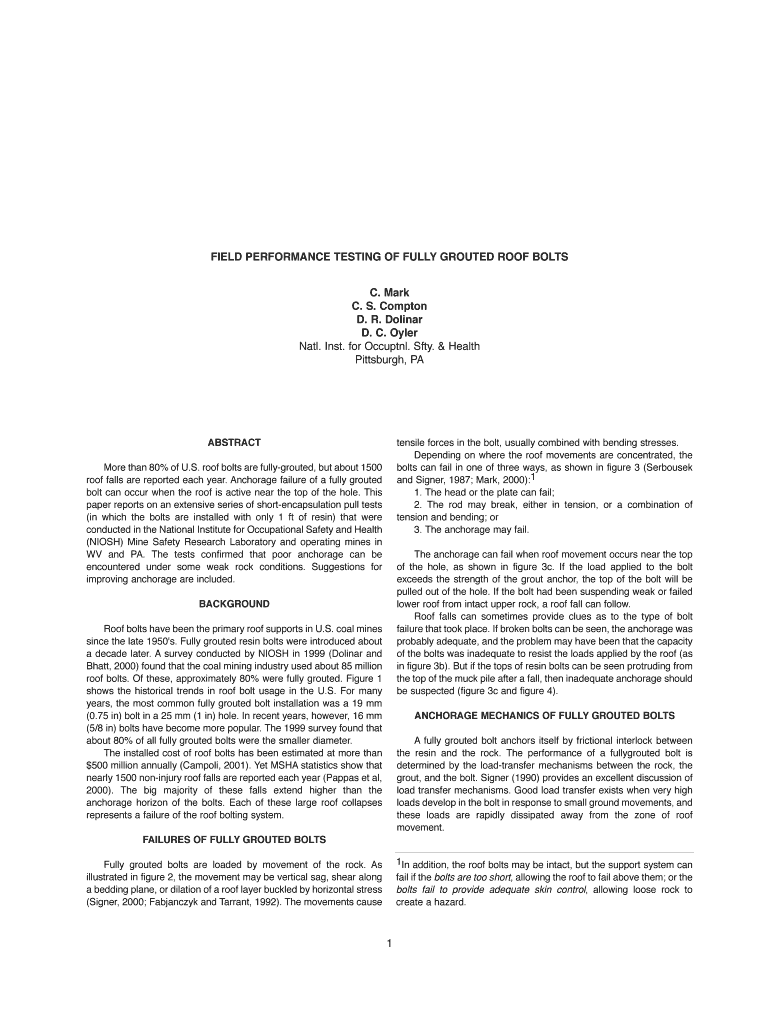
Field performance testing of fully grouted roof bolts, often abbreviated as C Mark, C S, is a critical process used to assess the effectiveness and reliability of roof bolts in mining operations. These tests evaluate the anchorage and overall performance of the bolts in real-world conditions, particularly in challenging environments like U.S. coal mines. The primary aim is to ensure safety by identifying potential failures and determining the conditions under which the bolts perform optimally.
Key Components
- Anchorage Evaluation: Measurement of bolt holding capability in various rock conditions.
- Failure Modes: Identification of common issues such as grout and bolt failures.
- Testing Methods: Use of short encapsulation pull tests to simulate mining conditions.
How to Use the Testing Form
Using the performance testing form involves collecting data during both installation and throughout the life of the roof bolts. The form helps in documenting factors affecting the performance of the bolts, guiding decisions for improving their implementation.
Practical Steps
- Record Data: During bolt installation, note the type of rocks, grouting materials, and installation techniques used.
- Monitor Performance: Continually assess the bolts' conditions and note any changes.
- Analyze Failures: When failures occur, document conditions to identify patterns and potential solutions.
Key Elements of the Form
Understanding the essential components of the form helps in interpreting results effectively and implementing changes that enhance safety and productivity in underground operations.
Critical Sections
- Installation Data: Information on the type, size, and length of bolts used.
- Grouting Details: Type of grout, mixing procedures, and curing time.
- Performance Metrics: Results of pull tests and any observed slippage or deformation.
Steps to Complete the Testing Form
Properly completing the form ensures that all necessary data is captured for accurate performance analysis.
- Preparation: Gather all necessary tools and materials for the test.
- Conduct Tests: Follow standardized test procedures for accurate results.
- Document Observations: Record all relevant details immediately after each test.
- Review and Submit: Double-check for completeness before submission for analysis.
Why Perform These Tests
Conducting these tests is imperative for maintaining safety and preventing catastrophic failures in mining operations. By understanding roof bolt performance, mine operators can make informed decisions on design and installation practices.
Benefits
- Safety Improvement: Reduces the risk of roof falls and associated accidents.
- Cost Management: Minimizes unexpected repair costs and operational downtimes.
- Regulatory Compliance: Adheres to safety regulations, ensuring legal operations.
Examples of Using the Form
Real-world applications of the testing forms reveal their importance in improving underground safety.
- Case Study 1: A mining operation in Pennsylvania used the form to identify that improper grouting techniques were leading to frequent bolt failures.
- Case Study 2: An examination in Virginia showed that certain rock types required different bolt types for optimal performance, helping tailor their safety strategy.
Legal Use & Compliance
The form adheres to national safety standards and regulations, ensuring that mining operations are both safe and legal.
Regulatory Framework
- OSHA Compliance: Meets Occupational Safety and Health Administration requirements for mining safety.
- Federal Guidelines: Aligns with federal regulations concerning mine safety equipment testing.
State-Specific Rules
Each state may have specific guidelines governing the testing and use of roof bolts, making understanding these differences essential to compliant operations.
Variations to Consider
- Documentation Differences: Some states may require additional reporting or documentation.
- Testing Frequencies: Mandatory testing intervals may differ by state, impacting operational scheduling.
Important Terms Related to Testing
Understanding specific technical terminology related to this field is vital for accurate data recording and analysis.
Glossary
- Grout: A fluid concrete mix used to fix bolts in drilled holes.
- Pull Test: A method to test the anchorage strength of a bolt.
- Roof Fall: An instance where part of the mine roof collapses.




