







Definition & Meaning
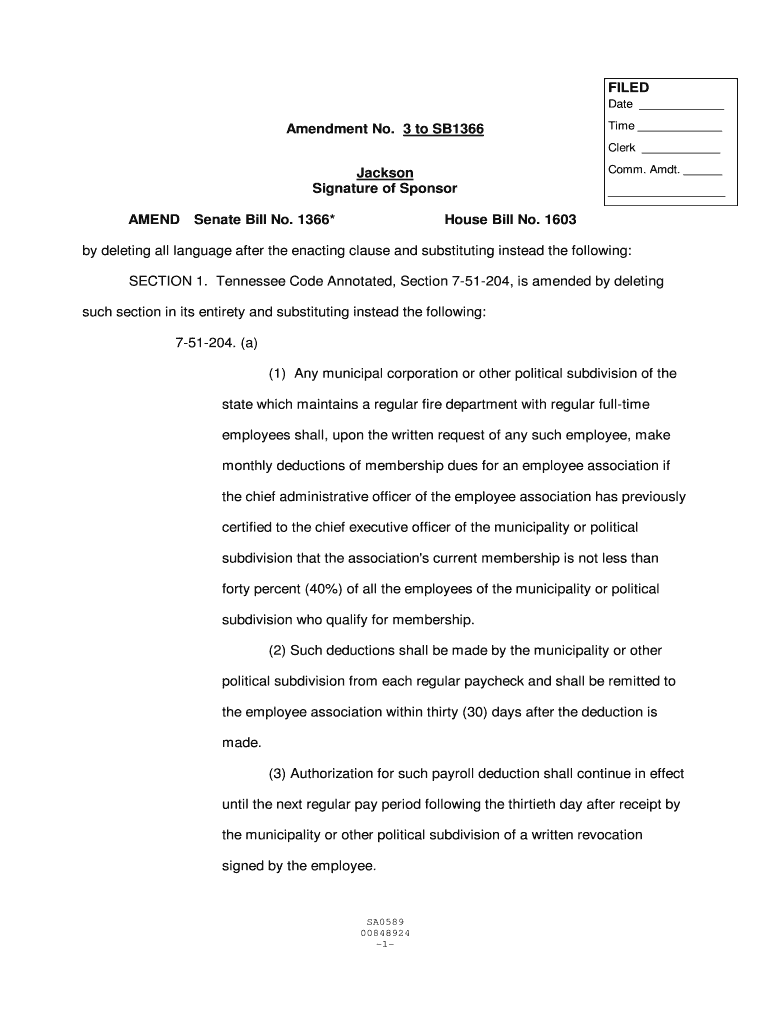
"Amendment No 3 to SB1366 Jackson Signature of Sponsor AMEND - capitol tn" refers to a specific legislative adjustment made to Senate Bill No. 1366 within the Tennessee General Assembly. This amendment modifies the previously established content of SB1366, aiming to address particular legal or procedural changes necessary for compliance with Tennessee law. The designation includes the signature of the sponsor, indicating sponsorship and endorsement of the amendment. The "capitol tn" notation suggests that these legislative activities are specific to the state of Tennessee.
Key Elements of the Amendment
The amendment to SB1366 particularly focuses on modifications to Tennessee Code Annotated, Section 7-51-204. A significant element of the amendment is the mandate that municipal corporations with organized fire services must automatically deduct the membership dues of employee associations from employee paychecks when requested. This is contingent upon the condition that the association has at least 40% membership from the pool of eligible employees. Additionally, the amendment ensures that the provisions within it are severable and will take effect immediately upon becoming law.
Steps to Complete the Amendment No 3 to SB1366
-
Review Legislative Text: Begin with a thorough review of the amendment text provided alongside the original Senate Bill No. 1366 documentation.
-
Analyze Legal Implications: Understand the legal implications, focusing on how the amendment alters existing statutory obligations.
-
Consult Stakeholders: Engaging with relevant stakeholders, including municipal corporations and employee associations, is crucial for alignment and understanding.
-
Implement Changes: Execute necessary administrative and procedural changes within municipal corporations to comply with the new mandates concerning membership dues.
-
Monitor Compliance: Establish a system to ensure ongoing compliance with the provisions as stated in the amendment.
How to Obtain the Amendment
The amendment is typically accessible through the official Tennessee General Assembly website or archives, where public legislative documents are stored. For comprehensive analysis, consulting legal databases or directly contacting legal offices specializing in legislative matters within Tennessee is advisable. These resources will provide both the amendment text and the necessary legislative history for context.
Legal Use of the Amendment
The amendment's legal framework mandates adherence to revised deductions policies for membership dues. It legally empowers employee associations to push for compliance once the criteria are met. Precisely, it upholds the rights of eligible employees within municipal fire services to have their association dues deducted upon meeting membership thresholds, ensuring streamlined processing of these transactions under the revised legal expectations.
State-Specific Rules
Being a state-centric legislative amendment, its application is uniquely tailored to Tennessee laws. This jurisdictional nature means that similar amendments in other states might differ in their provisions and implications due to varying state legal landscapes. For instance, other states may not require the same membership percentage or might have different processes for implementation.
Important Terms Related to the Amendment
- Severability: Legal provision ensuring parts of the amendment can stand independently if other sections are invalidated.
- Municipal Corporation: Local government entities such as cities and towns that will implement the dues deduction.
- Membership Dues: Payments collected from members of an association typically used for funding operations and activities.
Required Documents
Documents required for compliance with the amendment may include payroll authorization forms duly signed by employees opting into dues deductions, official membership verification figures from associations to substantiate the 40% threshold, and internal compliance reports from municipal corporations detailing adherence efforts.
Examples of Using the Amendment
Consider a municipal fire department with 100 eligible employees: if 40 of them belong to a dues-paying association, this satisfies the amendment’s requirement of 40% membership. Thus, these employees' paychecks would reflect the automatic deduction of dues with their documented consent. This example underscores the practical application of the amendment in a real-world context, highlighting its built-in membership prerequisites.




