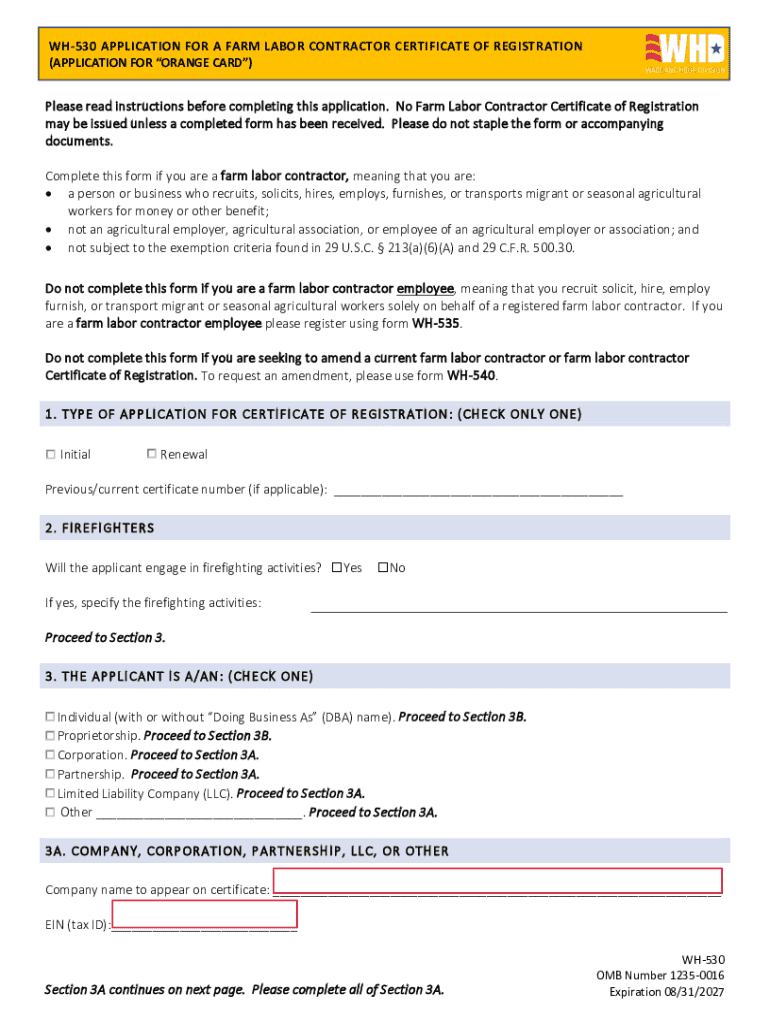







Definition and Purpose of the WH-530 Form
The WH-530 form, commonly known as the Farm Labor Contractor Certificate of Registration, is a crucial document for individuals or businesses engaged in the recruitment, hiring, or transportation of migrant or seasonal agricultural workers within the United States. This form, also referred to as the 'Orange Card,' is part of the requirements under the Migrant and Seasonal Agricultural Worker Protection Act (MSPA). The primary purpose of this form is to ensure that farm labor contractors comply with legal standards designed to protect the rights and well-being of agricultural workers. Through obtaining and maintaining this certification, contractors verify their adherence to regulations regarding wages, housing, transportation, and working conditions.
- Scope: The form applies to all entities involved in farm labor contracting activities, including sole proprietors, partnerships, and corporations.
- Regulatory Compliance: It emphasizes the importance of complying with MSPA, setting a standard for ethical employment practices in agriculture.
How to Obtain the WH-530 Form
Securing the WH-530 form involves a series of steps that ensure both eligibility and compliance with federal regulations. Prospective farm labor contractors must complete the application by detailing their operations and demonstrating their capacity to comply with the MSPA.
- Application Process: The first step is to gather necessary documentation related to the business's labor contracting activities, including any past compliance records.
- Submission: Applications can typically be submitted online or via mail to the Department of Labor office. Both methods require careful adherence to instructions provided within the form's guidelines.
- Documentation Requirements: Include proof of business operations, transportation authorizations, and past compliance certifications.
- Fee Payment: Ensure the appropriate processing fee accompanies the submission to avoid delays.
Steps to Complete the WH-530 Form
Completing the WH-530 form is detailed, requiring accurate information and the inclusion of necessary documentation.
- Applicant Information: Begin by filling out detailed personal and business information, ensuring all names and addresses are current and correct.
- Criminal History: Disclose any relevant criminal history, as this impacts eligibility.
- Transportation and Housing: Provide documentation proving that transportation and housing meet legal standards.
- Certifications: Include copies of certifications that demonstrate compliance with MSPA regulations.
- Accuracy: Precision in completing each section is crucial to avoid processing delays.
- Review: Double-check all sections for completeness and accuracy before submission.
Who Typically Uses the WH-530
The primary users of the WH-530 form are farm labor contractors, who are essential to the agricultural sector. These contractors often operate in varied capacities, influencing how the form is utilized.
- Independent Contractors: Many farm labor contractors operate independently, taking charge of recruitment and management of labor forces.
- Agricultural Businesses: Larger agricultural firms may employ dedicated teams to handle the logistics of worker management, necessitating the use of the WH-530.
- Cooperatives: In some instances, agricultural cooperatives may also require the use of this form to coordinate shared labor resources.


Key Elements of the WH-530
The form is comprehensive, broken down into critical sections that require detailed input to ensure every aspect of farm labor contracting is covered.
- Applicant Identification: Information identifying the applicant is crucial, ensuring accountability and traceability.
- Operational Details: This includes specifics on the type of work, geographical areas of operation, and the number of workers involved.
- Compliance Certifications: These confirm that the contractor meets all necessary legal requirements.
Legal Use of the WH-530
The WH-530 form is not just a bureaucratic requirement; it underpins the legal framework ensuring fair treatment of agricultural workers. The form's compliance mandates several legal assurances:
- Worker Protections: Guarantees that workers are provided with safe transportation and housing.
- Fair Labor Practices: Ensures labor contractors adhere to wage and hour regulations, preventing exploitation.
Important Terms Related to the WH-530
Understanding key terms associated with the WH-530 is vital for accurate completion and utilization.
- Farm Labor Contractor: An individual or entity that recruits or employs workers for agricultural work.
- MSPA Compliance: Refers to adherence to the Migrant and Seasonal Agricultural Worker Protection Act, safeguarding worker rights.
- Registration Certification: A legal document providing proof of compliance with MSPA and eligibility to operate as a farm labor contractor.
Penalties for Non-Compliance
Failure to comply with the requirements of the WH-530 form and associated MSPA regulations can lead to serious consequences.
-
Fines and Legal Action: Non-compliance can result in substantial fines and potential legal action, impacting business operations.
-
Revocation of Certification: Persistent violations may lead to the revocation of the farm labor contract certificate, prohibiting business operations.
-
Preventative Measures: Regular audits and legal consultations can help ensure ongoing compliance and mitigate risks of penalty.
State-Specific Rules for the WH-530
While the WH-530 form is federally mandated, individual states may have additional requirements that must be observed.
-
State Variations: Certain states may impose stricter standards or additional documentation requirements.
-
Local Compliance: Keeping abreast of state-specific legislation is essential for maintaining operational legality.
-
Consultation with Local Authorities: Engaging with state labor departments can provide clarity and assistance in meeting local obligations.
Required Documents for WH-530 Completion
Submitting the WH-530 form necessitates attaching specific documentation to validate claims and assertions made within the application.
-
Proof of Business Operations: Such as tax records, business licenses, and any additional operational certifications.
-
Insurance and Safety Documentation: Includes liability insurance for transportation and compliance with safety standards for housing.
-
Evidence of Past Compliance: Historical records of adherence to MSPA can support the application and facilitate approval.