




01. Edit your 2024 property tax credit chart online
Type text, add images, blackout confidential details, add comments, highlights and more.

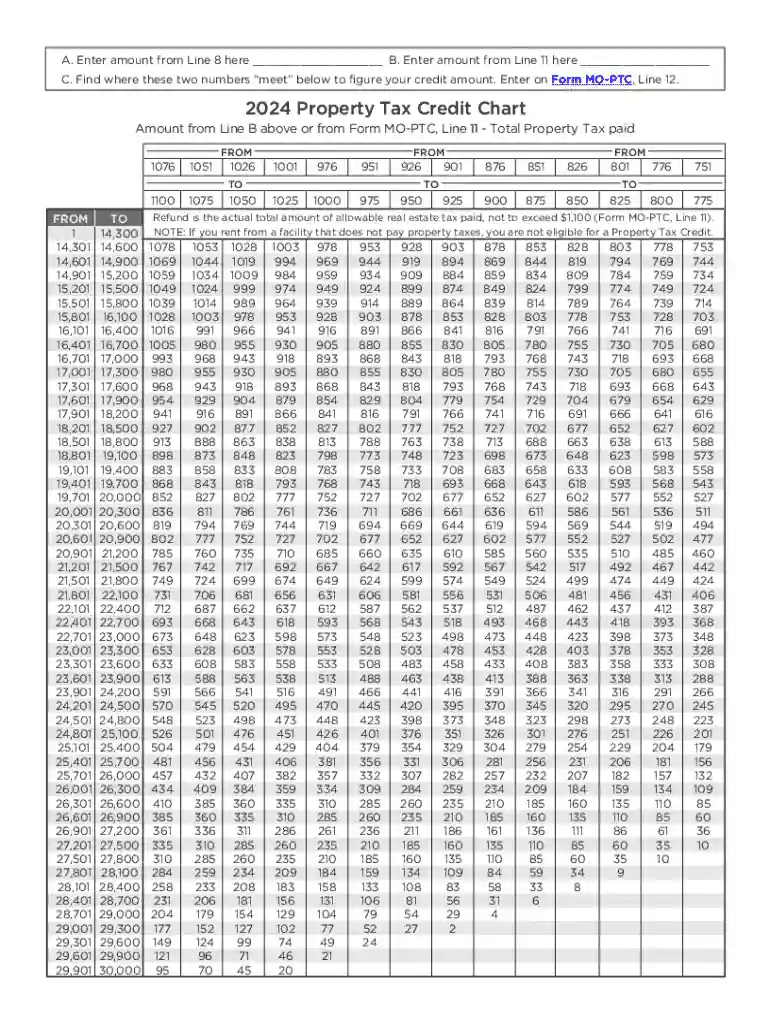
Type text, add images, blackout confidential details, add comments, highlights and more.

Draw your signature, type it, upload its image, or use your mobile device as a signature pad.

Send 2024 mo ptc chart via email, link, or fax. You can also download it, export it or print it out.
The 2024 Property Tax Credit Chart is a crucial financial tool that helps individuals and businesses determine their eligible tax credits based on the property taxes they have paid or rent they have submitted. This chart is particularly helpful for individuals residing in the United States, primarily focusing on Missouri's specific guidelines. The tool assists in calculating potential refunds, making it essential for efficient tax planning.
The main function of this chart is to correlate the amounts you have entered on specific lines of your tax forms, such as Form MO-PTC, with the applicable credit amounts. This correlation allows taxpayers to ascertain the precise amount they can claim as a property tax credit. The ultimate goal is to help taxpayers accurately calculate refunds and ensure compliance with state tax laws.
Utilizing the 2024 Property Tax Credit Chart involves a detailed analysis of the taxpayer’s financial inputs against the predefined parameters within the chart. Here is a breakdown of how to properly use the chart:
Collect Your Financial Data: Gather all the information related to property taxes you have paid or rent you have submitted. This includes receipts, tax bills, and rent agreements.
Identify Relevant Chart Sections: Based on your inputs, locate the corresponding sections in the chart that align with your payments.
Cross-Reference the Inputs: Calculate the credits by matching the paid amounts against the outlined credit values in the chart.
Apply the Chart Logic: The specified chart mechanistically draws connections between the input figures from your tax forms and formulates an appropriate credit sum.
Verify Credit Amounts: Ensure that the computed credit does not exceed the maximum allowable refund, which is $1,100 for property taxes and $750 for rent.
Understanding who qualifies for the property tax credit is integral to the efficient use of the 2024 Property Tax Credit Chart. The following points outline the critical eligibility requirements:
Residency: The applicant must be a legal resident of Missouri. Typically, this involves providing evidence of residency such as utility bills or state identification documents.
Income Thresholds: Eligibility is determined based on income levels, which must fall within particular boundaries as delineated by state laws. These thresholds vary annually, so ensure your income aligns with the current year’s criteria.
Property Usage: The credit primarily applies to residential property taxes, and in some cases, to commercial properties if certain conditions are met.
Rental Agreements: Renters can also be eligible under specific conditions, like bearing full rental responsibility and fulfilling the outlined rental payment minimums.


Completing the property tax credit application involves a suite of necessary documents that ensure transparency and precision in calculations:
Tax Bills and Receipts: Documentation for property taxes paid should be in the form of official receipts or validated tax bills.
Rental Agreements: For renters, authenticated copies of rental contracts detailing payment terms are compulsory.
Income Proof: Tax returns, W-2s, or other income statements to confirm earnings and validate income requirements.
Identification: Government-issued ID and proof of residency, which confirms that the applicant meets the legal residence stipulation.
Completing the chart requires inherent knowledge of both the documentation process and necessary calculations:
Gather Necessary Materials: Have all your financial documents readily available, including rental receipts, tax bills, and proof of income.
Fill Out Tax Forms: Begin by filling out essential tax forms such as the MO-PTC with all required information.
Locate the Correct Sections in the Chart: Reference the appropriate segments of the chart where your financial figures are relevant.
Input Data Accurately: Enter your numbers carefully into the corresponding chart sections, ensuring accuracy to reflect your true financial scenario.
Review Calculated Credits: Cross-check your calculations with the listed credits to verify accuracy and ensure compliance.
Submit Documentation: After completion, ensure all forms are appropriately submitted, either through online channels or by traditional mail.
Taxpayer: Any individual or entity liable to pay taxes on incomes or properties.
Refundable Credit: A credit that may result in a refund even if no taxes are owed.
Non-Refundable Credit: A credit that only applies against taxes owed, providing no refund for the surplus.
Tax Liability: The total amount owed to tax authorities based on applicable laws.
Claim Year: The specific tax year for which the credit is being claimed, often the previous calendar year.
Certain states, particularly Missouri, have specific rules that modify the general application of property tax credits. Here are some key points specific to Missouri:
Maximum Credit Limits: Missouri sets $1,100 as the maximum property tax credit and $750 for renters, which marks the upper boundary for reimbursements.
Filing Deadlines: Missouri requires submission by April 15 to qualify for the current year’s tax credit application.
Income Brackets: Missouri employs a graduated income bracket system that influences eligibility. Staying updated on these brackets is crucial as they undergo periodic revisions.
Rental Properties: Properties must be used primarily for residential purposes. Exceptions or additional criteria may apply if using the property for other purposes.
The IRS adheres to stringent protocols regarding tax credits, forming the backbone of acceptable practices under the ESIGN Act:
Documentation Requirements: Precision in documenting property taxes and retaining proof is imperative.
Electronic Filing: The IRS supports electronic submission, facilitating quick processing of your tax credits.
Compliant Record-Keeping: Maintain a complete record for each filing year to support audits.
Limits and Conditions: Be aware of federal limits on deductions and credits that could interact with state-level credits.
These guidelines promote transparent and fair tax filing, ensuring orderly credit distribution.
We've got more versions of the 2024 property tax credit chart form. Select the right 2024 property tax credit chart version from the list and start editing it straight away!
At DocHub, your data security is our priority. We follow HIPAA, SOC2, GDPR, and other standards, so you can work on your documents with confidence.
Refund is the actual total amount of allowable real estate tax paid, not to exceed $1,100 or rent credit equivalent not to exceed $750 (Form. MO-PTC, Line 11).Read more
Select the relevant assessment year (AY 2026-27 for income earned in FY 2025-26). Enter the country, the nature of the foreign income, and the amount of that
Your property tax credit is figured by comparing your total income received to 20 percent of your net rent paid or real estate tax paid.


