
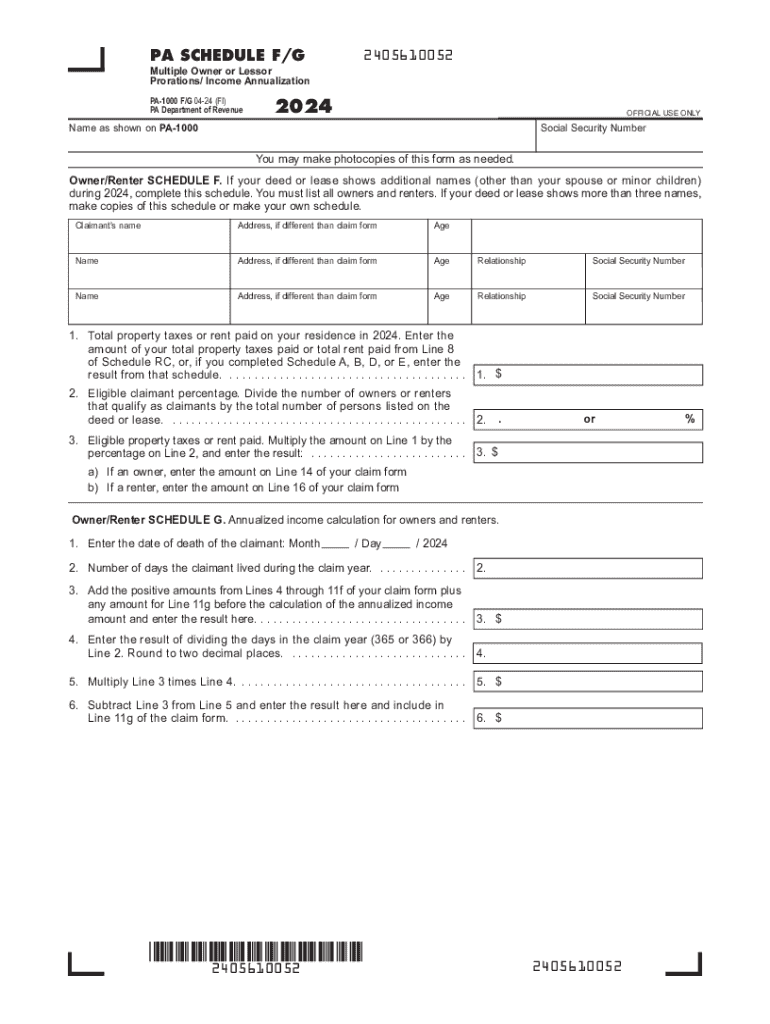







Definition and Meaning of 2024 PA Schedule F G
The 2024 PA Schedule F G—often referred to as the PA-1000 F G—is a specialized form used by multiple owners or lessors to report property taxes or rent paid in Pennsylvania. This form is crucial for calculating prorated share of income or expenses attributable to each owner or lessor. It includes detailed instructions to ensure accurate assessment and reporting. This form simplifies the process of annualizing income for tax purposes, aligning with state-specific requirements and promoting transparency in financial reporting.
Key Elements of the Form
- Personal Information: Capture essential details such as names, social security numbers, and contact information of all owners or lessors.
- Proration Details: Instructions and formulas for prorating income or expenses based on the proportion of ownership or lease.
- Calculation Instructions: Clear guidelines for determining eligible amounts, including property taxes, rent paid, and other relevant financial data.
- Annualization Guidelines: Steps to convert various income streams into an annualized format, aiding in the accurate reporting of annual taxes.
How to Use the 2024 PA Schedule F G
Step-by-Step Completion Guide
- Gather Required Documents: Collect details of rents received/payments made, ownership documentation, and any previous schedules that relate to the form.
- Enter Personal Details: Begin by filling in personal and identification details. Ensure accuracy to avoid discrepancies later.
- Calculate Prorations: Use the provided formulas to compute each portion of income or expenses. Input these into the relevant sections.
- Summarize Annualized Income: Follow the instructions to annualize various income streams for accurate tax representation.
Real-World Example
Consider a property owned by three individuals. Each person contributes to expenses and receives a portion of rental income. By using the PA-1000 F G, these owners can proportionally divide both income and expenses, ensuring equitable tax reporting and compliance with Pennsylvania regulations.
Steps to Complete the Form
The completion process can be broken down into a series of straightforward steps:
- Identify All Parties: Clearly define all ownership or lease stakeholders.
- Detailed Income Reporting: Record income derived from property operations.
- Document Expenses: Detail all eligible expenses, such as maintenance fees.
- Prorate Accordingly: Base calculations on agreed ownership percentages.
- Complete Final Verification: Review form entries for accuracy and completeness.
Legal Use of the 2024 PA Schedule F G
Compliance and Regulations
Adhering to the PA-1000 F G guidelines is mandatory for applicable parties to ensure compliance with Pennsylvania's department of revenue regulations. The form requires strict adherence to calculation methods and reporting standards to uphold transparency and accuracy. Any misrepresentation can lead to audits and financial penalties.
Important Terms Related to the Form
Understanding key terms facilitates accurate completion and compliance:
- Proration: The process of dividing or distributing financial data based on ownership percentages.
- Annualization: Converting periodic income into an equivalent annual sum.
- Eligibility Criteria: Requirements for using the form include residency, financial interest in the property, and more.
Who Typically Uses the Form
The PA-1000 F G is primarily utilized by:
- Property Owners: Individuals or entities co-owning rental properties.
- Lessors: Individuals leasing property to tenants.
- Accountants and Tax Professionals: Specialists tasked with ensuring accurate financial reporting on behalf of their clients.


State-Specific Rules for Pennsylvania
Unique Considerations
Pennsylvania has specific mandates regarding property tax reporting. Filers must be aware of these distinct regulations:
- Tax Rate Variations: Understand regional tax rates applicable to owned properties.
- Filing Deadlines: Compliance with state-initiated deadlines ensures adherence to taxation policies.
Software Compatibility with the PA-1000 F G
Integration with Financial Software
While the PA-1000 F G can be completed manually, several software options streamline the process:
- TurboTax and QuickBooks: These platforms offer tools for integrating tax forms, aiding in income and expense calculations.
- DocHub: Facilitates easy online form editing, signing, and sharing, ensuring a seamless document workflow.
Streamline Workflows
Using such software allows for:
- Error Reduction: Automated calculations decrease human error.
- Time Efficiency: Accelerated form completion processes.
- Secure Digital Filing: Safe online submission and storage of tax documents.




