




01. Edit your form online
Type text, add images, blackout confidential details, add comments, highlights and more.

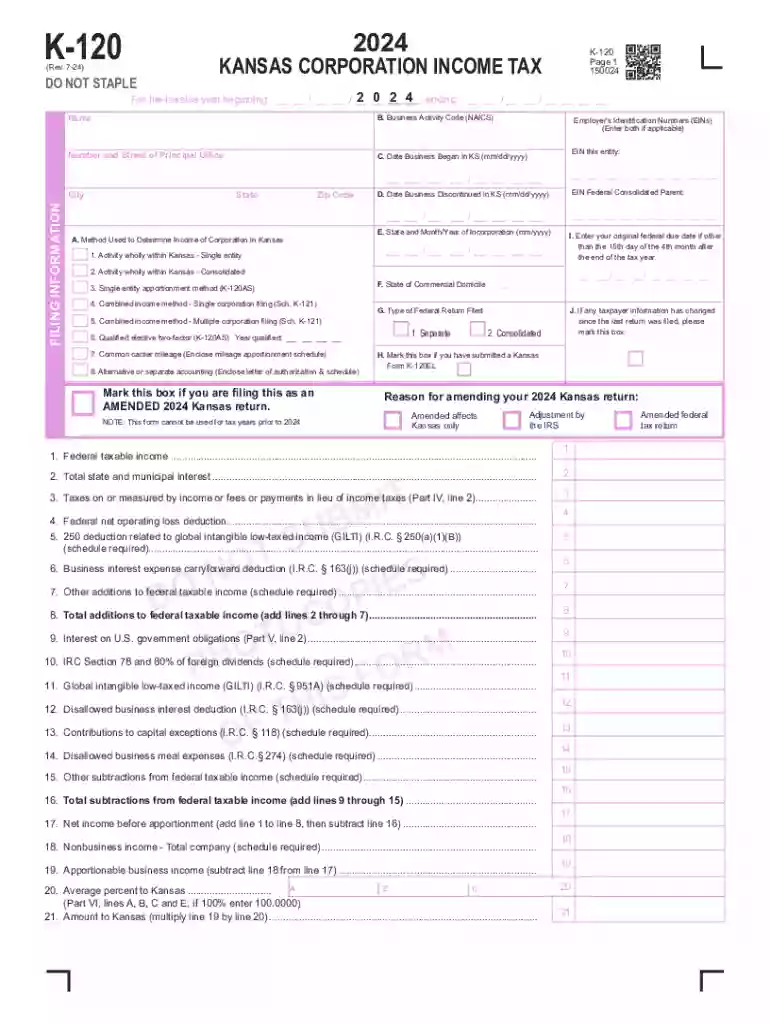
Type text, add images, blackout confidential details, add comments, highlights and more.

Draw your signature, type it, upload its image, or use your mobile device as a signature pad.

Send it via email, link, or fax. You can also download it, export it or print it out.
The K-120 form is a crucial document used for filing the Kansas Corporation Income Tax for the tax year 2024. Specifically designed for corporate entities operating within Kansas, this form collects comprehensive information required for calculating and reporting state income tax obligations. It includes sections for income determination, apportioning income, and claiming applicable tax credits. Notably, this form requires corporations to disclose business activities, income sources, and organizational changes since the previous filing. The primary purpose of the K-120 is to ensure accurate tax reporting and compliance with Kansas state taxation laws.
Gather Necessary Documents: Before completing the K-120, collect all relevant financial documents, including previous tax returns, income statements, and records of any business changes or transactions.
Filing Information: Start by filling in the basic information section. This includes the corporation’s legal name, address, Federal Employer Identification Number (FEIN), and other identification details relevant to the tax filing.
Income Determination: Calculate the corporation's taxable income. This involves itemizing all income sources and applying deductions as prescribed by Kansas tax law.
Apportionment and Allocation: If the corporation operates in multiple states, calculate the portion of income attributable to Kansas. This is crucial for accurately reporting state-specific income.
Calculate Tax and Credits: Determine the tax due based on the calculated income. Then, apply any eligible nonrefundable and refundable tax credits to reduce the overall tax liability.
Final Review and Submission: Ensure all sections are complete and accurate. Submit the form by the specified deadline either online, via mail, or in-person delivery.
Corporations operating in Kansas, regardless of size or industry, are required to file the K-120 form if they earn any income that is subject to state tax. Key eligibility criteria include:
Eligibility also extends to entities that are required to apportion income due to multi-state operations.


The K-120 form is composed of distinct sections, each tailored to capture detailed financial information:
To effectively complete the K-120, it is vital to understand specific terms:
The K-120 form must be filed annually by the standard corporate tax return deadline. For the tax year 2024, the due date is April 15, 2025. Corporations not meeting this deadline may face penalties for late submissions. Extensions may be granted upon request, but interest may accrue on any unpaid taxes.
Failing to file the K-120 form by the deadline can result in significant penalties. These can include:
Avoidance of these penalties ensures compliance and safeguards the corporation’s reputation.
Kansas imposes specific rules regarding income apportionment and tax credits that differ from federal tax guidelines. Understanding these distinctions is critical:
Comprehensive understanding of these rules aids in accurate filing and maximizes potential tax benefits.
We've got more versions of the K-120 form. Select the right K-120 version from the list and start editing it straight away!
| Versions | Form popularity | Fillable & printable |
|---|---|---|
| 2025 | 4.3 Satisfied (23 Votes) | |
| 2024 | 4.8 Satisfied (40 Votes) | |
| 2023 | 4.1 Satisfied (48 Votes) | |
| 2022 | 4.7 Satisfied (34 Votes) | |
| 2021 | 4.8 Satisfied (90 Votes) | |
| 2020 | 4.3 Satisfied (208 Votes) | |
| 2019 | 4 Satisfied (38 Votes) | |
| 2018 | 4.4 Satisfied (187 Votes) | |
| 2015 | 4.4 Satisfied (559 Votes) | |
| 2014 | 4.4 Satisfied (44 Votes) | |
| 2013 | 4 Satisfied (56 Votes) | |
| 2011 | 4.3 Satisfied (70 Votes) |
At DocHub, your data security is our priority. We follow HIPAA, SOC2, GDPR, and other standards, so you can work on your documents with confidence.



A qualified taxpayer, as defined in K.S.A. 79-32,211(b)(4) and amendments thereto, shall not be considered to be a community service organization, asRead more
Corporation Income Tax (K-120) - 2025 Corporate Income Tax Instructions (HTML) Vouchers, Worksheet and Instructions


