







Definition & Meaning
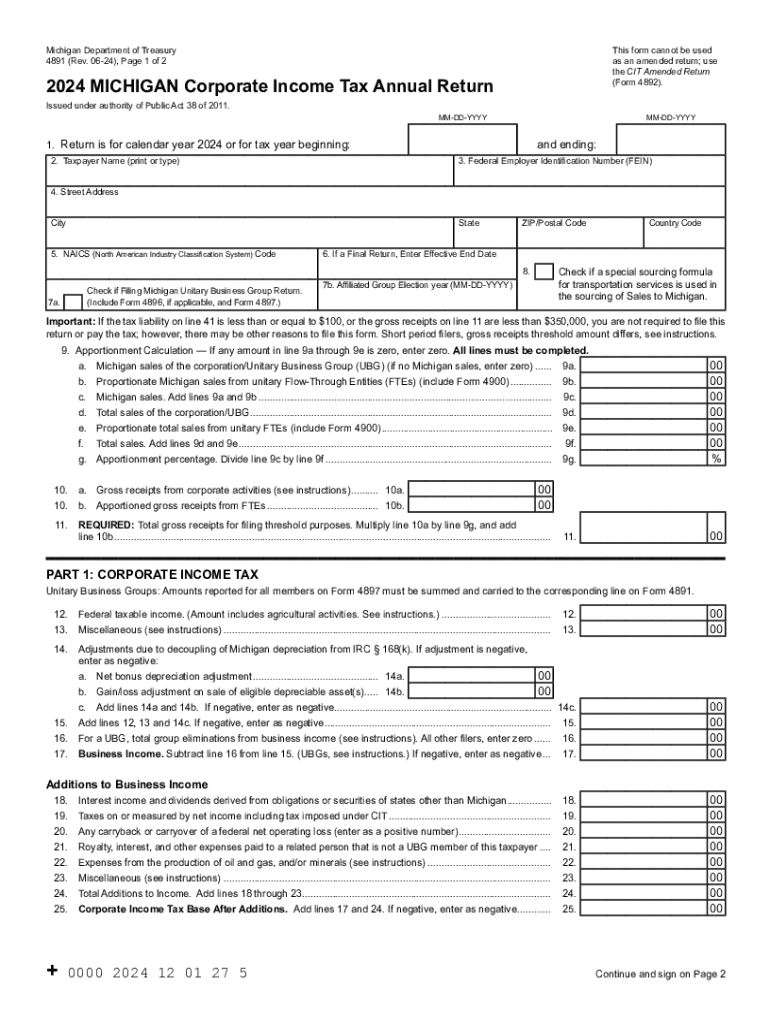
The 2024 Michigan Corporate Income Tax Annual Return, commonly referred to as Form 4891, is a critical tax document used by corporations and Unitary Business Groups (UBGs) to report their corporate income tax liabilities in the state of Michigan. It requires detailed financial information, including taxpayer identification, gross receipts, apportionment percentages, and business income adjustments. This form plays a pivotal role in ensuring that corporations comply with state tax requirements, accurately calculate their tax obligations, and determine any refunds or additional taxes owed.
Steps to Complete the 4891, 2024 Michigan Corporate Income Tax Annual Return
Filing Form 4891 involves several specific steps to ensure accurate and compliant submission:
- Gather Required Documentation: Obtain all necessary financial statements, records of business income, and receipts.
- Identify Taxpayer Information: Provide your corporation's legal name, taxpayer identification number, and primary business activity.
- Calculate Gross Receipts: Compute gross receipts from all sources, considering any exclusions specific to Michigan tax law.
- Determine Apportionment: Calculate apportionment percentages if your corporation operates both inside and outside Michigan to find the state-specific tax base.
- Business Income Adjustments: Adjust reported business income based on Michigan's allowable deductions or additions.
- Complete Tax Calculations: Incorporate all calculations to determine the total income tax liability.
- Review for Accuracy: Double-check all entered information for completeness and accuracy.
- Submit the Form: File the form through the appropriate submission method, ensuring all deadlines are met.
Key Elements of the 2024 Michigan Corporate Income Tax Annual Return
Form 4891 consists of several key sections that businesses must address:
- Taxpayer Information: Includes legal name and taxpayer identification.
- Income Section: For reporting gross receipts and income details.
- Adjustments and Deductions: A section for any state-specific modifications to reported income.
- Apportionment Details: If applicable, this section outlines how much income is attributable to Michigan.
- Tax Calculation: Where total liability is derived based on the information provided.
- Payment and Refund Details: To enter any payments made or refunds expected.
Required Documents
When preparing to file Form 4891, you will need to have the following documents on hand:
- Detailed Financial Statements: Balance sheets and income statements.
- Business Records: Information on sales and receipts.
- Prior Year Tax Returns: For reference and comparison.
- Supporting Documents for Adjustments: Any documentation supporting specific adjustments or deductions claimed.
Filing Deadlines / Important Dates
Corporations must be aware of critical dates related to filing Form 4891 to avoid penalties:
- Annual Deadline: Typically, the form is due by the same date as federal corporate income tax returns, which is generally April 15. However, specific dates may vary, so check with the Michigan Department of Treasury for the current year's deadline.
- Extension Requests: Extensions may be available, but must be requested before the initial filing deadline.
Penalties for Non-Compliance
Failure to comply with filing and payment requirements for Form 4891 can lead to significant penalties:
- Late Filing Fees: Imposed for submissions after the deadline without an approved extension.
- Interest on Unpaid Taxes: Accrues daily until the full tax liability is settled.
- Additional Penalties: May apply for underpayment or misrepresentation of tax liabilities.
Software Compatibility
To facilitate the completion of Form 4891, several software options are compatible with this form:
- TurboTax: Known for helping businesses navigate tax forms, including state-specific filings.
- QuickBooks: Offers integration for financial tracking, which can be useful in completing detailed income sections.
- Professional Tax Software: Many professional tax preparation software solutions also offer support for filling out Form 4891.
State-Specific Rules for the 2024 Michigan Corporate Income Tax Annual Return
Corporations should be aware of specific Michigan regulations that may impact the completion of Form 4891:
- Apportionment Rules: Unique state formulas for calculating how much income is subject to Michigan tax when operating in multiple states.
- Adjustments Specific to Michigan: Deductions or additions that are unique to Michigan, differing from federal guidelines.
- Filing Thresholds: Certain income levels may trigger different reporting requirements. For example, UBGs have additional considerations specific to Michigan.
Thorough preparation and understanding of these aspects will help ensure compliance and accuracy in reporting Michigan corporate income taxes.


