Small estate affidavit ohio 2026

Get Form
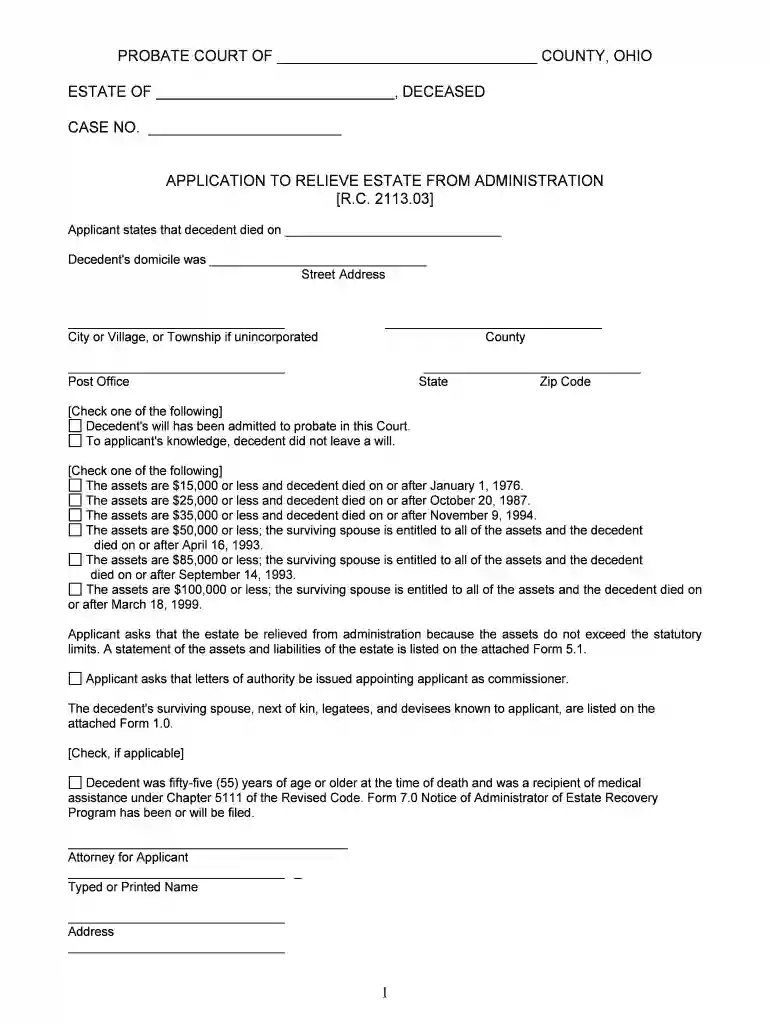
ohio estate Preview on Page 1

Here's how it works

01. Edit your ohio estate online
Type text, add images, blackout confidential details, add comments, highlights and more.

02. Sign it in a few clicks
Draw your signature, type it, upload its image, or use your mobile device as a signature pad.

03. Share your form with others
Send ohio small probate estate affidavit form via email, link, or fax. You can also download it, export it or print it out.

Definition and Meaning of the Small Estate Affidavit in Ohio

The small estate affidavit in Ohio is a legal instrument utilized to streamline the probate process for estates that fall below a certain asset threshold. This affidavit allows heirs to claim the deceased person's assets without the need for a formal probate proceeding, thereby saving time and resources. Primarily, it is used when the estate's value, minus any liens or encumbrances, does not exceed a preset limit determined by Ohio law. This process is designed to make it easier for survivors to access assets such as bank accounts, personal property, or real estate without enduring the full probate process.

Eligibility Criteria for Using the Small Estate Affidavit in Ohio

To use a small estate affidavit in Ohio, certain conditions must be met:

  • The total value of the estate, excluding specific allowances, debts, and liens, must not exceed the threshold set by Ohio state law.
  • The individual seeking to use the affidavit must be an heir, beneficiary, or someone legally qualified to manage the decedent's estate.
  • All debts, taxes, and funeral expenses should be addressed or accounted for to ensure that distributions to heirs comply with any legal obligations.
  • All interested parties, such as other heirs and creditors, must waive their rights to object to using the affidavit for estate settlement.
decoration image ratings of Dochub

Steps to Complete the Small Estate Affidavit Ohio

Completing the small estate affidavit in Ohio involves a series of procedural steps:

  1. Determine Eligibility: Verify that the estate qualifies as a small estate under Ohio law, including any calculations of the estate's total value.
  2. Gather Necessary Documents: Collect pertinent documentation related to the deceased, such as death certificates, tax records, and identification papers.
  3. Fill Out the Affidavit: Complete the affidavit form with accurate details regarding the deceased's assets, the estate's value, and the distributees.
  4. Notarize the Affidavit: Have the completed affidavit notarized by a certified notary public to ensure its legality and acceptance by financial institutions or relevant authorities.
  5. Submit the Affidavit: File the affidavit with the probate court or the relevant institution handling the transfer of assets, such as a bank, to formally commence the claim process.

Required Documents for the Small Estate Affidavit in Ohio

When preparing to file a small estate affidavit, ensure that you gather the following documents:

  • A certified copy of the death certificate
  • The original small estate affidavit, completed and notarized
  • Proof of relationship to the decedent, such as a will, birth certificate, or marriage certificate
  • Detailed list of assets and their values
  • Waiver forms signed by other potential heirs or beneficiaries acknowledging the affidavit process
  • Any documents related to outstanding debts, liens, or claims against the estate

Legal Use of the Small Estate Affidavit in Ohio

In Ohio, the small estate affidavit serves several legal purposes beyond simplifying asset transfer. It helps facilitate the resolution of straightforward estates, ensuring a more expedited transition of property to rightful heirs. By bypassing full probate, it reduces the legal costs and delays commonly associated with probate court. The affidavit also provides a mechanism to settle estates in a manner consistent with Ohio state laws, protecting the rights of all stakeholders involved.

Important Terms Related to the Small Estate Affidavit Ohio

Understanding key terms associated with the small estate affidavit can be crucial:

  • Affidavit: A written statement confirmed by oath or affirmation, used as evidence in court.
  • Probate: The judicial process through which a will is proven valid or invalid.
  • Decedent: The person who has passed away, leaving behind an estate.
  • Heirs: Individuals entitled to inherit property upon the death of another person.
  • Liens and Encumbrances: Legal claims or holds on an estate property due to debts.
  • Intestate: The state of dying without a legal will.

State-Specific Rules for the Small Estate Affidavit Ohio

Ohio law stipulates specific guidelines for small estate affidavits:

  • The threshold for an estate's value changes periodically, so it's essential to consult current statutes or seek legal advice to confirm eligibility.
  • If minors are beneficiaries, additional court approvals may be needed to protect their rights.
  • Unlike some states, Ohio requires that all debts, taxes, and funeral expenses be resolved before distributing assets through a small estate affidavit.

Why Individuals Should Use the Small Estate Affidavit in Ohio

Utilizing a small estate affidavit in Ohio offers numerous benefits:

  • Expedites Estate Settlement: This process allows heirs to access the decedent's assets faster than traditional probate.
  • Cost-Effective: It minimizes legal fees and court costs associated with more involved probate proceedings.
  • Simplifies Legal Procedures: Tailored for those who might find formal probate complex, particularly during a time of mourning.
  • Protects Interests: Provides a legal structure for asset distribution that adheres to Ohio statutes, ensuring that all parties' rights are respected.

These insights offer a comprehensive understanding of the small estate affidavit in Ohio, elucidating its purpose, processes, and the scenarios in which it is employed.

be ready to get more

Complete this form in 5 minutes or less

Get form

Got questions?

We have answers to the most popular questions from our customers. If you can't find an answer to your question, please contact us.
Contact us
Although affidavits are considered legal documents, anyone can draft one. As long as it is signed, witnessed, and docHubd correctly, the affidavit will be valid. This means that you do not need to ask a lawyer to create an affidavit.
Of course, you should always be prepared to consult your estate planning attorney if matters are complicated. Otherwise, most individuals can complete their small estate affidavit on their own.
A Small Estate Affidavit is a legal form used to manage and distribute a deceased persons estate without going through long court processes. It works best when the total value of the estate falls below a certain limit set by state law.
Complete the affidavit: Fill out the form with the decedents information, a list of their assets and the names and addresses of all heirs or beneficiaries. docHub the affidavit: Sign the completed affidavit in front of a notary public. Some states might also require additional witnesses.
Who Can Complete a Small Estate Affidavit Form? A spouse. A domestic partner. Children, or legal guardian of minor children. Parent of the decedent, if the decedent does not have a spouse.

Security and compliance

At DocHub, your data security is our priority. We follow HIPAA, SOC2, GDPR, and other standards, so you can work on your documents with confidence.

Learn more
ccpa2
pci-dss
gdpr-compliance
hipaa
soc-compliance
be ready to get more

Complete this form in 5 minutes or less

Get form