






Definition & Meaning
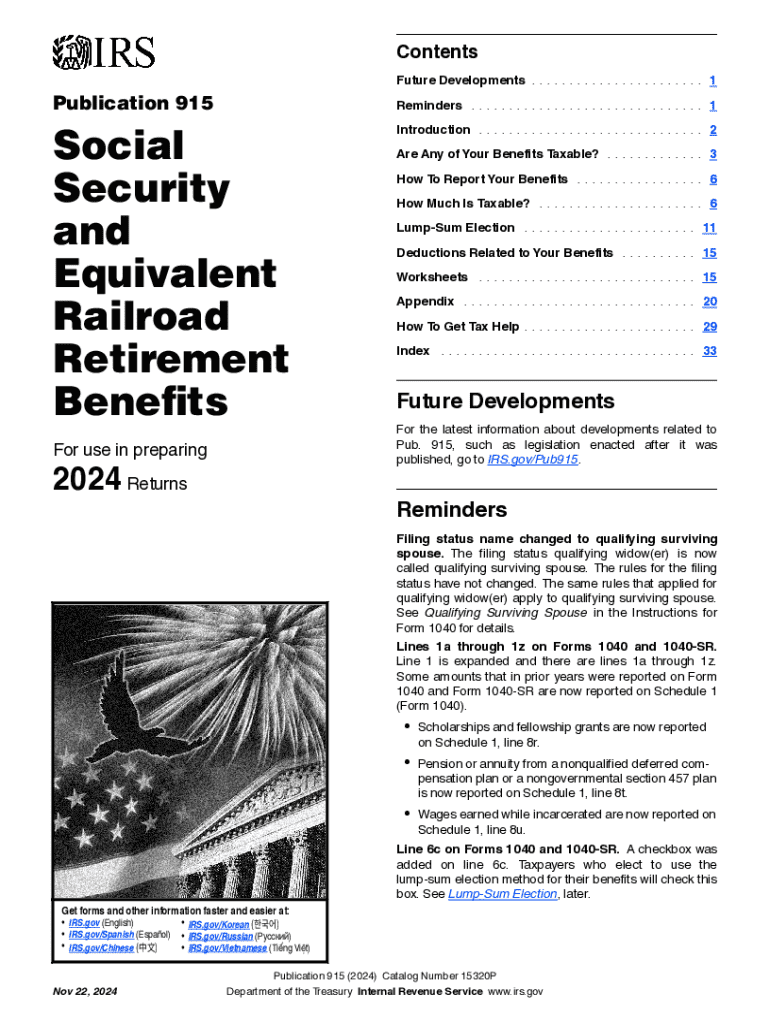
"2024 Publication 915" refers to an IRS document that provides guidelines on the federal income tax rules concerning social security benefits and equivalent railroad retirement benefits. It helps individuals understand if their benefits are taxable by explaining criteria and offering worksheets for calculating taxable amounts. This publication is pivotal for taxpayers as it incorporates updates in tax law and filing requirements specific to the 2024 tax year. Key topics include income thresholds, reporting requirements, and nuances related to lump-sum payments.
Nuances and Background
- Income Thresholds: The page defines income levels that determine benefit taxation.
- Benefit Types: It distinguishes between social security benefits and railroad retirement benefits.
- Updates: Includes notable changes in tax laws for the year to ensure compliance.
How to Use the 2024 Publication 915
Efficient usage of Publication 915 begins with understanding its practical purpose. Primarily, it guides taxpayers through the process of determining how much of their benefits are taxable.
Step-by-Step Usage Guide
- Identify Taxable Benefits: Begin by reviewing the benefit criteria outlined in the publication.
- Use Provided Worksheets: Complete the worksheets to calculate taxable amounts accurately.
- Consider Lump-Sum Payments: If applicable, follow the instructions on handling lump-sum payments.
- Refer to Examples: Utilize examples to compare scenarios and clarify complex sections.
Steps to Complete the 2024 Publication 915
Completing the requirements within Publication 915 isn't about filing the form but ensuring all necessary steps are taken for accurate taxation.
Detailed Process
- Gather Necessary Documents: Include forms like SSA-1099 and RRB-1099.
- Estimate Provisional Income: Follow instructions to calculate provisional income using available examples.
- Calculate Taxable Part of Benefits: Use worksheets to assess which portions of benefits are taxable.
- Finalize Reporting: Ensure all calculations are neatly documented for tax return attachments.
IRS Guidelines
The IRS provides an array of guidelines within Publication 915 to facilitate proper reporting and compliance.
Key Aspects of IRS Guidelines
- Income Calculation Rules: Specific instructions on counting various income types.
- Tax Bracket Implications: Information on how tax brackets affect benefit taxation.
- Compliance Requirements: Requirements for fitting into filing categories and ensuring you're following current rules.
Filing Deadlines / Important Dates
Deadlines are critical for taxpayers who rely on Publication 915 to file accurate returns.
Major Deadlines for 2024
- January: Start organizing documents and understanding any changes introduced in 2024.
- April 15: Federal income tax return deadline. Ensure calculations are complete.
- October 15: Final deadline for extended tax returns if an extension was filed.
Required Documents
To fully utilize 2024 Publication 915, certain documents must be on hand to support the process of calculating taxes on benefits.
Essential Documents
- SSA-1099: Social Security Benefit Statement.
- RRB-1099: Equivalent statement for railroad retirement benefits.
- Form 1099-INT: For any taxable interest received.
Legal Use of the 2024 Publication 915
Ensuring compliance while using Publication 915 is essential for legal adherence to IRS regulations. The document acts as an instructional guide rather than a form that needs filing.
Adherence Practices
- Accurate Reporting: Report all relevant benefit incomes based on worksheet analysis.
- Understanding Deductions: Familiarize yourself with deductions applicable as per IRS guidelines.
- Audit Preparedness: Document calculations comprehensively to prepare for potential audits or inquiries.
Examples of Using the 2024 Publication 915
Providing examples can clarify complex situations taxpayers might face.
Real-world Scenarios
- Retiree with Multiple Incomes: Breakdown of how combined payments affect taxable benefits.
- Lump-Sum Receivers: Detailed depiction of benefit inclusion rules over multiple years for lump-sum payments.
- Comparison of Tax Brackets: Examples show the impact on taxation as income thresholds change.
Each block delves into essential information that aligns with Publication 915's purpose of guiding taxpayers through social security and railroad retirement benefit taxation for 2024. With varied headings and expanded content, these blocks offer comprehensive insights crucial for understanding and utilizing this publication effectively.