
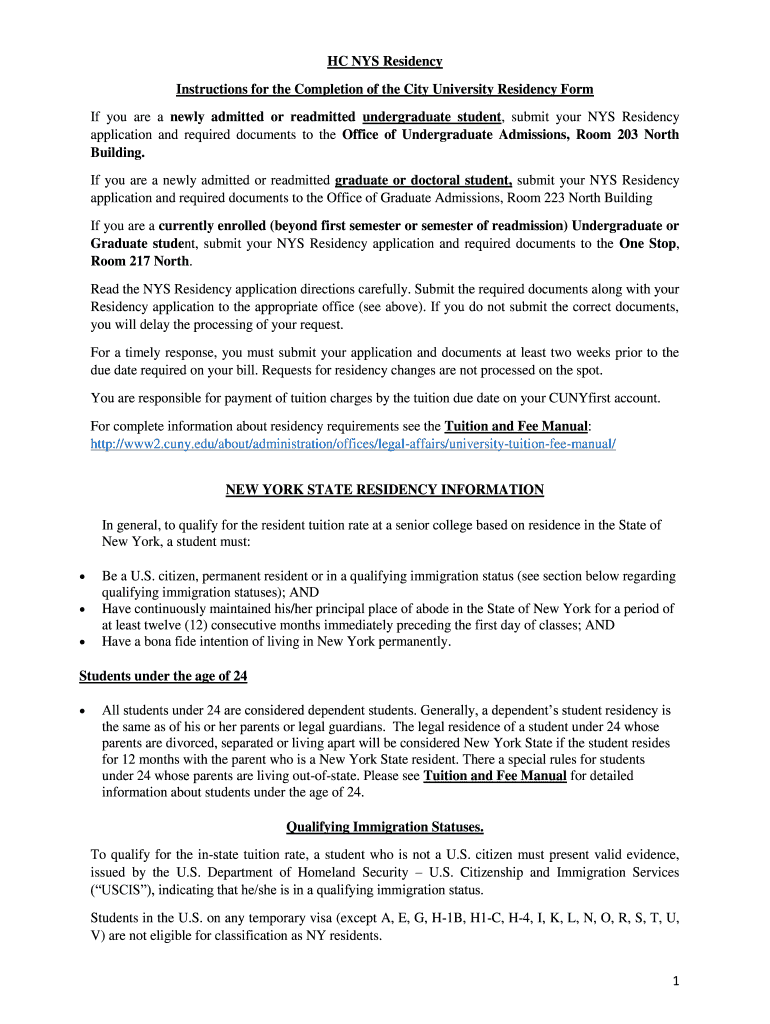







Definition and Meaning of HC NYS Residency
The HC NYS Residency form assesses an individual's eligibility for New York State residency status, particularly within the context of educational institutions like the City University of New York (CUNY). It determines if students qualify for in-state tuition rates based on their residency status. Understanding this form involves recognizing its role in documentation and verification of residency, which is essential for cost reduction in tuition fees.
Steps to Complete the HC NYS Residency
-
Gathering Required Documentation: Begin by collecting all necessary supporting documents such as proof of domicile, tax returns, or immigration status. Each document must align with the residency requirements outlined by the institution and New York State.
-
Filling Out the Form: Carefully fill out each section of the HC NYS Residency form, ensuring accuracy in details such as personal information, residency history, and any claims of financial independence or dependency.
-
Submission: Submit the completed form and all accompanying documents before any specified deadlines to avoid processing delays. Forms can often be submitted online, by mail, or in person, depending on the institution's procedures.
-
Residency Status Review: Once submitted, the residency status will be evaluated. This process might include a review of documentation to confirm residency status.
-
Appeals Process: If residency status is denied, there is typically an appeals process that applicants can follow to contest the decision.
Required Documents for HC NYS Residency
- Proof of Domicile: Includes utility bills, lease agreements, or property deeds displaying your New York address over a specified period.
- Tax Returns: Often needed to establish financial residency within the state, particularly for independent students.
- Immigration Documents: For non-citizens, proper immigration documents must be provided to verify status.
- High School Diploma or Transcripts: Often required to corroborate residency claims if obtained within New York State.
Eligibility Criteria for HC NYS Residency
- Duration of Residency: Typically, students must have resided in New York State for at least 12 months prior to the start of the term.
- Primary Residency: The applicant’s permanent home must be within New York State.
- Financial Independence: Independent students must demonstrate financial self-sufficiency through tax returns or other financial documents.
- Special Circumstances: Individuals with unique situations like refugees or active military personnel might have different eligibility criteria.


State-Specific Rules for HC NYS Residency
While the general principles of determining residency for educational purposes are consistent, certain nuances exist within New York State regulations, such as the emphasis on financial independence, the impact of parents' residency status on dependent students, and the significance of immigration status or ongoing legal proceedings, like asylum seekers.
Form Submission Methods
- Online Submission: Many institutions allow for an easy-to-use online submission portal where students can upload their forms and documents digitally.
- Mail Submission: Forms and documents can be mailed directly to the institution's admissions or registrar office.
- In-Person Submission: Directly submit at the university’s administrative office, which may offer immediate confirmation of receipt.
Penalties for Non-Compliance
Non-compliance with residency requirements can result in significant financial implications, such as being charged non-resident tuition rates. Failure to submit the correct documentation or adhere to deadlines might also lead to delays in processing or rejection of tuition status adjustments.
Legal Use of the HC NYS Residency
The legal framework governing the HC NYS Residency form is primarily intended for educational institutions within New York State, such as CUNY. It ensures that only those meeting specific legal and residency criteria benefit from state-supported tuition rates. Adherence to these regulations is critical to maintain eligibility and avoid penalties associated with misrepresentation or fraud.




