




01. Edit your form online
Type text, add images, blackout confidential details, add comments, highlights and more.

Type text, add images, blackout confidential details, add comments, highlights and more.

Draw your signature, type it, upload its image, or use your mobile device as a signature pad.

Send it via email, link, or fax. You can also download it, export it or print it out.
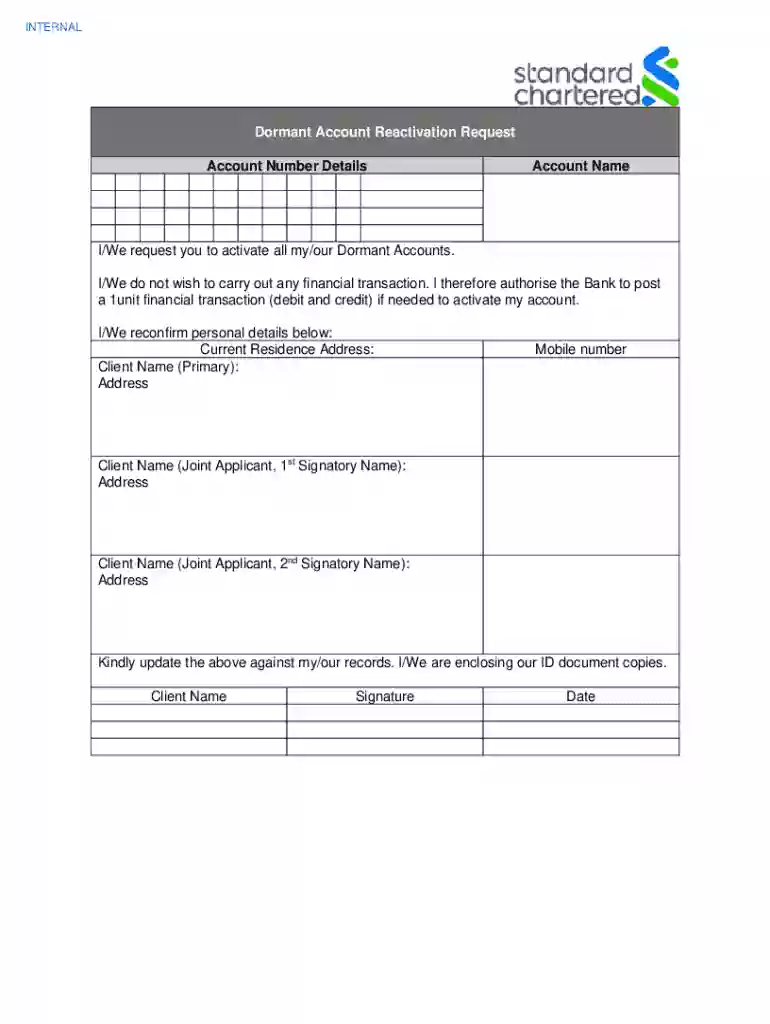
A "Request For Re-Activation of A Dormant Account: Branch" is a formal application utilized by account holders to restart the operations of an inactive or dormant bank account. Dormant accounts typically arise from a period of inactivity — often defined by banks as a year or more without any transactions. This process involves the account holder providing specific authorization for the bank to perform a minimal financial transaction, which can help bring the account back to active status. This type of request ensures that the account holder’s personal information is up to date with the bank’s records, facilitating secure and accessible banking services.
To effectively use this form, account holders need to adhere to a few procedural steps:
Obtain the Form: The form can usually be acquired directly from the bank where the dormant account is held. Many banks offer digital versions that can be filled out online or downloaded for printing.
Provide Personal Information: Applicants must accurately fill in their personal details, such as full name, account number, and contact information. This information is crucial for the bank to verify the account holder's identity.
Authorization of Transaction: The account holder should explicitly authorize a minimal transaction — often a deposit or withdrawal — to facilitate reactivation. This action is crucial as it indicates consent for movement of funds.
Submit the Form: The completed form, often along with any required identification documents, should be submitted to the bank. Submissions can typically be made online, by mail, or in person at a branch.
Completing this form involves several detailed steps, ensuring all necessary information is provided:
Gather Necessary Information: Before filling out the form, collect your account details, such as the account number and any previous correspondence regarding the account status.
Complete Personal Details Section: Enter all required personal information, making sure there are no errors that could delay processing.
Specify the Dormant Account: Clearly indicate the dormant account needing reactivation. This may involve inputting specific details that differentiate it from other accounts.
Authorize the Transaction: Formally authorize a minimal transaction on the form as part of the reactivation process. Specify the type and amount (e.g., a $1 transaction).
Sign and Date the Form: Ensure that the form is signed and dated, confirming the account holder's approval and understanding of the form’s terms.
Attach Required Documents: Depending on the bank’s policy, you may need to attach a copy of your identification or other documentation.
Submit the Request: Follow the submission guidelines as specified by the bank, choosing either an online, mail, or in-person submission.
Several terms are integral to understanding this process:
Dormant Account: An account that has had no financial activity for a set period, often triggering the need for reactivation.
Minimal Transaction: A small financial action such as a deposit or withdrawal required to reactivate the account.
Authorization: The account holder’s formal consent permitting the bank to perform a transaction on their behalf.
Submission: The process of formally presenting the completed form and any required documents to the bank.
Legally, this request is designed to safeguard both the bank and the account holder. Reactivating a dormant account ensures:
Updated Records: Account holder details are current, minimizing fraud risk.
Compliance: Adherence to legal and regulatory requirements which mandate keeping financial records active and accurate.
Consent: Banks obtain documented consent from the account holder for all transactions, which is fundamental for legal protection against unauthorized account access.
The form is composed of several crucial sections:
Personal Information Section: Collects the account holder’s details for verification purposes.
Account Details: Identifies the specific dormant account to separate it from other active accounts.
Authorization Statement: Section where the account holder authorizes a transaction.
Signatures: Confirms the account holder’s identity and consent.
Banks typically require additional documentation to process this request, including:
Identification Proof: Government-issued ID such as a passport or driver's license.
Account Documentation: May include previous account statements or correspondence that can aid verification.
Additional Bank-Specific Forms: Some banks may have supplementary forms or affidavits that need to be filled out.
Different methods available for submission provide flexibility to account holders:
Online: Digital submission through the bank’s portal is convenient and quick.
Mail: Physical mailing of the form and documents is an option for those who prefer paper submissions.
In-Person: Direct submission at a branch allows for real-time verification and confirmation with a bank official.
We've got more versions of the Request For Re-Activation of A Dormant Account: Branch form. Select the right Request For Re-Activation of A Dormant Account: Branch version from the list and start editing it straight away!
At DocHub, your data security is our priority. We follow HIPAA, SOC2, GDPR, and other standards, so you can work on your documents with confidence.


To reactivate, give the bank a written request and update your KYC at any branch or by V-CIP video call. It is free, within three working days.
Dec 14, 2020 You can start by DocHubing out to the institution and asking whether they have an account in your name or in the name of the person who owns or


