







Definition & Meaning
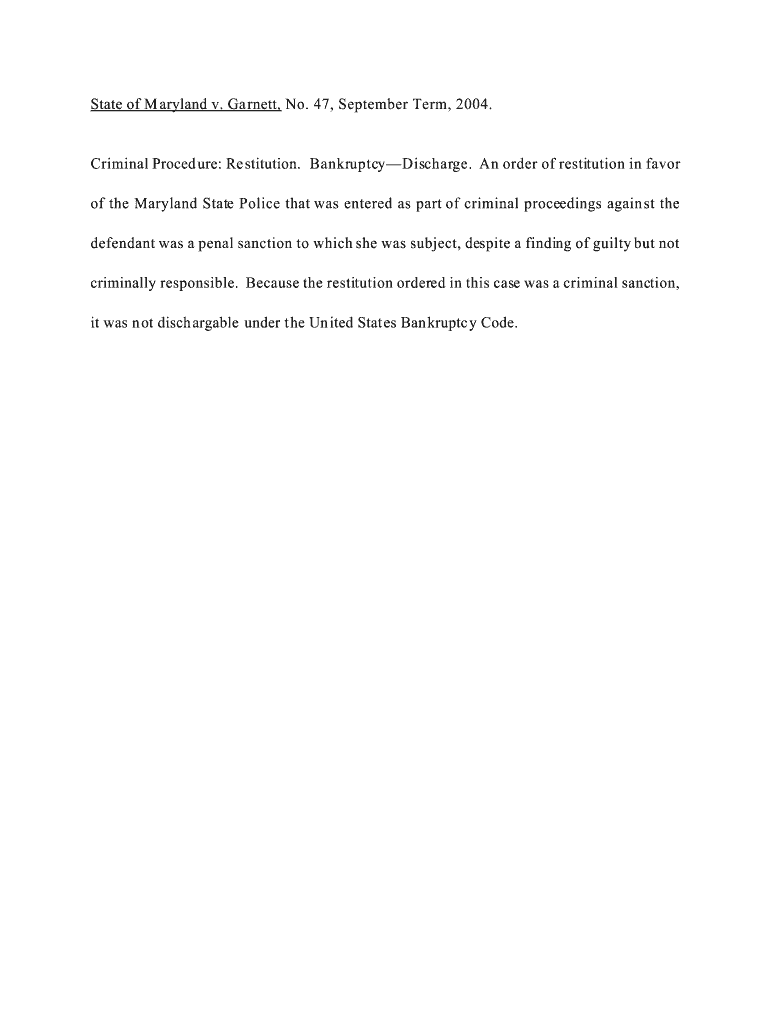
The case of "State of Maryland v. Garnett, No 47, September - Maryland Courts" addresses the question of whether a restitution order issued as part of criminal proceedings is dischargeable in bankruptcy. In this context, restitution refers to the obligation of an individual found guilty to compensate for loss or damage. The court ruled that such restitution is a penal sanction, aligning it with criminal penalties, thus not dischargeable under the Bankruptcy Code. This decision highlights the dual nature of restitution, serving both punitive and rehabilitative purposes, distinct from civil remedies.
Key Elements of the State of Maryland v Garnett, No 47, September - Maryland Courts
The ruling in the Garnett case delineates key legal concepts: the nature of restitution as a penal sanction and its implications for bankruptcy proceedings. The court's decision underscores the importance of understanding restitution beyond a mere financial compensation mechanism. It emphasizes restitution's integral role in the justice system as a punitive measure designed to hold offenders accountable and facilitate rehabilitation. This understanding is crucial for legal practitioners dealing with criminal and bankruptcy law.
Legal Use of the State of Maryland v Garnett, No 47, September - Maryland Courts
The Garnett decision serves as a significant precedent in Maryland and potentially influences similar cases across the United States. Legal professionals can reference this case to argue the non-dischargeability of restitution in bankruptcy filings. By establishing restitution as a criminal penalty rather than a civil obligation, the ruling reinforces its non-negotiable status in bankruptcy courts. It provides a legal framework for attorneys navigating the complexities of criminal justice, bankruptcy law, and financial restitution.
Important Terms Related to State of Maryland v Garnett, No 47, September - Maryland Courts
Understanding key legal terms is essential for comprehending the implications of the Garnett case. Important terms include "restitution," "penal sanction," and "dischargeable" as defined by the Bankruptcy Code. "Restitution" in this context is a court-ordered sum paid by offenders as part of their sentence. A "penal sanction" refers to punishments imposed by the court to enforce legal standards and rehabilitation. The term "dischargeable" pertains to debts that can be eliminated in bankruptcy proceedings, which does not include restitution based on this ruling.
Restitution vs. Civil Remedies
The Garnett ruling draws a clear distinction between restitution as a penal sanction and typical civil remedies. Civil remedies aim to compensate victims for their losses and are dischargeable in bankruptcy proceedings. In contrast, restitution in a criminal context is punitive and rehabilitative, imposing accountability beyond mere financial liability.
State-Specific Rules for the State of Maryland v Garnett, No 47, September - Maryland Courts
While the Garnett case is a Maryland ruling, its principles can resonate beyond state lines, especially in jurisdictions with similar legal interpretations. However, state-specific rules and interpretations may vary, which affects how restitution is applied and enforced. Legal professionals should consult local statutes and case law to determine how closely their state laws align with the Garnett ruling's principles, especially when handling cross-jurisdictional cases.
Examples of Using the State of Maryland v Garnett, No 47, September - Maryland Courts
The application of Garnett in legal practice can be illustrated through various scenarios. For example, defense attorneys may invoke the ruling to argue for discharge strategies in bankruptcy cases that mistakenly include restitution. Prosecutors may use the case to support motions ensuring that restitution remains unaltered in bankruptcy proceedings. In both scenarios, Garnett serves as a pivotal reference point for articulating arguments around the penal nature of restitution.
Steps to Complete the State of Maryland v Garnett, No 47, September - Maryland Courts Process
-
Identify applicable cases: Compare your case criteria with the principles established in Garnett to determine relevant applicability.
-
Analyze restitution orders: Examine the language and basis of the restitution orders to verify if they fall under penal sanctions.
-
Consult legal precedents: Review similar case outcomes to support your stance on non-dischargeability in bankruptcy.
-
Prepare legal documentation: Assemble the necessary documentation citing Garnett as a precedent for penal sanction reasoning.
-
Present arguments: Articulate your position clearly in court proceedings, referencing Garnett's rulings.
-
Monitor outcomes: Continuously track related case law to adapt your strategies as necessary.
Who Typically Uses the State of Maryland v Garnett, No 47, September - Maryland Courts
The Garnett ruling is of particular interest to legal professionals, including defense attorneys, prosecutors, and bankruptcy lawyers. It is also relevant for defendants facing restitution as part of their sentencing. Legal scholars and students may analyze this case for its implications in the broader context of criminal justice and bankruptcy law. Understanding the impact of the Garnett ruling aids these stakeholders in navigating legal challenges related to restitution orders.


Penalties for Non-Compliance
Non-compliance with restitution orders, as outlined in the Garnett ruling, could result in significant legal consequences. Courts may impose additional penalties, including extended probation, additional charges, or even incarceration, depending on the severity of the case. Compliance with restitution orders ensures that offenders remain within the bounds of their legal obligations, aligning with both punitive and rehabilitative objectives as stressed by the Garnett decision.




