







Definition & Meaning
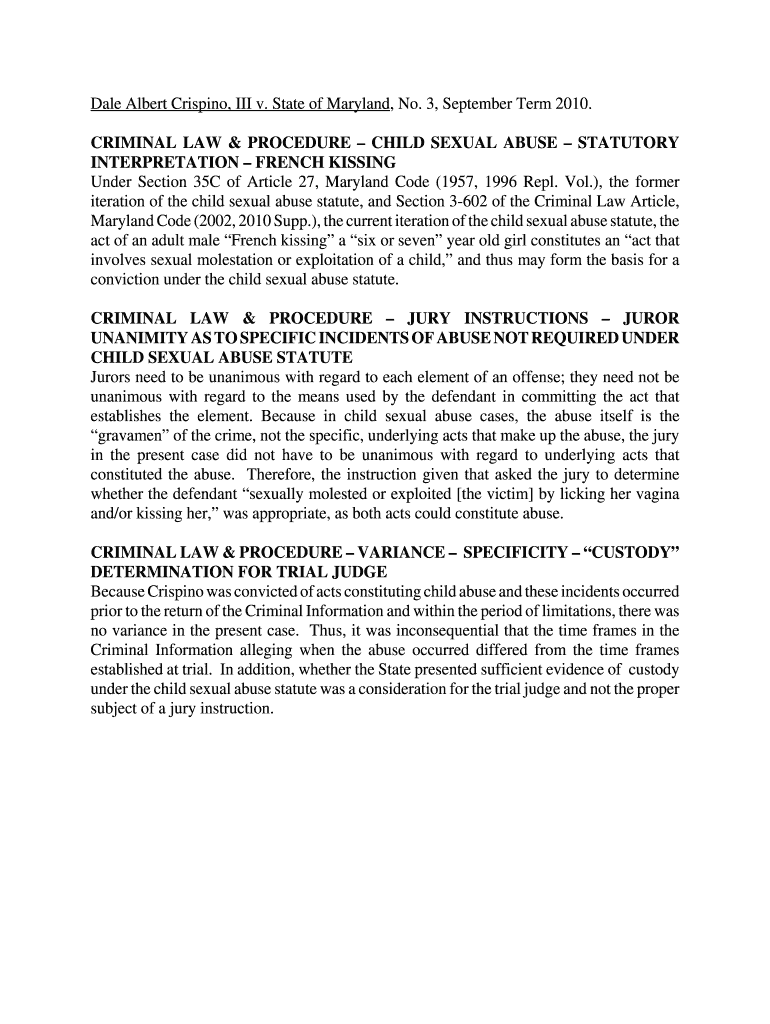
The case "Dale Albert Crispino, III v State of Maryland, No 3 - Maryland Courts" involves a legal dispute centered on the conviction of Dale Albert Crispino, III for child sexual abuse. Under Maryland's child abuse statute, the court ruled that acts such as 'French kissing' a minor qualify as sexual molestation. This case further clarifies the application of Maryland law regarding what constitutes abuse.
Important Terms Related to the Case
Understanding key legal terms in the context of this case is crucial:
- Child Sexual Abuse: An illegal act involving a minor for sexual purposes. The case expands the definition to include non-traditional abuse acts.
- Sexual Molestation: Specifically refers to unwanted or inappropriate sexual actions directed towards a minor.
- Unanimity: In this context, it refers to the jury's agreement on the act of abuse without needing consensus on the specific actions performed.
Legal Use of the Case
This case serves as a precedent for future legal interpretations of the child abuse statute within Maryland. It highlights:
- The broad interpretation of sexual molestation under current laws.
- The jury's ability to convict based on the overall act of abuse rather than specific individual acts.
Key Elements of the Case
The case's significance lies in several elements:
- The court's affirmation that varied abusive actions individually need not be agreed upon by jurors.
- The stance that precise time frames for the occurrence of abuse acts, as detailed in charges, are not essential for a conviction.
- The adherence to child protection principles, reinforcing stringent interpretations of what involves molestation.
Who Typically Uses This Case
This case is often utilized by:
- Legal professionals specializing in child abuse and family law.
- Maryland state prosecutors as a reference point in similar cases.
- Academic researchers analyzing statutory law enforcement in child protection.
State-Specific Rules for Maryland
Maryland's statutory framework plays a crucial role:
- The state's child abuse laws are interpreted to offer maximum protection against a wide range of abusive acts.
- Maryland emphasizes the importance of considering the welfare of minors by allowing broader definitions within custody and criminal proceedings.
How to Obtain Court Records for the Case
Accessing detailed court records for this case involves:
- Visiting Maryland state judiciary websites or physical court locations.
- Requesting records by specifying the case number for streamlined processing.
- Exploring online databases offering archives of legal rulings under Maryland law.
Steps to Complete Document Submission for Related Cases
Following similar legal processes requires submitting documentation efficiently:
- Compile relevant documents, including affidavit, witness testimonies, or additional evidence.
- Ensure accuracy by cross-referencing case numbers or parties involved.
- Submit through approved methods such as online portals or direct mail to the appropriate court address.
Examples of Using This Case in Legal Practice
Legal professionals may reference this case when:
- Arguing in court for child abuse prosecution, using precedence set here to interpret molestation.
- Discussing nuances where precise timing of events is not fundamental to verdicts, aligning with the larger verdict principles in Maryland.
- Training law students and fresh legal practitioners on Maryland’s expansive legal definitions concerning child welfare.




