







Definition and Meaning
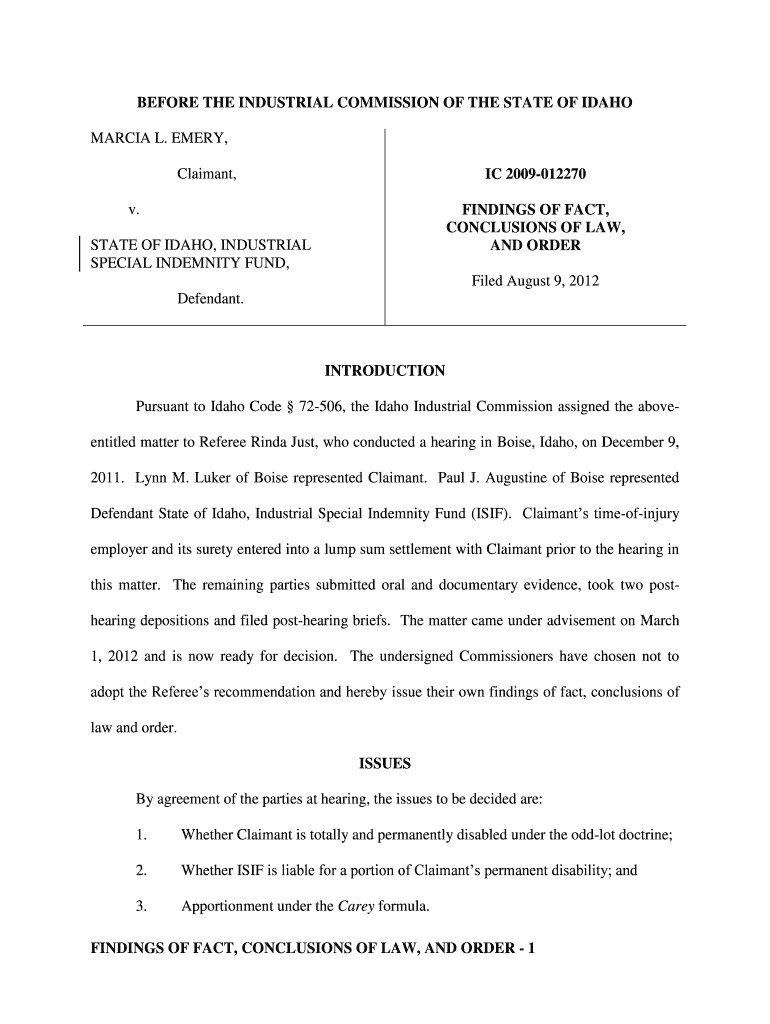
The legal case "Emery v State of Idaho, Industrial Special Indemnity - the Idaho - iic idaho" refers to the ruling by the Idaho Industrial Commission regarding Marcia L. Emery's claim for total and permanent disability benefits. Emery, injured in a workplace accident, claimed that her disability fell under the 'odd-lot' category, which suggests that her limitations prevent her from obtaining suitable employment. The Commission ultimately decided that although Emery is deemed totally and permanently disabled, the State of Idaho's Industrial Special Indemnity Fund (ISIF) is not responsible for her benefits. This decision rests on the finding that her pre-existing health conditions sufficiently account for her inability to work, thus releasing ISIF from liability.
How to Use the Ruling
Understanding and using the ruling from "Emery v State of Idaho" begins with recognizing its implications for similar disability claims.
-
Claim Evaluation: Legal professionals can use this case as a benchmark when evaluating disability claims involving pre-existing conditions.
-
Legal Arguments: Attorneys might reference this ruling when building a case involving similar circumstances to highlight the role of pre-existing conditions in determining liability.
-
Precedent: The ruling serves as a precedent in Idaho for cases involving the ISIF and the determination of liability for workplace injuries complicated by pre-existing conditions.
Key Elements of the Case
A few crucial elements define the "Emery v State of Idaho" case:
- Total and Permanent Disability: The designation of Emery as an 'odd-lot worker' highlights her inability to secure employment due to her disability.
- Pre-existing Conditions: The focus on Emery's pre-existing conditions played a pivotal role in absolving the ISIF from liability.
- Industrial Special Indemnity Fund: Established to manage claims where an injury combines with pre-existing conditions, the ISIF's non-liability in this case sets an important precedent.
Who Typically Uses the Ruling
The primary users of the "Emery v State of Idaho" ruling include:
- Legal Professionals: Attorneys and legal scholars researching case law on disability and indemnity fund claims.
- Insurance Companies: Evaluating potential liabilities and claims related to workplace injuries.
- State Agencies: Officials assessing policy guidelines for disability benefits and indemnity responsibilities.


State-Specific Rules
The ruling is specific to Idaho and reflects the state's approach to cases involving the ISIF and workplace injuries.
- Idaho Worker's Compensation Laws: The case underscores the importance of these laws, particularly how they handle claims involving pre-existing conditions.
- Odd-lot Doctrine: Idaho recognizes this doctrine, impacting how total and permanent disability is assessed within the state.
Legal Use of the Ruling
The "Emery v State of Idaho" case has practical applications in legal settings:
- Case Reference: Lawyers may cite this ruling in future cases to argue points about the liability of indemnity funds.
- Policy Formation: State agencies could use the findings to help shape disability compensation policies more effectively.
Examples of Using the Ruling
Consider these scenarios illustrating how the ruling might be applied:
- Legal Defense: An attorney defending a case involving a similar fund could use this ruling as evidence that indemnity funds are not liable when pre-existing conditions are significant.
- Insurance Adjustment: Insurers might adjust their evaluation criteria for claims in light of this precedent, focusing more on the impact of pre-existing conditions.
Eligibility Criteria
To determine eligibility under similar claims:
- Evidence of Injury: Claimants must demonstrate the injury's impact on their ability to work.
- Medical History: Documentation of pre-existing conditions is critical, as it can influence liability and compensation.
- Disability Status: Establishing an odd-lot worker status is crucial for obtaining benefits under such claims.

Steps to Complete a Related Claim
- Gather Medical Documentation: Compile records detailing all health conditions, both new and pre-existing.
- File the Claim: Submit a claim to the relevant authority, including thorough documentation.
- Legal Consultation: Obtain advice to ensure compliance with state-specific rules.
- Negotiate: Work through claim negotiations, possibly using precedents like Emery’s case as a negotiating tool.
- Adjudication: Await the adjudication process, where the claim will be assessed against existing law and precedents.
Understanding and leveraging this ruling can help individuals and professionals navigate the complexities of disability claims, particularly those involving composite factors like workplace injury and prior health conditions.




