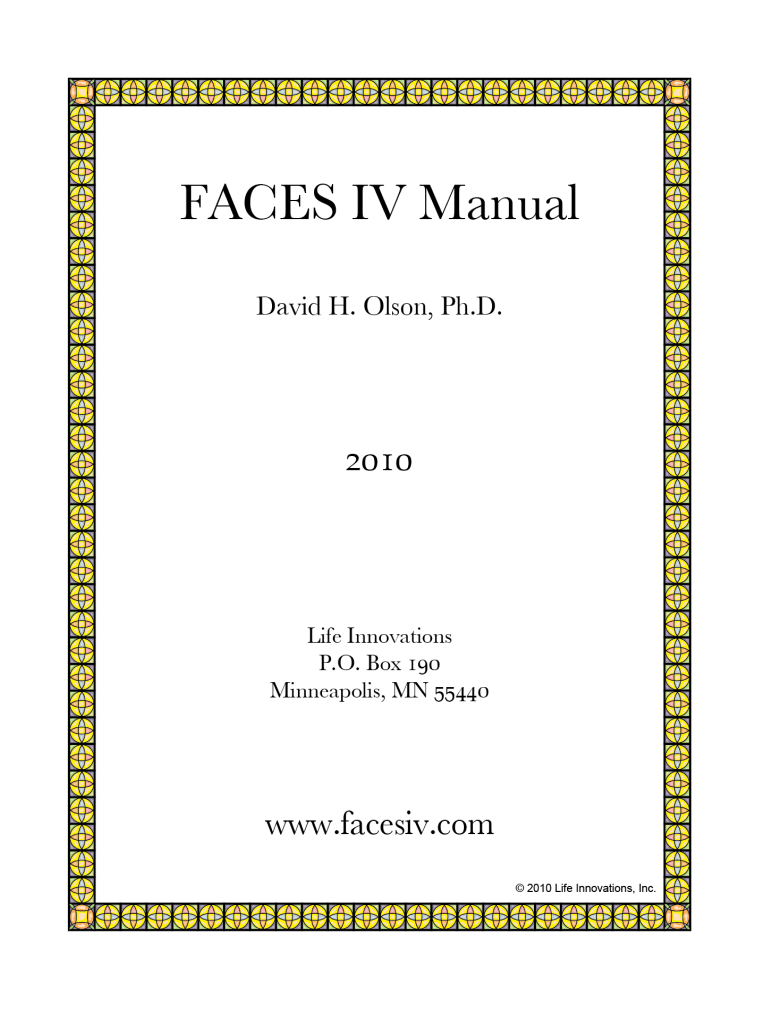





Overview of the FACES IV Manual
The FACES IV manual serves as a vital resource for understanding and applying the FACES IV assessment tool, which is pivotal for evaluating family dynamics. This tool measures two critical dimensions: family adaptability and cohesion, providing insights into family interactions through its structured framework. The manual contains essential information on the administration, scoring, and interpretation of the FACES IV questionnaire, making it an invaluable guide for clinicians, researchers, and practitioners working in family therapy and related fields.
Purpose of the FACES IV Assessment
The FACES IV assessment aims to facilitate the understanding of family functioning. By evaluating family cohesion and adaptability, professionals can identify patterns that may influence emotional and relational well-being. The assessment consists of eight scales, each addressing different aspects of family relationships.
- Cohesion Scales: These measure the emotional bonding between family members.
- Adaptability Scales: These focus on the family's ability to respond to change and maintain function amidst stress.
The data obtained from the assessment offers insights that can guide interventions and improve communication strategies within families.
Administering the FACES IV Questionnaire
Administering the FACES IV questionnaire involves several steps to ensure accurate and reliable results. The manual details the procedures to follow:
-
Preparation:
- Ensure that participants understand the purpose of the questionnaire and how the data will be used.
- Provide necessary materials and ensure a conducive environment for taking the assessment.
-
Distribution:
- The questionnaire can be distributed in various formats, including paper and digital versions. It is essential to choose a format that is most accessible for the participants.
-
Collecting Responses:
- Gather completed questionnaires carefully. For electronic versions, ensure that responses are stored securely.
Scoring the FACES IV Assessment
Scoring the FACES IV assessment requires a systematic approach as dictated by the manual. Each scale is designed to yield specific scores that reflect the family’s dynamics. The scoring procedure includes:
- Quantitative Scores: Each response is typically scored based on a defined scale, with higher scores indicating greater adaptability or cohesion.
- Interpretation of Scores: After scoring, the manual provides guidelines for interpreting the results. It includes benchmarks for understanding what specific score ranges may indicate about family functioning.
Understanding Results and Data Analysis
Interpreting the results from the FACES IV assessment entails analyzing the scored data to draw meaningful conclusions about family dynamics. The manual provides in-depth instructions on data analysis, including:
- Aggregate Scores: Understanding average scores for families as a unit.
- Individual Profile Interpretation: Assessing individual scores within the context of family cohesion and adaptability.
This analysis can help identify areas for improvement and facilitate targeted interventions based on the family's unique profile.
Permissions and Ethical Use of the FACES IV Tool
Using the FACES IV assessment in research or clinical settings requires adherence to ethical guidelines outlined in the manual. Important considerations include:
- Informed Consent: Ensure participants are informed about the assessment's purpose and use.
- Data Confidentiality: Protect participant data during both collection and storage phases.
Obtaining necessary permissions to use the tool is also crucial, especially in academic research contexts. The manual outlines the process for securing these permissions.
Strengths and Limitations of the FACES IV Assessment
While the FACES IV assessment tool is robust, understanding its strengths and limitations is essential for effective application.
-
Strengths:
- Comprehensive evaluation of family dynamics.
- Clear and structured approach facilitates reproducibility.
-
Limitations:
- Context-specific; results may vary based on cultural factors.
- May require skilled interpretation to fully leverage insights.
Applications of the FACES IV Assessment
The FACES IV assessment is used in various settings, including:
- Clinical Practice: Provides therapists with insights into family dynamics for improved therapeutic strategies.
- Research: Used in studies exploring family relations and mental health.
- Educational Settings: Assists professionals in understanding family impacts on student performance and well-being.
By utilizing the FACES IV manual and focusing on the structured assessment process it outlines, users can significantly enhance their understanding and application of the FACES IV tool in various professional contexts.