




01. Edit your form online
Type text, add images, blackout confidential details, add comments, highlights and more.

Type text, add images, blackout confidential details, add comments, highlights and more.

Draw your signature, type it, upload its image, or use your mobile device as a signature pad.

Send it via email, link, or fax. You can also download it, export it or print it out.
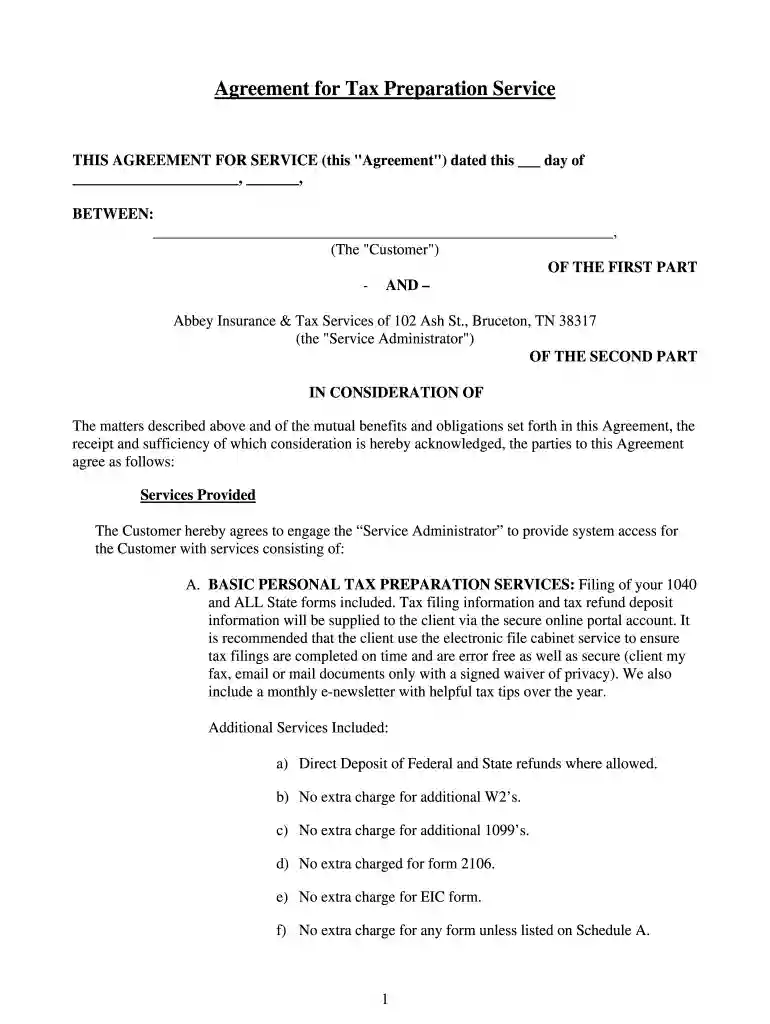
The "Agreement for Tax Preparation Service" offered by Abbey Insurance and Tax is a formal contract between the tax preparer and the client. This agreement outlines the professional relationship and the specific services that the tax firm commits to providing. It includes the preparation of basic personal tax returns and potentially handle more complex filings for sole proprietors. Both parties' responsibilities, such as fee structures, confidentiality, and the terms under which services can be terminated, are specified. This document serves as a legally binding agreement that sets clear expectations and terms to safeguard both parties' interests.
Utilizing the agreement involves several key steps to ensure that both the tax preparer and the client are aligned on service expectations. Initially, the client and tax preparer should thoroughly review the document to understand the scope of services, fees, and confidentiality provisions. This understanding avoids any miscommunication and ensures clarity. Once both parties agree, signatures should be appended to confirm their acceptance of the terms. Clients should also retain a copy for their records, which will be essential if any disputes arise regarding the scope of services or fee structures at a later date.
Review the Document Thoroughly: Both parties need to carefully read each section to comprehend what is covered and what is not, including all obligations and expectations.
Clarify Any Uncertainties: If any terms or conditions are unclear, both parties should seek clarification before signing.
Sign the Agreement: Once all parties are satisfied with the terms, the agreement should be signed electronically or manually.
Maintain a Copy: It's crucial for both the client and Abbey Insurance and Tax to keep a signed copy for future reference, aiding in resolving any potential disputes.
Completing the "Agreement for Tax Preparation Service" involves a series of systematic steps to ensure accuracy and understanding. Initially, the client must provide necessary personal and financial information, which is required for accurate tax preparation. Subsequently, both the client and the tax service must detail and agree upon the services required, the fees associated, and the payment terms. Finally, both parties should sign the agreement, ensuring that the document reflects all agreed terms and responsibilities.
Collect Required Information: Gather all necessary financial documents, including income statements, tax forms, and any previous tax records.
Detail Services and Fees: Clearly define the services to be rendered and associated costs. Both fixed and variable fees should be transparently listed.
Review Payment Terms: Agree on how and when payments should be made.
Sign and Date the Agreement: Ensure both parties sign and date the document, confirming their agreement to the outlined terms.
Distribute Copies: Provide copies of the signed agreement to all concerned parties.
The "Agreement for Tax Preparation Service" includes several crucial components designed to provide legal protection and mutual understanding between Abbey Insurance and Tax and its clients. Key elements include the scope of services, fee structures, confidentiality agreements, and dispute resolution processes. Additionally, the agreement frequently outlines obligations regarding document retention, client cooperation, and adherence to all applicable tax laws and regulations. Clear articulation of these elements provides a comprehensive framework that avoids ambiguities.
Scope of Services: Detailed list of services provided, including preparation of specific tax forms and additional advisory support.
Fee Structure: Transparent breakdown of costs associated with different services, including any additional fees for supplementary services.
Confidentiality: Terms to protect client information and details regarding how data will be managed and shared.
Dispute Resolution: Outlines methods for resolving disagreements, emphasizing mediation before legal action.
Clients will need to provide various documents to ensure proper tax preparation and compliance with the agreement's terms. These documents typically include W-2s, 1099s, previous tax returns, and other relevant records of income and expenses. In the case of business owners, additional documentation may be required, such as balance sheets and profit and loss statements. Ensuring these documents are comprehensive and accurate reduces the risk of errors and potential issues with the IRS.
Personal Identification: Includes social security cards and driver’s licenses or other ID forms.
Income Documents: Such as W-2s, 1099s, and other relevant payment records.
Expense Records: Receipts and statements pertinent to deductions and credits claimed.
Previous Tax Returns: Copies of prior year tax returns can provide context and ensure consistency.
From a legal standpoint, the "Agreement for Tax Preparation Service" must comply with federal and state regulations in the U.S., ensuring it is enforceable in court. This means including clauses that align with the ESIGN Act for electronic signatures, as well as state-specific requirements. Ensuring legal compliance prevents future disputes and reinforces the agreement's validity, serving as the foundation for a stable professional relationship.
ESIGN Act Compliance: Ensures electronic signatures are legally binding.
State-Specific Regulations: Adherence to individual state requirements that may affect the agreement’s enforceability.
Governing Law Clause: Specifies which state’s laws will govern the agreement, offering clarity if legal action is necessary.
DocHub ensures compatibility with other popular accounting and tax preparation software, making it easy for clients to manage documents seamlessly. Compatibility with tools like TurboTax and QuickBooks allows users to easily export or import financial data, maintaining consistency across all digital platforms. This ensures that users leveraging various software for different aspects of tax preparation can do so efficiently without facing data compatibility issues.
TurboTax: Often used for filing personal tax returns and compatible with import/export features of DocHub.
QuickBooks: Facilitates bookkeeping and financial tracking, supporting seamless data sharing with DocHub.
Google Workspace: Provides integration for document management, offering a centralized place to store and modify documents efficiently.
The agreement can be utilized by a broad range of taxpayers, each with unique requirements and expectations. These include individual filers, self-employed individuals, retirees, students, and small business owners. Each scenario may require different documentation, services, and communication to ensure all tax obligations are met accurately and efficiently. Understanding these variations helps Abbey Insurance and Tax tailor their services to meet diverse client needs effectively.


Self-Employed Individuals: Often have complex tax situations involving multiple income streams.
Retirees: May focus on managing withdrawals from retirement accounts and social security benefits.
Students: Primarily concerned with educational credits and deductions.
Small Business Owners: Require detailed financial statements and potentially more complex service agreements.
Understanding the terminology within the "Agreement for Tax Preparation Service" is essential for both parties. Terms such as "ESIGN Act," "confidentiality," "governing law," and "scope of services" play a pivotal role in defining the rights and responsibilities within the agreement. Interpreting these terms correctly is vital to fulfilling the contract's obligations and ensuring a smooth, professional relationship.
ESIGN Act: Federal law that ensures the legality of electronic signatures.
Confidentiality: Legal obligation to protect sensitive client information from unauthorized disclosure.
Governing Law: Legal framework determining which jurisdiction’s laws will apply.
Scope of Services: Specific duties and tasks the tax preparer will perform on behalf of the client.
At DocHub, your data security is our priority. We follow HIPAA, SOC2, GDPR, and other standards, so you can work on your documents with confidence.





The Mackinac Center for Public Policy is a right-wing pressure group based in Michigan. Founded in 1987, it is the largest state-level think tank in the
Nancyk Tax Insurance Services LLC d/b/a Nancyk Tax Insurance Services, 10740 Meridian Avenue N Suite 102. Seattle, WA 98133 206-825-2499. Pressburg TaxRead more


