






Definition & Meaning
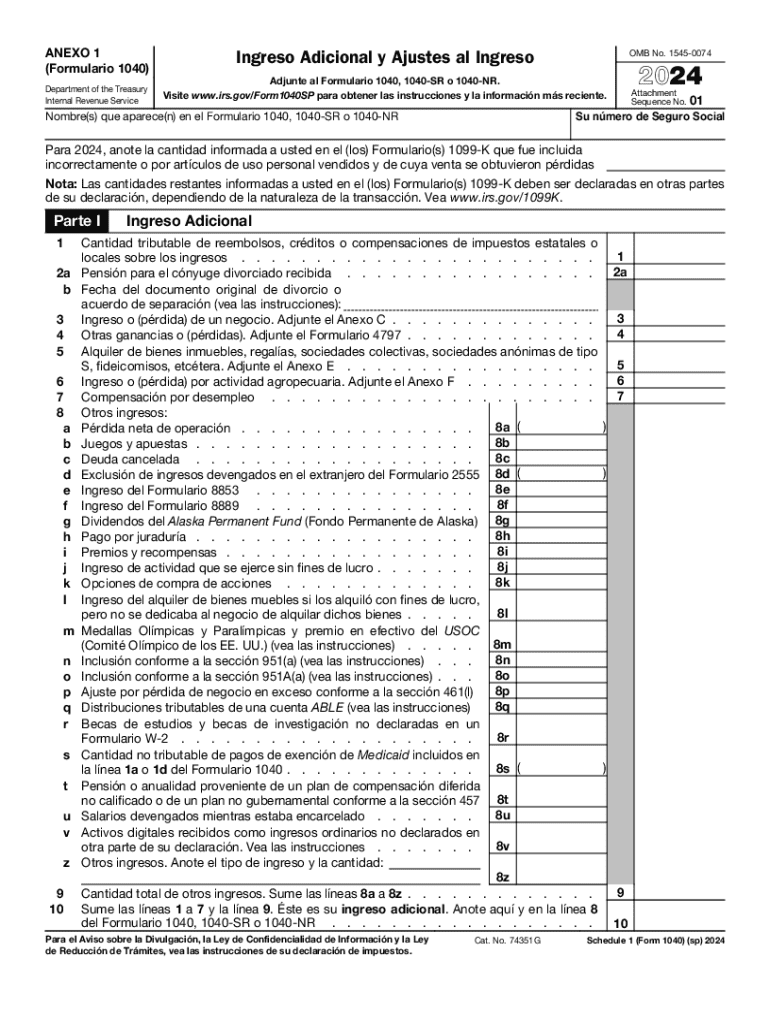
The 2024 Schedule 1 (Form 1040) (sp) Additional Income and Adjustments to Income (Spanish Version) is an IRS tax form used by individuals to report specific types of income that are not entered directly on the standard Form 1040. This form is an integral part of the tax filing process, detailing additional income such as business income, rental property income, unemployment compensation, and deductions like educator expenses and health savings account contributions. This particular version provides these instructions and fields in Spanish, making it more accessible for Spanish-speaking taxpayers in the United States.
How to Use the 2024 Schedule 1
To use the 2024 Schedule 1 effectively, taxpayers should first gather all relevant documents that report income beyond what's captured in Form 1040. Here's a guide on how to complete the form:
- Identify All Additional Income Sources: Gather documentation for any income not reported on Form 1040, such as royalties or gambling winnings.
- Input Data in the Correct Sections: Enter each type of income in its designated section on Schedule 1. For instance, line 3 is typically used for dividend income not reported on Form 1040.
- Deduct Eligible Adjustments: Utilize the latter sections to note any deductions, such as student loan interest or IRA contributions.
- Review Calculations: Ensure all figures are correctly totaled and carried over to the main 1040 Form.
- Verify Spanish Terms: If Spanish isn't your first language, verify the translation of critical terms to ensure accurate data entry.
Steps to Complete the 2024 Schedule 1
Completing the Schedule 1 involves several detailed steps, which vary depending on the type of income or adjustments reported:
- Gather Documents: Compile all necessary income documents, such as 1099 forms.
- Fill Out Income Sections:
- Report business income on line 12.
- List rental real estate income on line 17.
- Report Adjustments to Income:
- Include educator expenses on line 23.
- Document health savings account deductions on line 25.
- Calculate Totals: Summarize the income and adjustments to transfer accurately to the main Form 1040.
- Review and File: Double-check the form for any errors and ensure it is filed with the 1040.
IRS Guidelines
The IRS provides clear guidelines to ensure accurate completion of Schedule 1, including:
- Reporting Criteria: Detailed instructions for situations that necessitate Schedule 1, such as reporting unemployment compensation.
- Calculation Methods: Information on how to use other schedules or worksheets to assist in calculation tasks.
- Filing Instructions: Guidance on when and how to attach Schedule 1 to the primary tax return forms 1040, 1040-SR, or 1040-NR.
Filing Deadlines / Important Dates
Understanding the filing deadlines is crucial for form submission:
- Regular Filing Deadline: Typically, April 15th, unless it falls on a weekend or holiday, in which case it may be adjusted to the next business day.
- Extension Options: Taxpayers may file for an Automatic Extension using Form 4868, extending the deadline usually until October 15th.
Eligibility Criteria
Certain criteria dictate the need to submit Schedule 1:
- Income Type: Taxpayers earning income from self-employment, rental income, or alimony received.
- Adjustments Qualification: Individuals eligible for particular adjustments such as IRA contributions or educator expenses are required to complete this form along with 1040.


Digital vs. Paper Version
Taxpayers have options regarding how they complete and submit the form:
- Digital Filing Advantages: Offers quicker processing and verification through IRS e-file approved software.
- Paper Filing: Traditional mail submissions require careful attention to deadlines and document accuracy.
Software Compatibility
For those filing electronically, specific tax software can facilitate completing Schedule 1:
- TurboTax and QuickBooks: These platforms feature automated calculations and offer guidance to ensure sections are completed accurately.
- Integrated Methods: Software often allows direct importation of 1099 data, simplifying the entry of additional income types.