
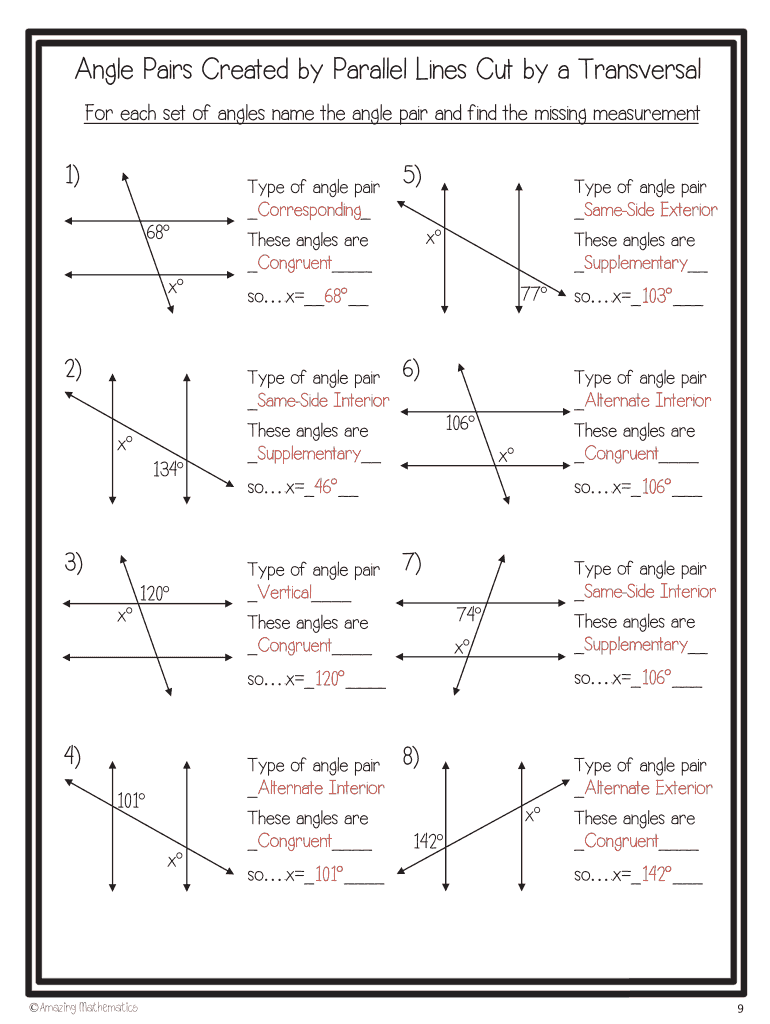







Definition and Meaning of Angle Pairs Created by Parallel Lines Cut by a Transversal
The concept of angle pairs created by parallel lines cut by a transversal is fundamental in geometry. When two parallel lines are intersected by a transversal, several angle pairs are formed. Understanding these relationships is essential for solving problems related to angles, particularly in higher-level mathematics.
Types of Angle Pairs
- Corresponding Angles: These are angles that occupy the same relative position at each intersection where a transversal crosses two lines. For example, if lines A and B are parallel, and line C is the transversal, angle one corresponds to angle five.
- Alternate Interior Angles: These angles are located between the parallel lines and on opposite sides of the transversal. They are equal in measure. For example, angles three and six in a diagram of parallel lines crossed by a transversal.
- Alternate Exterior Angles: These angles lie outside the parallel lines and are also on opposite sides of the transversal. Similar to alternate interior angles, they are equal. For example, angles two and eight.
- Same-Side Interior Angles: These are located on the same side of the transversal and between the two lines. They are supplementary, which means that their measures add up to 180 degrees. An example includes angles three and five.
- Same-Side Exterior Angles: Also supplementary, these angles are on the same side of the transversal but outside the parallel lines, such as angles one and seven.
These definitions set the stage for understanding the application of these angle relationships in solving geometrical problems.
How to Use the Angle Pairs Created by Parallel Lines Cut by a Transversal
Using angle pairs formed by parallel lines cut by a transversal involves recognizing the relationships between the angles and applying them in problem-solving scenarios. This can be particularly useful in various geometric tasks, including calculating unknown angle measures or proving that two lines are parallel.
Steps for Application
- Identify Parallel Lines: Ensure the lines are indeed parallel; this is essential for the properties of angle pairs to hold true.
- Locate the Transversal: Recognize the transversal that intersects the parallel lines, dividing them into segments with corresponding angles.
- Label the Angles: Clearly label the angles formed at the intersection points to effectively apply the angle relationships.
- Apply the Angle Relationships: Use the identified angle properties to solve for unknown angles. For instance, if you know one angle measure, you can find the corresponding, alternate interior, or same-side angles based on established relationships.
Practical Examples
Suppose line L1 is parallel to line L2, and a transversal line T intersects them creating angles. If angle one measures 70 degrees, then:
- Corresponding angle (angle five) is also 70 degrees.
- Alternate interior angle (angle four) is also 70 degrees.
- Same-side interior angle (angle three) can be calculated as 110 degrees.
Examples of Using Angle Pairs Created by Parallel Lines Cut by a Transversal
Understanding how to use angle pairs is essential for solving problems in various contexts. Below are examples demonstrating typical applications.
Example Problem
Given two parallel lines cut by a transversal, if angle seven measures 120 degrees, determine the measures of the other angles created.
- Corresponding Angle (angle three): This angle is also 120 degrees.
- Alternate Interior Angle (angle six): It also measures 120 degrees.
- Same-Side Interior Angle (angle five): Being supplementary, it measures 60 degrees (180 - 120).
- Alternate Exterior Angle (angle two): This angle is also 120 degrees.
- Same-Side Exterior Angle (angle one): This angle will measure 60 degrees.
Real-World Scenarios
Identifying angles formed by parallel lines intersected by a transversal has practical applications in construction, engineering, and design where angles need to be accurately measured and maintained.
Important Terms Related to Angle Pairs Created by Parallel Lines Cut by a Transversal
Understanding certain terminology is crucial in working with angle pairs related to parallel lines cut by a transversal. Below are some key terms.
- Transversal: A line that crosses at least two other lines.
- Complementary Angles: Two angles that add up to 90 degrees.
- Supplementary Angles: Two angles that sum up to 180 degrees.
- Angle: Formed by two rays with a common endpoint, measured in degrees.
Contextual Importance
These basic terms provide the foundation for discussing more complex geometrical concepts and enable clearer communication when forming proofs or solving problems.
Angle Relationships Worksheet Resources
Creating worksheets that involve angle pairs formed by parallel lines cut by a transversal can help reinforce understanding through practice. For educators, resources can include:
Worksheet Structure
- Problem Statements: Include diagrams where students identify angle pairs and calculate their measures.
- Answer Key: Provide solutions alongside each problem to facilitate self-study.
- Variety of Problems: Incorporate different complexity levels including simple identification, calculations, and proofs of angle relationships.
Using worksheets with structured problems helps learners to engage with the material actively, solidifying their understanding of angle relationships in practical settings.


