Definition & Purpose of the Accredited Investor Certification Letter
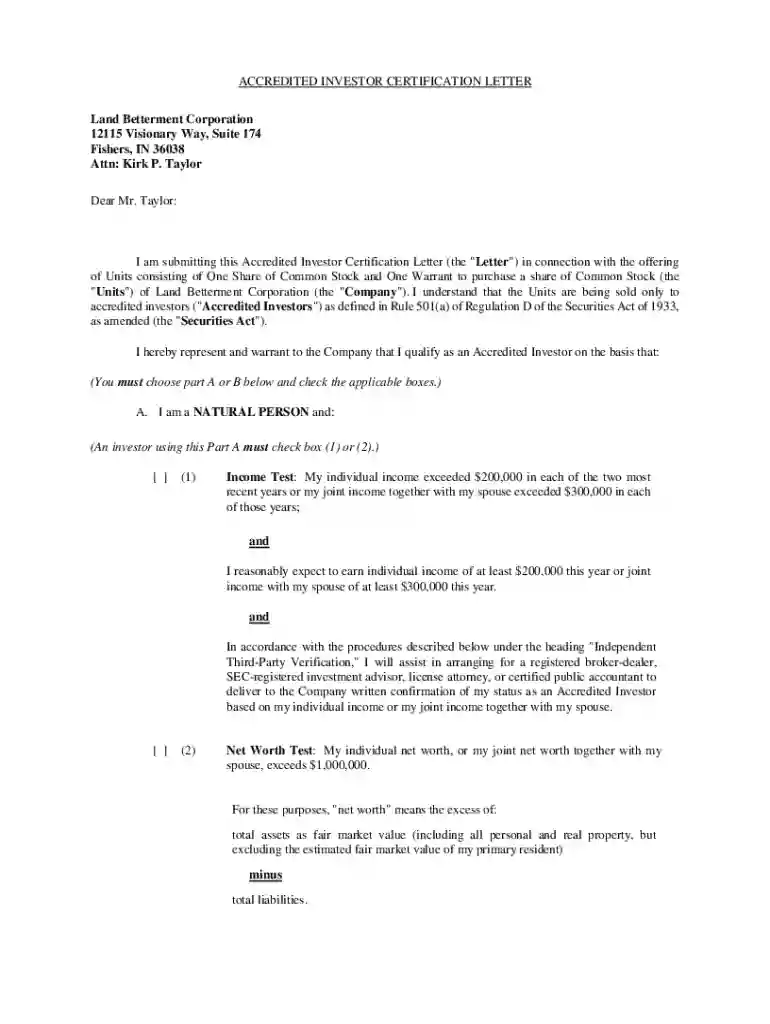
An Accredited Investor Certification Letter is a document required by individuals or entities to verify their status as accredited investors under Regulation D of the Securities Act of 1933. The letter confirms that the investor meets specific financial criteria, such as income and net worth requirements, and serves as evidence when participating in securities offerings that are not registered with the Securities and Exchange Commission (SEC). This certification is crucial for protecting less-experienced investors from high-risk investments that are often associated with unregistered securities.
Criteria for Accreditation
- Income Requirements: An individual must have an annual income exceeding $200,000 (or $300,000 combined with a spouse) in each of the past two years with the expectation of the same income level in the current year.
- Net Worth Requirements: The individual or entity must have a net worth of over $1 million, either individually or jointly with a spouse, excluding the value of their primary residence.
- Professional Experience: Individuals holding certain licenses or with defined expertise may also qualify.
How to Use the Accredited Investor Certification Letter
Upon confirming eligibility, investors use the Accredited Investor Certification Letter to demonstrate their accredited status to investment issuers. This letter is often required to participate in investment opportunities not available to non-accredited investors.
Document Submission
- Presentation: Submit the certification to investment issuers when requested. Usually, it is part of the documentation package when scrutinizing investment opportunities.
- Verification: This letter may be subject to verification by the issuer or third-party bodies to confirm the investor's eligibility.
How to Obtain the Accredited Investor Certification Letter
Investors typically acquire the Accredited Investor Certification Letter through a CPA, attorney, or financial advisor who will provide third-party verification of their qualifications.
Steps to Obtain
- Assess Eligibility: Determine whether the financial and professional criteria for accreditation are met.
- Engage a Professional: Consult with a CPA, attorney, or financial advisor to review financial statements and attest to the accredited status.
- Request Certification: The professional will prepare and provide the certification letter.
Steps to Complete the Accredited Investor Certification Letter
Completing the Accredited Investor Certification Letter involves coordinating with financial or legal professionals to ensure accurate documentation and compliance.
Completion Process
- Gather Financial Documents: Compile necessary financial statements and proof of income or net worth.
- Verification by Professional: Present documents to the verifying professional for review.
- Certification Drafting: The professional drafts the letter certifying that the investor meets the criteria.
- Review and Sign: Ensure accuracy and completeness before signing the letter.
Why Obtain an Accredited Investor Certification Letter
Having an Accredited Investor Certification Letter enables investors to access a broader range of investment opportunities, particularly in higher-risk, higher-reward markets. It serves as a gatekeeper function, maintaining legal compliance and investor protection.
Benefits
- Access to Private Investments: Opportunities in private placements, hedge funds, and venture capital.
- Potential High Returns: Often associated with sophisticated investment strategies that are not available to non-accredited investors.
- Legal Compliance: Ensures conformity with securities regulations, reducing liability for investors and issuers.
Who Typically Uses the Accredited Investor Certification Letter
The Accredited Investor Certification Letter is utilized by individuals, trusts, partnerships, and corporations that meet the prescribed financial criteria and are looking to invest in unregistered securities.

Common Users
- Individuals: High net worth individuals seeking diversified investment portfolios.
- Business Entities: Entities with sufficient financial resources, such as corporations and partnerships, engaging in strategic investments.
- Institutional Investors: Despite usually being accredited by default, they may still require certification for certain transactions.
Important Terms Related to the Accredited Investor Certification Letter
Understanding the terminology surrounding the Accredited Investor Certification Letter is vital for compliance and informed decision-making in investment scenarios.
Key Terms
- Regulation D: SEC regulation that provides exemptions allowing sale of unregistered securities.
- Third-Party Verification: Independent assessment by an external professional confirming investor status.
- Indemnity Clauses: Provisions that protect the issuer from misinformation or errors in the certification process.
Legal Use of the Accredited Investor Certification Letter
The Accredited Investor Certification Letter serves as legal documentation that verifies the investor's eligibility to participate in certain financial transactions and securities offerings.
Compliance Requirements
- Adherence to SEC Regulations: Ensures transactions meet legal standards to protect investors and maintain market integrity.
- Supporting Documentation: Must always accompany the certification to substantiate claims of accredited status.
Key Elements of the Accredited Investor Certification Letter
The contents of an Accredited Investor Certification Letter must include specific information that confirms the criteria for accreditation have been met.
Essential Components
- Investor Information: Full name, address, and contact information.
- Financial Criteria: Detailed account of income and net worth satisfying SEC thresholds.
- Independent Verification: Statement by a qualified professional who has reviewed and confirms the necessary financial data.