







Definition & Meaning
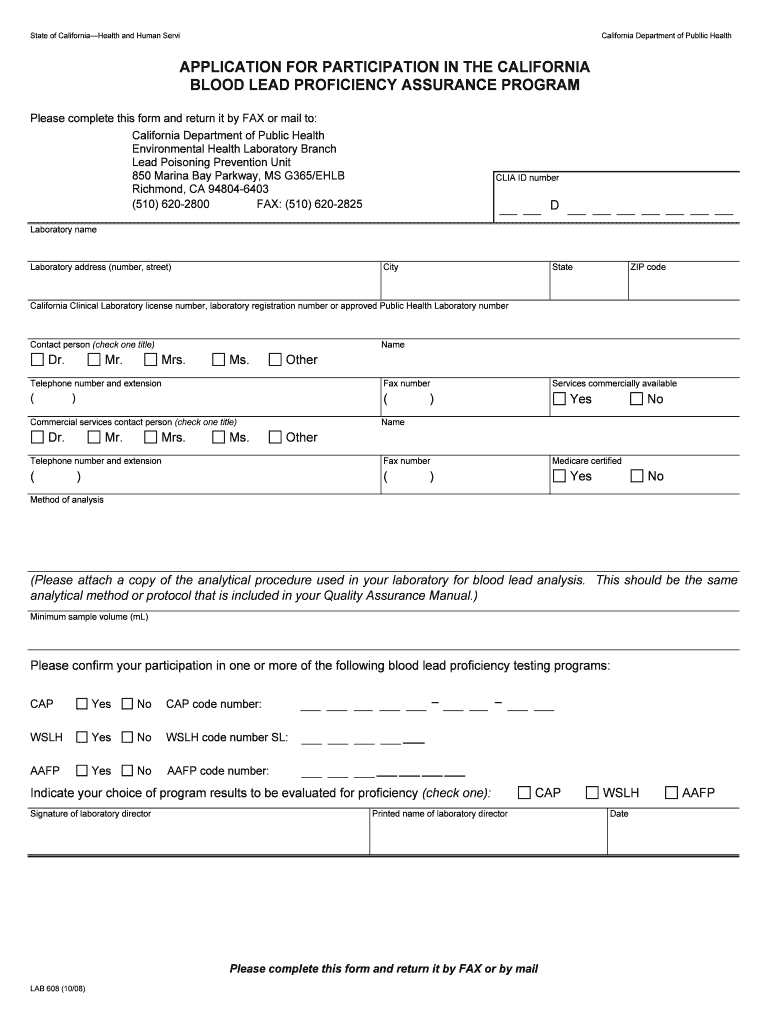
The Application for Participation in the California Blood Lead Proficiency is a document used by laboratories to enroll in the proficiency assurance program managed by the California Department of Public Health. This program is designed to ensure that participating laboratories maintain high standards in blood lead testing. The application form requires detailed information about the laboratory's operations, including contact details, licensing, and testing methodologies. The purpose of the form is to certify that laboratories are proficient in analyzing blood lead levels, thereby safeguarding public health by ensuring accurate and reliable testing outcomes.
Key Elements of the Application
The application consists of several critical elements necessary for comprehensive participation in the proficiency program. These include:
- Laboratory Information: Provides the name, address, and contact details of the laboratory.
- Licensing Details: Requires the laboratory's state and federal licenses to be listed, ensuring compliance with regulatory requirements.
- Testing Methods: Details the specific methodologies used by the laboratory for blood lead analysis. This ensures consistency and accuracy in test results.
- Participation Confirmation: Asks for confirmation of participation in other proficiency testing programs, verifying the lab's commitment to maintaining testing standards.
- Laboratory Director's Signature: Mandates a signature from the laboratory director, which certifies the information's accuracy and the laboratory's adherence to required protocols.
How to Use the Application
Utilizing the Application for Participation in the California Blood Lead Proficiency involves several steps:
- Gather Required Information: Collect all necessary laboratory details, licenses, and testing methods.
- Complete the Form: Fill out the form sections meticulously, ensuring accuracy in all entries.
- Review for Accuracy: Before submission, review the entire application to confirm that all provided information is precise and complete.
- Obtain Necessary Signatures: Ensure that the laboratory director or an authorized representative signs the application.
- Submit the Application: Send the completed form to the appropriate department within the California Department of Public Health.
Eligibility Criteria
Not all laboratories are eligible to participate in the California Blood Lead Proficiency Assurance Program. Here's a look at the required eligibility criteria:
- Valid Licensing: Laboratories must hold valid state and federal licenses for conducting lead testing.
- Accreditation: Must be part of recognized proficiency testing programs, establishing a baseline for quality.
- Qualified Personnel: Staff must be trained and certified in blood lead testing methodologies.
- Compliance with State Laws: Laboratories must adhere to all relevant Californian public health laws and regulations.


Steps to Complete the Application
To successfully complete the application, follow these step-by-step instructions:
- Section One - Lab Information: List name, address, and contact details.
- Section Two - Licenses: Add state and federal licensing details.
- Section Three - Testing Methods: Describe methods used for blood lead analysis.
- Section Four - Other Test Programs: Confirm participation in related proficiency programs.
- Section Five - Signatures: Secure signatures from the laboratory director or designated authority.
Obtaining the Application
Acquiring the application form is a straightforward process. Laboratories can request the form directly from the California Department of Public Health’s official website or through their designated contact avenues. The form may be available for download or could be requested via mail or email, depending on the department's provisions.
Important Terms Related to the Application
Understanding specific terminology is essential when dealing with the Application for Participation in the California Blood Lead Proficiency. Key terms include:
- Proficiency Assurance Program: A system to uphold testing accuracy.
- Laboratory Director: The individual responsible for overseeing the testing operations.
- Testing Methodologies: Techniques employed to determine the lead content in blood samples.
- Licensure: Official permission to carry out lead testing activities.
State-specific Rules
The application and its associated rules may vary according to California's specific public health regulations. Laboratories must familiarize themselves with any unique state mandates that could impact their testing protocols or eligibility. Compliance with state and local laws is mandatory, and non-compliance could result in penalties or disqualification from the program.
Why Laboratories Should Apply
Participating in the California Blood Lead Proficiency Assurance Program offers numerous benefits, such as:
- Enhanced Trust: Certification assures clients and stakeholders of the laboratory’s competence.
- Quality Control: Participation ensures adherence to high-quality testing standards.
- Regulatory Compliance: Program involvement helps meet industry standards and legal obligations.
- Competitive Advantage: Being part of the program can differentiate laboratories from their competitors.




