01. Edit your w 9s online
Type text, add images, blackout confidential details, add comments, highlights and more.

Type text, add images, blackout confidential details, add comments, highlights and more.

Draw your signature, type it, upload its image, or use your mobile device as a signature pad.

Send irs w 9s form via email, link, or fax. You can also download it, export it or print it out.
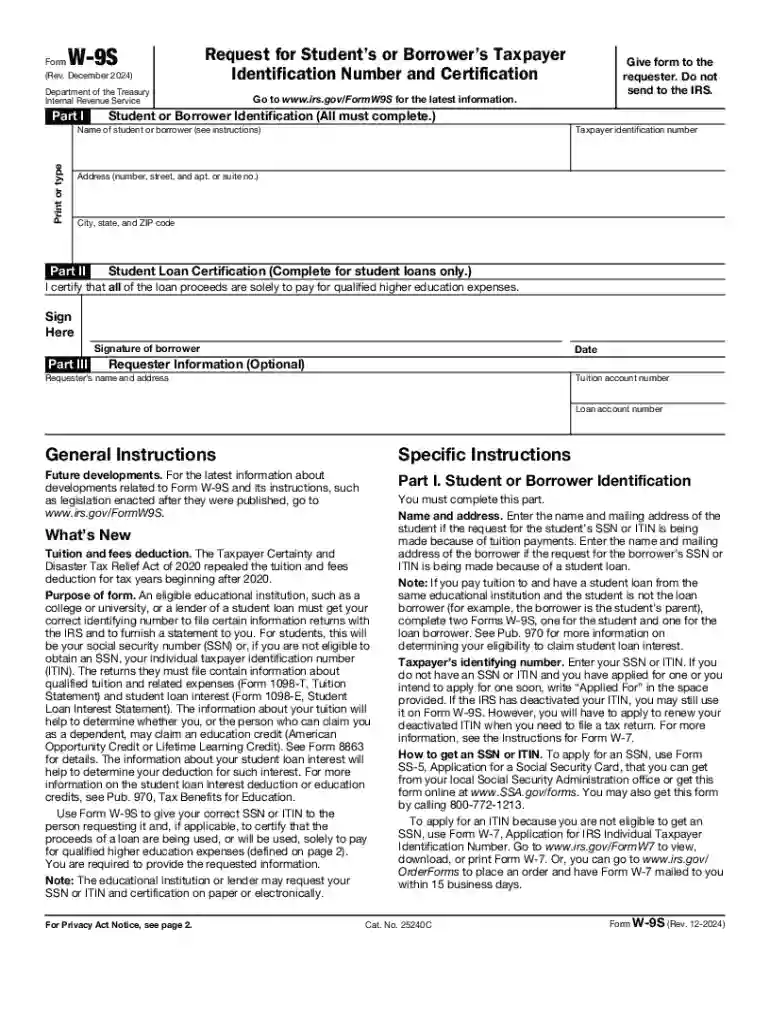
The W-9S form is a document issued by the Internal Revenue Service (IRS) in the United States. This form is specifically used to request a taxpayer identification number and certification from students or borrowers. The primary objective of the form is to facilitate the filing of information returns related to qualified higher education expenses and student loan interest. It plays a crucial role in ensuring that educational institutions and lenders have accurate taxpayer information for reporting purposes.
Using the W-9S form involves several steps aimed at verifying and providing accurate taxpayer information. It's vital for individuals to understand its specific usage to ensure compliance with IRS requirements.
Understanding the elements of the W-9S is essential for accurate completion. Each part of the form serves a specific function that directly impacts tax reporting.
The W-9S is a legally binding document and its use is governed by specific IRS rules and regulations. The information collected is critical for tax reporting and compliance.
Completing the W-9S form accurately is vital for both students and borrowers to avoid any discrepancies in tax reporting.
The W-9S form is specifically designed for certain groups who need to provide their taxpayer information for education-related financial transactions.



The IRS provides specific guidelines to ensure that the form is completed accurately and that the information is used correctly.
Practical scenarios can help individuals better understand the application of the W-9S form in real-world contexts.
Once completed, the W-9S form must be submitted through appropriate channels to ensure it is properly processed.
We've got more versions of the w 9s form. Select the right w 9s version from the list and start editing it straight away!
At DocHub, your data security is our priority. We follow HIPAA, SOC2, GDPR, and other standards, so you can work on your documents with confidence.