
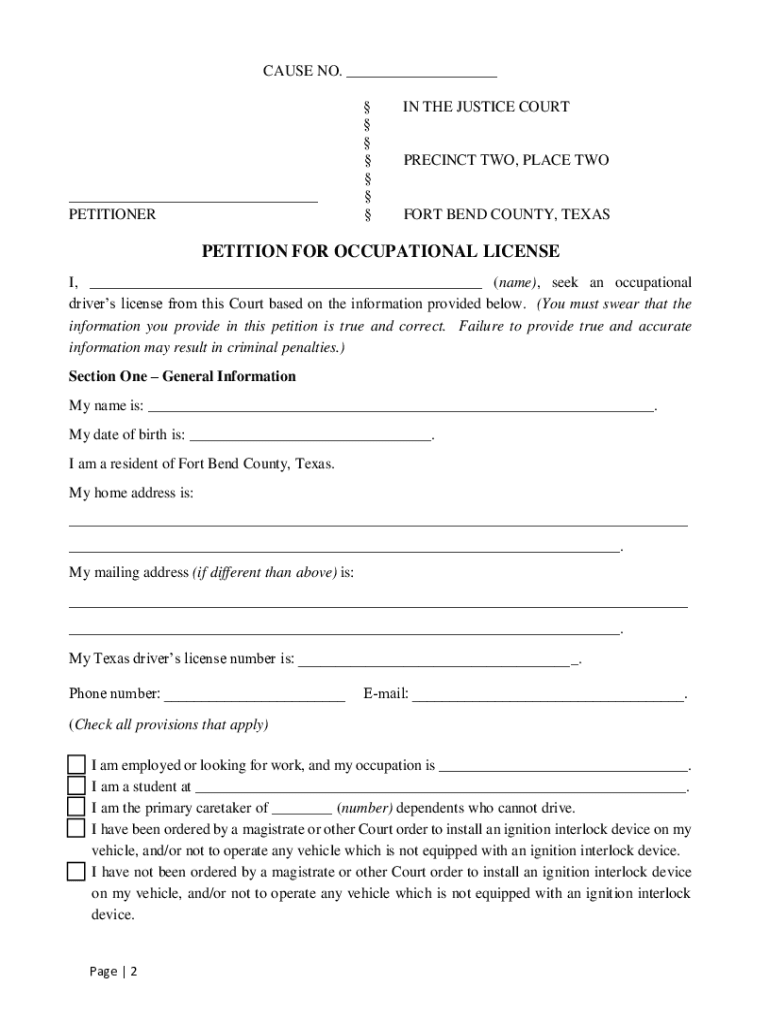







Definition and Purpose of Fort Bend County Justice of the Peace Courts
Fort Bend County Justice of the Peace Courts serve as the judicial body responsible for handling small claims, civil disputes, traffic violations, eviction proceedings, and other minor legal matters in Fort Bend County, Texas. These courts operate under the Texas judicial system and are integral in ensuring accessible justice for residents within this geographical area. Primarily, they adjudicate cases that involve sums below a specific threshold, simplifying legal processes for the community without the need for extensive legal representation.
How to Use the Fort Bend County Justice of the Peace Courts
- Filing a Case: Residents can file small claims by filling out the relevant forms and submitting them in person or via mail at the local Justice of the Peace Court offices.
- Attending Hearings: Once a case is filed, parties will be notified of the time and date for the hearing. Attendees are expected to present evidence and arguments in front of the judge.
- Resolving Disputes: This court offers mediation services as an alternative resolution method, promoting settlements without the need for a formal court ruling.
Steps to Complete a Filing with the Justice of the Peace Courts
- Determine Jurisdiction: Ensure that the Justice of the Peace Courts are the appropriate venue for your case based on the monetary amount and type of dispute.
- Prepare Documentation: Gather all necessary documents, including evidence, any contracts, receipts, and the correct filing forms available on Fort Bend County's official website.
- Submit Forms: File your completed forms along with any required fees at the Justice of the Peace office either in person or by mail.
- Receive Notice: Await notification from the court regarding the scheduling of your hearing.
- Attend the Hearing: Attend the scheduled date with all evidence prepared to support your claim.
Why Use the Fort Bend County Justice of the Peace Courts
- Accessibility: These courts offer a straightforward process for handling minor disputes, making them ideal for individuals without extensive legal knowledge or representation.
- Cost-Effectiveness: Filing fees are generally lower than in higher courts, making this an affordable option for resolving disputes.
- Efficiency: The streamlined processes often result in quicker case resolutions compared to larger court systems.
Who Typically Uses the Fort Bend County Justice of the Peace Courts
- Individual Residents: People seeking resolutions for personal disputes such as unpaid dues or property damage.
- Landlords and Tenants: Both parties frequently engage these courts for eviction proceedings and landlord-tenant disputes.
- Small Business Owners: Businesses often seek justice for small claims related to vendor contracts, unpaid invoices, or property issues.


Important Terms Related to Fort Bend County Justice of the Peace Courts
- Small Claims: Legal disputes involving limited monetary values, ideal for this court’s jurisdiction.
- Evictions: Legal process where a landlord seeks to remove a tenant from a property.
- Civil Disputes: Non-criminal cases involving personal or business disagreements regarding contracts, warranties, or other agreements.
Legal Use of the Fort Bend County Justice of the Peace Courts
These courts are empowered to handle specific types of cases as dictated by Texas law, such as small claims, evictions, and traffic violations. They provide a legal platform for residents to seek resolutions in a structured environment, offering a legally binding outcome that is recognized throughout the state.
Required Documents for Filing
- Petition Form: Required to officially initiate a case.
- Proof of Claims: Documents evidencing the claims being made, such as invoices, contracts, or witnesses’ testimony.
- Identification: Valid government-issued ID to verify the identity of the filer.
- Receipt of Filing Fee: Proof of payment for any applicable court fees.
Form Submission Methods
- Online: Some paperwork may be initiated online, but typically, final submissions require a visit to the courthouse.
- Mail: Forms and accompanying documents can be mailed to the appropriate court office.
- In-Person: Direct submission at the court office, allowing for immediate assistance from clerical staff to ensure forms are complete.
Penalties for Non-Compliance
Failing to comply with procedures, timelines, or court orders may result in default judgments against one party, fines, or inability to further pursue the claim. It is critical to adhere to all court instructions and deadlines to maintain legal standing within proceedings.




