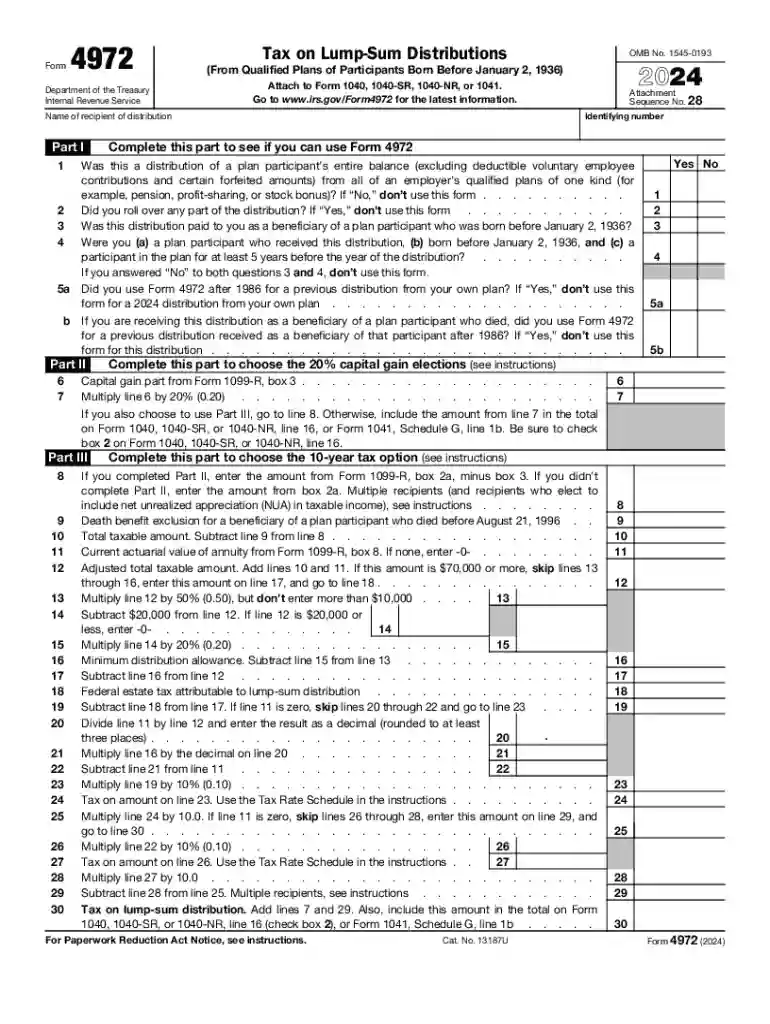
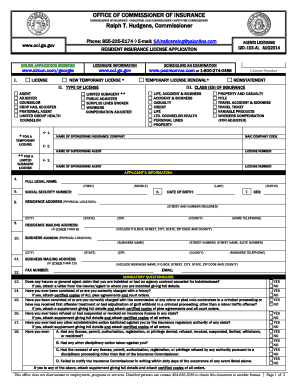
Form 4972, Tax on Lump-Sum Distributions-2026

Get Form
irs form 4972 Preview on Page 1

Here's how it works

01. Edit your irs form 4972 online
Type text, add images, blackout confidential details, add comments, highlights and more.

02. Sign it in a few clicks
Draw your signature, type it, upload its image, or use your mobile device as a signature pad.

03. Share your form with others
Send form 4972 via email, link, or fax. You can also download it, export it or print it out.

Definition & Meaning

Form 4972, Tax on Lump-Sum Distributions, is a specialized tax form used to calculate taxes on certain qualified lump-sum distributions from retirement plans. This form is most relevant for individuals born before January 2, 1936, as it allows them to apply specific tax options, such as the 20% capital gain election and the 10-year tax option. Utilizing these options can potentially reduce tax liability when compared to reporting the distribution as ordinary income.

Lump-Sum Distributions

  • Lump-sum distributions refer to the complete withdrawal of funds from a retirement plan within a single tax year.
  • Eligible retirement plans commonly include pensions and profit-sharing plans.

Tax Options

  • 20% Capital Gain Election: Allows qualifying plan participants to pay a lower tax rate on portions of the distribution categorized as long-term capital gains.
  • 10-Year Tax Option: May permit taxation of the lump-sum distribution over a ten-year period, potentially reducing the immediate tax burden.

Eligibility Criteria

Eligibility to use Form 4972 to compute the tax involves several specific criteria:

decoration image ratings of Dochub

Age and Timing

  • The individual must have been born before January 2, 1936.
  • The distribution should be from a qualified employer retirement plan, such as a pension.

Distribution Conditions

  • The entire balance of the account must be distributed within one tax year.
  • Only certain types of distributions qualify, typically those made on account of separation from service, reaching age 59½, disability, or death.

Steps to Complete Form 4972

Successfully filling out this form requires careful adherence to several steps:

  1. Gather Required Documents: Ensure you have all relevant details from your retirement plan provider, including 1099-R forms.
  2. Verify Eligibility: Confirm eligibility by reviewing age requirements and the nature of the distribution.
  3. Choose Tax Option: Decide between the 20% capital gain option or the 10-year tax option based on what benefits your financial situation the most.
  4. Fill Out Personal Information: This includes your name, social security number, and year of birth at the top of the form.
  5. Complete Calculations: Follow IRS instructions to calculate the tax owed under your chosen method.
  6. Review and Submit: Double-check all information for accuracy and submit the completed form along with your tax return.

Key Elements of Form 4972

Understanding the essential sections of Form 4972 can ease its completion:

Part I: Capital Gain Election

  • Computes the tax on the distribution using long-term capital gain rates.

Part II: Ordinary Income Portion

  • Determines the tax attributable to any ordinary income portion of the distribution.

Part III: Ten-Year Tax Option

  • Facilitates calculations if electing to spread the tax burden over ten years.

Important Terms

Familiarize yourself with technical terms related to Form 4972 for accurate form completion:

  • Eligible Plan: Refers to types of employer retirement plans that qualify under federal tax laws.
  • Qualified Participant: An individual meeting the age and distribution criteria set by the IRS.

IRS Guidelines

The IRS provides comprehensive guidelines to assist taxpayers in effectively using Form 4972:

Instructions and Publications

  • IRS Publication 575 provides detailed instructions and examples for computing taxes using Form 4972.
  • Updated each tax season to reflect policy changes or clarifications.

Compliance

  • Following IRS guidelines is critical to avoiding penalties or misreported taxes.

Examples of Using the Form 4972

Illustrative scenarios help clarify how the form applies in practical situations:

  • Retiree Using Capital Gain Option: A retiree born before 1936 receives a lump-sum distribution and opts for the capital gain election to benefit from lower tax rates.
  • Separation Due to Disability: A qualified individual takes a distribution upon disability and uses the ten-year tax option to minimize immediate tax impact.

Filing Deadlines / Important Dates

Timely filing is crucial for maximizing the benefits of Form 4972:

Annual Tax Deadlines

  • The form must be submitted alongside your annual tax return, typically by April 15 for calendar-year taxpayers.

Extensions

  • Filing an extension for your tax return also extends the deadline for submitting Form 4972, although taxes owed must still be estimated and paid by April 15 to avoid penalties.

Penalties for Non-Compliance

Failure to adhere to regulations associated with Form 4972 can lead to penalties:

Inaccurate Reporting

  • Misreporting taxable income may result in additional taxes, penalties, or interest charges.

Late Filing

  • Late submission of the form without an approved extension might incur additional fees and charges.

Software Compatibility

DocHub and other tax software programs offer functionalities that enhance ease of use for completing and submitting Form 4972:

  • Integration with Common Software Platforms: Fully compatible with tax programs like TurboTax and QuickBooks.
  • Electronic Filing Support: Allows for seamless integration and submission of completed forms via these digital platforms.

Digital vs. Paper Version

With advancements in technology, Form 4972 can be filed in various formats:

Digital Filing Benefits

  • Offers convenience and efficiency, facilitates quick data verification, and can reduce errors through integrated software checks.

Paper Version

  • Some individuals may prefer traditional paper filing due to comfort or limited access to digital resources. However, paper filing may involve longer processing times.
be ready to get more

Complete this form in 5 minutes or less

Get form

Got questions?

We have answers to the most popular questions from our customers. If you can't find an answer to your question, please contact us.
Contact us
26 U.S. Code 4972 - Tax on nondeductible contributions to qualified employer plans. In the case of any qualified employer plan, there is hereby imposed a tax equal to 10 percent of the nondeductible contributions under the plan (determined as of the close of the taxable year of the employer).
Mandatory income tax withholding of 20% applies to most taxable distributions paid directly to you in a lump sum from employer retirement plans even if you plan to roll over the taxable amount within 60 days. Note that the default rate of withholding may be too low for your tax situation.
Retirement fund lump sum benefits or severance benefits Taxable income (R)​Rate of tax 1 550 000 0% of taxable income 550 001 770 000 18% of taxable income above 550 000 770 001 1 155 000 39 600 + 27% of taxable income above 770 000 1 155 001 and above 143 550 + 36% of taxable income above 1 155 000 May 21, 2025
When we send a lump-sum payment directly to you, it is subject to a mandatory 20% federal withholding tax rate in the year you receive the payment. This withholding will be reported to the IRS and credited toward any income tax you may owe.
To do so: Apportion the lump sum over the total number of pay periods in the financial year. Add the average amount to the employees regular earnings for the current pay period. Apply the appropriate tax rate based on the combined income.

Security and compliance

At DocHub, your data security is our priority. We follow HIPAA, SOC2, GDPR, and other standards, so you can work on your documents with confidence.


Learn more
ccpa2
pci-dss
gdpr-compliance
hipaa
soc-compliance

People also ask

How to Calculate Taxes on a $30,000 Lump Sum Step 1: Identify the Source of the Lump Sum. Step 2: Determine Your Filing Status. Step 3: Calculate Your Total Taxable Income. Step 4: Apply the Tax Brackets. Step 5: Consider Withholding and Estimated Taxes. Step 6: Account for Additional Taxes.
You may be able to defer tax on all or part of a lump-sum distribution by requesting the payer to directly roll over the taxable portion into an individual retirement arrangement (IRA) or to an eligible retirement plan.
A lump-sum distribution is an option for individuals who want to take out all of their funds at once, but this could lead to taxes on both pre-tax contributions and earnings in the account. Individuals born before January 2, 1936, may be able to use Form 4972 to reduce taxes based on various options.

pension lump sum tax rules