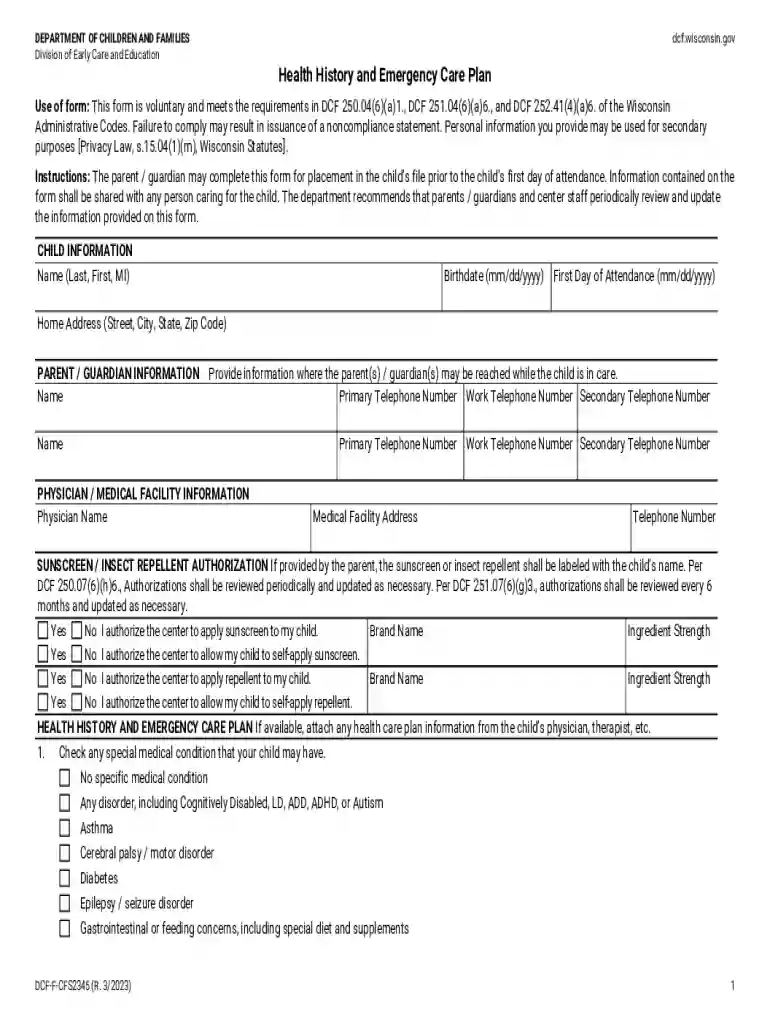
Health History and Emergency Care Plan, DCF-F-CFS2345-E Division of Early Care and Education 2026

Get Form
Health History and Emergency Care Plan, DCF-F-CFS2345-E Division of Early Care and Education Preview on Page 1

Here's how it works

01. Edit your form online
Type text, add images, blackout confidential details, add comments, highlights and more.

02. Sign it in a few clicks
Draw your signature, type it, upload its image, or use your mobile device as a signature pad.

03. Share your form with others
Send it via email, link, or fax. You can also download it, export it or print it out.

Definition & Purpose of the Health History and Emergency Care Plan

The Health History and Emergency Care Plan, known as form DCF-F-CFS2345-E, is a critical document issued by the Wisconsin Department of Children and Families. This form serves as a comprehensive record for early care and education providers to understand a child's health needs and emergency protocols. The primary purpose of the form is to gather detailed health information, ensuring caregivers are fully prepared to address a child's medical requirements and potential emergencies.

Parents and guardians use this form to provide personal details, emergency contacts, physician information, and permissions for medication application. This specification allows childcare facilities to tailor their care and quickly respond to a child's medical needs. For instance, if a child has allergies or chronic health conditions, this form gives caregivers the procedural insights required for tailored care.

Key Aspects of the Form

  • Child’s Personal Details: Includes the child's name, birth date, and health insurance information.
  • Emergency Contacts: Primary contacts to reach in case of a health emergency.
  • Medical Conditions: Details about allergies, chronic conditions, and required medications.
  • Care Instructions: Instructions specific to handling medical situations and emergencies.

How to Use the Health History and Emergency Care Plan

Using form DCF-F-CFS2345-E effectively involves filling out each section with precise information. Parents or guardians should complete the form accurately and ensure the details are current. It requires coordination with healthcare providers to include valid medical advice or protocols.

Steps for Effective Use

  1. Gather Required Information: Prepare all necessary personal, medical, and contact information.
  2. Consult Healthcare Providers: Verify medical conditions and medication requirements with your child's physician.
  3. Complete the Form: Accurately fill out all sections, ensuring no field is left incomplete.
  4. Review with Caregivers: Discuss the filled form with childcare providers to ensure they understand all medical instructions.

Practical Scenarios

  • Child with Asthma: Include detailed instructions on inhaler use and triggers.
  • Allergy Management: Specify known allergens and emergency treatment plans, such as the use of an EpiPen.

Steps to Complete the Health History and Emergency Care Plan

To ensure comprehensive coverage, completing the form DCF-F-CFS2345-E should follow a structured approach:

Detailed Process

  1. Personal Information: Start by entering the child's name, date of birth, and health insurance details.
  2. Emergency Contacts: List multiple contacts, ensuring at least one can be reached at all times.
  3. Medical Information: Detail any allergies, chronic conditions, or other medical needs.
  4. Physician and Medical Provider Information: Provide the contact details of the child's primary care provider.
  5. Authorization for Care: Grant necessary permissions for sunscreen application, insect repellent, and emergency medical interventions.

Key Elements of the Form

Understanding and correctly filling out each part of the Health History and Emergency Care Plan ensures no detail is overlooked, crucial for effective childcare.

Core Components

  • Personal and Insurance Details: Compilation ensures caregivers have essential identification and coverage information.
  • Emergency Contact Information: Critical for quick communication in emergency situations.
  • Medical History and Allergies: Provides a snapshot of all health considerations that caregivers need to be aware of.
  • Authorization Sections: Allows caregivers to administer minor medical interventions as needed.

State-Specific Considerations for Wisconsin

Given that the DCF-F-CFS2345-E is regulated by Wisconsin's Department of Children and Families, it's important to acknowledge specific state regulations and legalities surrounding childcare.

Wisconsin Regulations

  • Compliance with State Guidelines: This form complies with local requirements for the safety and well-being of children in care services.
  • Legally Binding: Parents' authorizations and signatures make provided instructions enforceable.

Who Typically Uses This Form

The primary users of the Health History and Emergency Care Plan are parents or guardians and providers in child care services. This includes early childhood educators, daycares, and any institution in the domain of child development and care.

Typical Settings

  • Daycare Centers: Use the form to tailor daily childcare practices to individual child's needs.
  • Home-Based Childcare: Small settings where caregivers may have more personalized interactions with children, benefiting from detailed health information.
  • Preschools: Provide preemptive action plans against health-related incidents in young children.

Legal Aspects and Compliance

Parents or guardians signing the Health History and Emergency Care Plan assure that all information is truthful and up-to-date. It is crucial for compliance with Wisconsin's health and safety regulations in educational settings.

Legal Use Understanding

  • Authorization of Care: Legal permissions must be clearly understood and agreed upon with caregivers.
  • Liability and Confidentiality: Information shared through this form is typically protected under privacy laws and should be treated accordingly by caregivers.

Important Terms to Know

Familiarity with the specific terminology related to the Health History and Emergency Care Plan aids in accurate completion and compliance with healthcare requirements.

Key Terms

  • EpiPen: A common emergency treatment for severe allergic reactions.
  • Asthma Action Plan: A detailed guide provided by healthcare professionals to manage asthma episodes.
  • Authorization for Treatment: Legal consent allowing caregivers to intervene medically when necessary.
be ready to get more

Complete this form in 5 minutes or less

Get form

Got questions?

We have answers to the most popular questions from our customers. If you can't find an answer to your question, please contact us.
Contact us
The plan is organized to correspond to the four phases of emergency management: mitigation, preparedness, response, and recovery. The plan is predicated on the principle that emergency operations will be executed at the level of government most appropriate to provide an effective response.
Emergency care and treatment plans (ECTP) record a summary of decisions made as a result of discussions between individuals and their doctors and nurses about the kind of treatments and care they want in case of an emergency.
Emergency care is an integrated platform for delivering accessible, quality and time-sensitive health care services for acute illness and injury across the life course.
Your emergency plan must cover: notifying emergency services quickly. medical treatment and help. communication protocols between the emergency response coordinator and all people at the workplace. when and how to do emergency procedure testing.
A safety plan is a written agreement between caregivers and DCF that establishes how impending (or present) danger threats will be managed.

Security and compliance

At DocHub, your data security is our priority. We follow HIPAA, SOC2, GDPR, and other standards, so you can work on your documents with confidence.

Learn more
ccpa2
pci-dss
gdpr-compliance
hipaa
soc-compliance
be ready to get more

Complete this form in 5 minutes or less

Get form