01. Edit your form online
Type text, add images, blackout confidential details, add comments, highlights and more.

Type text, add images, blackout confidential details, add comments, highlights and more.

Draw your signature, type it, upload its image, or use your mobile device as a signature pad.

Send it via email, link, or fax. You can also download it, export it or print it out.
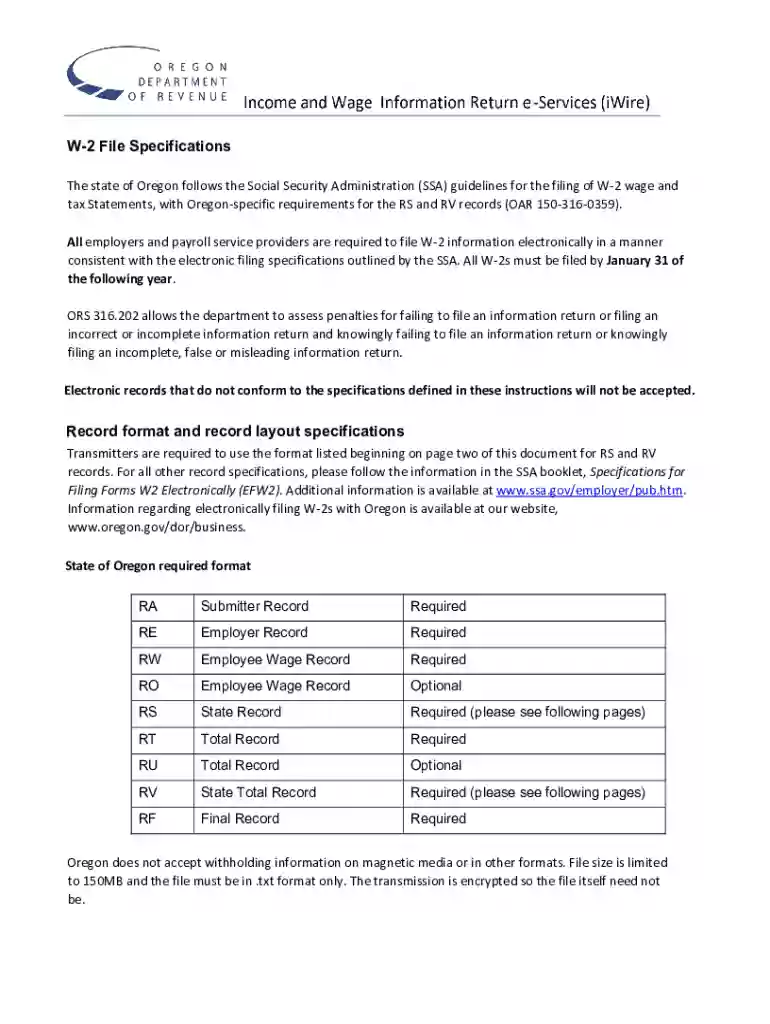
The "W-2 File Specifications" refer to the detailed guidelines and requirements that employers must follow when preparing and submitting W-2 forms, which report wages and taxes withheld from employees. These specifications ensure compliance with both federal and state regulations, standardizing the format for digital and paper submissions. By adhering to these guidelines, businesses can accurately report their financial activities to the relevant authorities, such as the Social Security Administration (SSA) and the Internal Revenue Service (IRS).
The W-2 specifications include crucial elements such as data encryption, file format, and specific record layouts to facilitate processing by government systems. Understanding these specifications is essential for accurate tax reporting and to avoid potential penalties associated with misfiled or non-compliant submissions.
Employers must leverage the W-2 file specifications to properly structure their electronic or paper submissions of employee wage information. Utilizing these specifications begins with identifying the correct format for your business's submissions.
Data Collection: Gather all necessary employee wage and tax information, ensuring accuracy and completeness.
Compliance Check: Review SSA and IRS guidelines within the specifications to ensure all federal requirements are met.
Format Structuring: Follow the prescribed file format, such as electronic filing using SSA's Business Services Online for large corporations, ensuring data integrity and encryption.
State Regulations: Integrate any additional state-specific requirements that might apply to your business's operations.
Final Review: Conduct a thorough check of the W-2 forms for accuracy before submission.
Each step relies heavily on the employer's understanding of the data and the specifications, ensuring error-free filings.
The process of completing W-2 file specifications involves several stages, each requiring careful attention to detail:
Data Entry: Begin by entering accurate employee details such as name, address, social security number, and salary figures into your payroll system.
Compliance Verification: Cross-check the entered data against both federal and state regulations to ensure compliance with reporting requirements.
File Creation: Utilize payroll software or SSA tools to create an electronic file adhering to prescribed layouts and structures.
Error Checking: Conduct validations to detect and rectify any discrepancies or formatting errors.
Submission to Authorities: Submit the finalized W-2 forms to the IRS and SSA, through either electronic filing systems or paper submissions for smaller entities.
Record Keeping: Maintain copies of completed W-2s and related documentation, as specified by federal regulations, for a minimum of four years for any future audits or verifications.
The legal use of W-2 file specifications is mandated by U.S. tax laws. These guidelines ensure that the information reported by employers is consistent, accurate, and suitable for federal and state tax processing systems. Employers are legally obligated to deliver W-2 forms to employees by January 31 each year and furnish the same to the SSA.
Violations of these specifications, such as inaccuracies, delays, or non-submission, can lead to penalties. Thus, thorough adherence to the specifications not only aligns with legal requirements but also safeguards the employer against any financial or legal repercussions.
Each U.S. state may have additional requirements concerning the filing of W-2 forms to address local taxation laws:
Oregon: Requires a specific statewide transit tax to be filed alongside the W-2 form, incorporating distinct regional elements.
California: May have its own filing deadlines and data submission formats to accommodate state-specific tax credits or deductions.
New York: Could demand additional certification regarding employment status and tax categories.
Employers must familiarize themselves with these nuances to ensure comprehensive compliance with both federal and state mandates.
The notable deadline for employers regarding W-2 submissions is January 31 for the previous tax year. This date applies to providing W-2 forms to employees as well as submitting them to the IRS and SSA. Employers operating across multiple states should also account for state-specific deadlines, which may have variations based on state policies.
Timeliness in meeting these deadlines is pivotal, as late submissions can lead to substantial penalties. Automated reminders or scheduling within payroll systems can help adhere to these critical dates.
Failure to comply with W-2 file specifications or missing submission deadlines can result in significant penalties:
Late Filing: Penalties apply for late submission of W-2 forms to the IRS and SSA, with charges escalating based on the duration of delay.
Inaccuracies: Misreporting of employee details or remuneration can lead to fines, especially if such errors are discovered during audits.
State-specific Infractions: States may impose their penalties for failure to meet regional filing requirements.
Companies are encouraged to employ robust verification procedures to minimize risks associated with non-compliance.
Software compatibility is an essential aspect of W-2 file specifications. Various tax software solutions like TurboTax and QuickBooks offer compatibility with W-2 filing requirements, streamlining the data entry and submission processes. These platforms enable:
Seamless Data Transfer: Integrated payroll functions allow for efficient data migration, reducing manual errors.
Regulatory Updates: Automated updates ensure that the latest filing specifications and tax laws are adhered to.
Comprehensive Guidance: Step-by-step instructions within these systems guide users through the intricacies of W-2 preparations.
Employers are encouraged to utilize such compatible software solutions to enhance accuracy and compliance in their tax reporting activities.
We've got more versions of the W-2 File Specifications form. Select the right W-2 File Specifications version from the list and start editing it straight away!
At DocHub, your data security is our priority. We follow HIPAA, SOC2, GDPR, and other standards, so you can work on your documents with confidence.