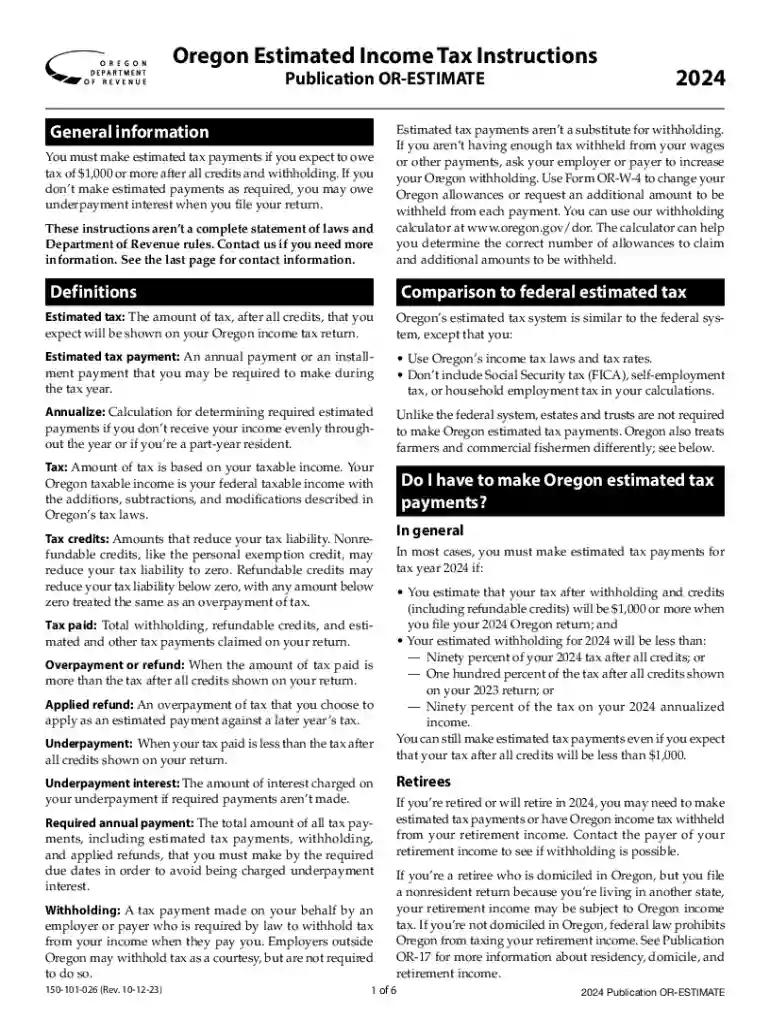
Oregon Department Of Revenue, Oregon Tax 2026

Get Form
Oregon Department Of Revenue, Oregon Tax Preview on Page 1

Here's how it works

01. Edit your form online
Type text, add images, blackout confidential details, add comments, highlights and more.

02. Sign it in a few clicks
Draw your signature, type it, upload its image, or use your mobile device as a signature pad.

03. Share your form with others
Send it via email, link, or fax. You can also download it, export it or print it out.

Definition and Meaning of Oregon Department Of Revenue, Oregon Tax

The "Oregon Department of Revenue, Oregon Tax" refers to the framework and processes the Oregon Department of Revenue uses to administer and collect taxes in the state of Oregon. This encompasses various forms of taxes, including personal income tax, corporate tax, and other state-specific levies. The Department of Revenue also oversees the enforcement of tax laws and the provision of guidance to taxpayers on compliance matters. Understanding the scope and responsibilities of this department is essential for accurate tax reporting and adherence to state tax requirements.

How to Use the Oregon Department Of Revenue, Oregon Tax

Using the Oregon Department of Revenue tax resources involves accessing the right information and tools to fulfill your tax obligations. Taxpayers can utilize various online services provided by the department to file their taxes, pay taxes via electronic transfer, and track the status of their returns. The official website offers a comprehensive portal with resources, forms, and guides that assist taxpayers in achieving compliance. Additionally, taxpayers can contact the department for personalized assistance or consultation regarding complex tax issues.

Key Tools and Resources

  • Online Portal: Facilitates tax filing, payments, and tracking.
  • Guides and Publications: Offers detailed instructions for different taxpayer categories.
  • Customer Support: Provides assistance via phone, email, or in-person consultations.

Steps to Complete the Oregon Department Of Revenue, Oregon Tax

Filing taxes with the Oregon Department of Revenue requires diligently following these steps to ensure compliance and accuracy:

  1. Gather Required Information: Collect all necessary documents including W-2s, 1099 forms, and any other relevant tax documentation.
  2. Determine Tax Obligations: Calculate your taxable income to determine what taxes are due using the state-provided resources or software.
  3. Prepare the Return: Use online filing software approved by the department or manual forms to prepare your tax return.
  4. Review and File: Ensure all details are accurate before submitting. Filers can choose electronic submission or mailing physical forms via post.
  5. Payment: If taxes are due, make the necessary payment through direct debit, credit card, or mailing a check.
  6. Confirmation and Recordkeeping: Keep copies of all submitted documents and confirmation receipts for future reference.

Key Elements of the Oregon Department Of Revenue, Oregon Tax

Understanding the components of the tax framework in Oregon is crucial for effective tax management.

  • Income Tax: A primary revenue source, calculated based on earned income.
  • Corporate Tax: Obligations for businesses operating within the state.
  • Property and Excise Taxes: Collected based on property ownership and usage of specific goods.
  • Deductions and Credits: Available to reduce taxable income for qualifying taxpayers.

Important Terms Related to Oregon Department Of Revenue, Oregon Tax

Familiarity with the following terms enhances comprehension of Oregon's tax system:

  • Filing Status: Categories that determine applicable tax rates and obligations.
  • Tax Credit: Reductions in tax owed to incentivize specific behaviors.
  • Withholding: Portion of income withheld by employers for tax purposes.
  • Estimated Payments: Required for individuals or entities expected to owe $1,000 or more after tax credits and withholding.

State-Specific Rules for the Oregon Department Of Revenue, Oregon Tax

Oregon has unique tax rules that taxpayers need to recognize and adhere to:

  • No State Sales Tax: Oregon is one of a few states that do not impose a state sales tax.
  • Retirement Income Considerations: Specific exclusions and credits are available for retirees.
  • Nonresident and Part-Year Resident Considerations: Special provisions apply for those not residing in the state full time.

Penalties for Non-Compliance

Failure to comply with Oregon tax regulations can result in significant penalties:

  • Late Filing Fee: Charged for returns submitted after the deadline without a valid extension.
  • Underpayment Penalty: Imposed if too little tax is paid throughout the year.
  • Fraud Penalty: Applied to instances of deliberate misinformation or evasion.

Filing Deadlines and Important Dates

Key dates are crucial for maintaining compliance and avoiding penalties:

  • April 15: Standard deadline for filing state income tax returns.
  • Quarterly Estimated Payments: Due every April 15, June 15, September 15, and January 15 of the following year.
  • Extension Deadlines: If granted, extended filing is typically due by October 15.

Digital vs. Paper Version of the Oregon Department Of Revenue, Oregon Tax

Both digital and paper filing options are available to meet diverse taxpayer needs:

  • Digital Filing: Offers faster processing times and better accuracy through validation checks.
  • Paper Filing: Traditional method preferred by some, though it can be more prone to errors and longer processing times.

Examples of Using the Oregon Department Of Revenue, Oregon Tax

Consider these scenarios to understand real-world applications:

  • Scenario for Retirees: Utilizing specific deductions and credits to minimize tax liability.
  • Nonresident Taxpayer Case: Filing obligations when income is sourced both inside and outside Oregon.
  • Business Scenario: Corporate tax filing for businesses with operations or registered headquarters in the state.
be ready to get more

Complete this form in 5 minutes or less

Get form

Got questions?

We have answers to the most popular questions from our customers. If you can't find an answer to your question, please contact us.
Contact us
About tax records You can request your own tax records quickly and easily by signing up for a Revenue Online account. If you already have an account, log in and click on Request photocopies under I Want To. The Department of Revenue does not keep property tax statements.
Wheres My Refund has the latest information on your return. If you dont have internet, call the automated refund hotline at 800-829-1954 for a current-year refund or 866-464-2050 for an amended return. If you think we made a mistake with your refund, check Wheres My Refund or your online account for details.
Average Time for State Tax Refund Direct Deposit Most states process refunds within 7 to 21 days if you file electronically. If you file a paper return, it can take 4 to 8 weeks or more. Here is a breakdown of estimated processing times for electronic filers in different states: California: 10-14 days.
Oregon State Refund Facts Oregon usually issues refunds within 2-weeks of receipt of an electronically filed return. If you are a part-year or non-resident of Oregon, your Oregon refund will not be issued before March.
As of July 12, 2021, the Revenue Building in Salem and all regional field offices are open to the general public. No appointment is necessary, but it is still appreciated. You can schedule an appointment in Salem or in our regional field offices by using our self-service tool or calling 800-356-4222 toll-free.

Security and compliance

At DocHub, your data security is our priority. We follow HIPAA, SOC2, GDPR, and other standards, so you can work on your documents with confidence.
Learn more
ccpa2
pci-dss
gdpr-compliance
hipaa
soc-compliance
be ready to get more

Complete this form in 5 minutes or less

Get form

People also ask

A recent GOBankingRates analysis calculated the annual after-tax income for a single filer earning $100,000 and claiming the standard deduction in every U.S. state. Oregon had the highest tax burden, reducing annual take-home pay to about $70,500.
Logging into your Revenue Online account is the best way to get detailed updates on your tax refund status. In your Revenue Online account use our Wheres My Refund?
Logging into your Revenue Online account is the best way to get detailed updates on your tax refund status. In your Revenue Online account use our Wheres My Refund? link located in the Personal Income Tax section to check your refund status.

Related links