




01. Edit your form online
Type text, add images, blackout confidential details, add comments, highlights and more.

Type text, add images, blackout confidential details, add comments, highlights and more.

Draw your signature, type it, upload its image, or use your mobile device as a signature pad.

Send it via email, link, or fax. You can also download it, export it or print it out.
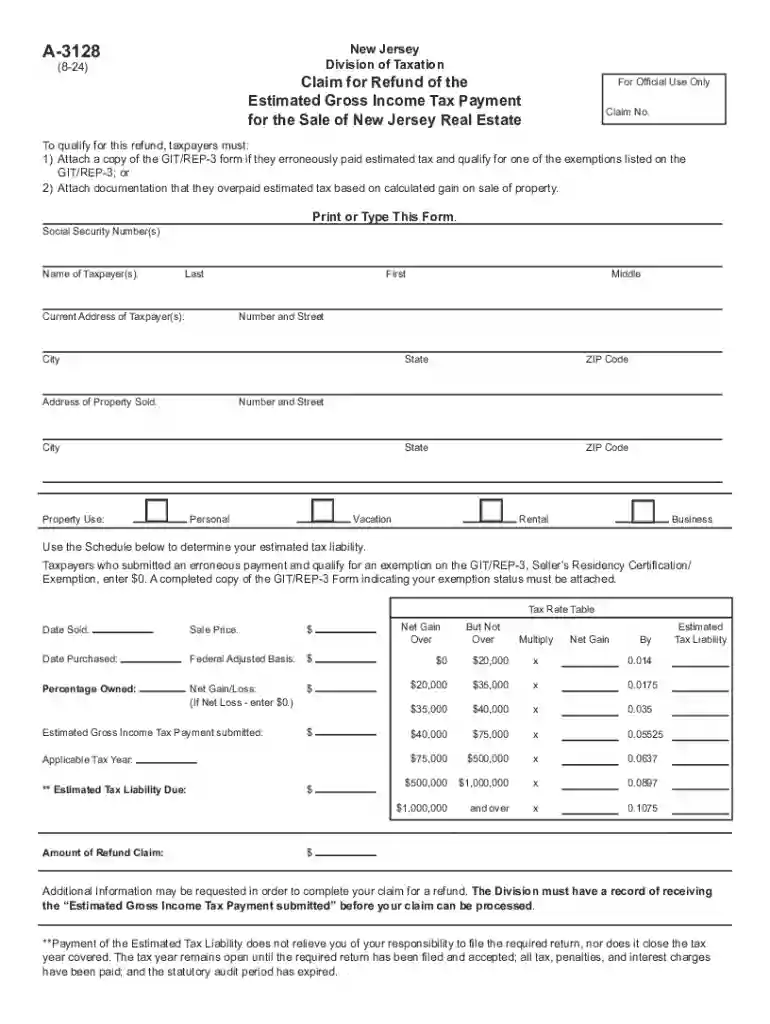
Form A-3128 is used by nonresident individuals, estates, or trusts to claim a refund on the estimatedGross Income Tax payments made following the sale of real estate in New Jersey. This form is crucial for ensuring that taxpayers do not overpay, as it enables them to adjust their tax liabilities post-transaction.
To use Form A-3128, complete each required section with detailed information about the real estate transaction. Include property details, sale price, and prior estimated tax payments. It involves calculating the liability using the state's tax rate table, and then determining any overpayment eligible for refund. Accuracy in completing this form ensures a smooth refund process.
Nonresident individuals, estates, or trusts involved in selling New Jersey real estate typically use this form. These taxpayers need to reclaim overpaid estimated taxes due to differences between estimated and actual tax liabilities upon property sale.
Adhering to filing deadlines is essential to avoid penalties and receive timely refunds. The deadlines for submitting Form A-3128 are typically aligned with state tax return deadlines, but specific dates should be confirmed annually.
Eligibility for submitting Form A-3128 requires:


An individual who lives outside New Jersey sells their property within the state and had earlier paid estimated taxes based on projected gain. Upon determining the exact gain, they find they've overpaid. The A-3128 form allows them to reclaim the excess, ensuring they only pay the exact tax required for the income generated from the sale.
New Jersey-specific regulations govern the completion and submission of Form A-3128, emphasizing precise compliance with its tax law. Taxpayers must adhere to state's validation and documentation requirements to secure approval and receive refunds.
Form A-3128 is legally recognized for processing tax refunds related to real estate transactions in New Jersey. Proper completion and submission guarantee taxpayers' rights for refunds according to state tax legal frameworks.
By presenting this in-depth content, users gain a comprehensive understanding necessary to accurately and efficiently manage the Form A-3128 Claim for Refund of the Estimated Gross Income Tax Payment for the Sale of New Jersey Real Estate.
We've got more versions of the Form A-3128 Claim for Refund of the Estimated Gross Income Tax Payment for the Sale of New Jersey Re form. Select the right Form A-3128 Claim for Refund of the Estimated Gross Income Tax Payment for the Sale of New Jersey Re version from the list and start editing it straight away!
At DocHub, your data security is our priority. We follow HIPAA, SOC2, GDPR, and other standards, so you can work on your documents with confidence.


if the seller has already submitted the tax to the State, the taxpayer must complete a Claim for Refund (Form A-3730) and include supporting documents to
Dec 3, 2025 A-3128, Claim for Refund of Estimated Gross Income Tax Payment Required on the Sale of Real Property Located in New Jersey. Select A Year. 2018.Read more


