




01. Edit your pa schedule nrh online
Type text, add images, blackout confidential details, add comments, highlights and more.

Type text, add images, blackout confidential details, add comments, highlights and more.

Draw your signature, type it, upload its image, or use your mobile device as a signature pad.

Send it via email, link, or fax. You can also download it, export it or print it out.
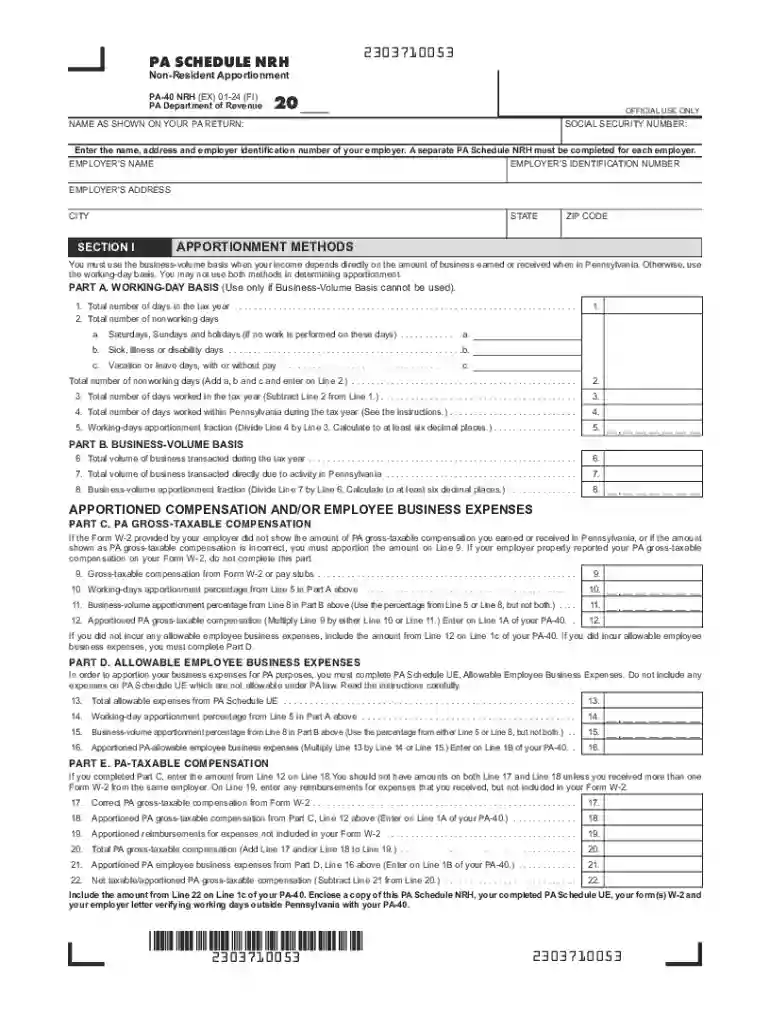
The PA Schedule NRH, or Pennsylvania Schedule NRH, is a specialized tax form used by non-resident employees working in Pennsylvania. Its primary function is to structure and report the apportionment of gross-taxable compensation received for work performed in the state. The form aids in dividing business expenses and earnings between activities within and beyond Pennsylvania. It facilitates the application of Pennsylvania state tax laws to non-residents, ensuring accurate state tax filings in accordance with the individual's specific work situation.
Working-Day Basis: This method breaks down income apportionment according to the number of days worked in Pennsylvania. Employees calculate the taxable portion by comparing their in-state working days to total working days throughout the year.
Business-Volume Basis: This approach bases the apportionment on business volume generated both inside and outside Pennsylvania. Non-residents assess their income by allocating profits according to the state-attributable portion of their overall business activities.
Completing the PA Schedule NRH involves several detailed steps to ensure full compliance and accuracy:
Gather Necessary Information: Obtain records of all income earned and expenses incurred during the tax year, especially those relevant to Pennsylvania.
Choose Apportionment Method: Decide between the Working-Day or Business-Volume Basis for dividing your income attributable to Pennsylvania.
Calculate Income: Use chosen apportionment method to calculate taxable income specific to Pennsylvania.
Complete Form Sections: Fill out the sections of the PA Schedule NRH that correspond with income, deductions, and selected apportionment method.
Attach Supporting Documents: Include any supporting documentation, such as W-2 forms or business volume reports, to validate your calculations.
Submit with PA-40: File the completed PA Schedule NRH alongside the PA-40 state tax return.
The primary users of the PA Schedule NRH are non-resident employees who perform part of their work in Pennsylvania but reside elsewhere:
Employed Professionals: Individuals whose jobs require travel or temporary work assignments in Pennsylvania.
Remote Workers: Staff primarily based outside the state yet frequently working from offices or client locations within Pennsylvania.
Business Owners: Non-resident proprietors directing operations or earning revenues from within the state.


Non-Resident Income Section: Details and calculates the portion of income earned within Pennsylvania.
Apportionment Calculations: Specific areas dedicated to either the Working-Day or Business-Volume Basis computations.
Expense Deductions: Areas for detailing deductible business-related expenses that occurred while working in Pennsylvania.
Understanding certain terms is crucial in accurately completing the PA Schedule NRH:
Gross-Taxable Compensation: Total income subject to tax before apportionment and deductions.
Non-Resident: Employees living outside of Pennsylvania but earning income within the state.
Apportionment: The process of calculating taxable portions of income based on criteria such as workdays or business volumes.
The PA Schedule NRH must be used with adherence to Pennsylvania's legal guidelines concerning non-resident income taxation:
Compliance Requirements: Ensuring the accuracy of the form to avoid legal complications.
State Tax Law Alignment: Following Pennsylvania's specific rules regarding income allocation and tax responsibilities for non-residents.
ESIGN Act Adherence: Electronic submissions must conform to electronic signature authentication norms for legitimacy.
Timely submission of the PA Schedule NRH ensures compliance with state taxation timelines:
Annual Filing Deadline: Typically aligns with the federal tax return deadline in April, unless an extension is granted.
Extension Requests: Must be filed before the original deadline to avoid late penalties and interest charges.
Successfully completing the PA Schedule NRH demands specific documents and offers different submission methods:
Supporting Documents: Includes proof of income, employment records, and details of expense deductions.
Online Submit: Available via Pennsylvania's e-filing platforms for streamlined processing.
Mail or In-Person: Traditional methods include sending paper forms by mail or hand-delivering to a Pennsylvania Department of Revenue office.
We've got more versions of the pa schedule nrh form. Select the right pa schedule nrh version from the list and start editing it straight away!
At DocHub, your data security is our priority. We follow HIPAA, SOC2, GDPR, and other standards, so you can work on your documents with confidence.


Correct PA gross-taxable compensation from Form W-2 . Instructions for PA-40 Schedule NRH. Non-Resident Apportionment. PA-40 NRH IN (EX) 03-24. Page 4. PARead more
Jan 21, 2026 Instructions for PA-40 Personal Income Tax Return ; Schedule A Interest Income ; Schedule B Dividend Income ; Schedule NRH CompensationRead more


