




01. Edit your form online
Type text, add images, blackout confidential details, add comments, highlights and more.

Type text, add images, blackout confidential details, add comments, highlights and more.

Draw your signature, type it, upload its image, or use your mobile device as a signature pad.

Send it via email, link, or fax. You can also download it, export it or print it out.
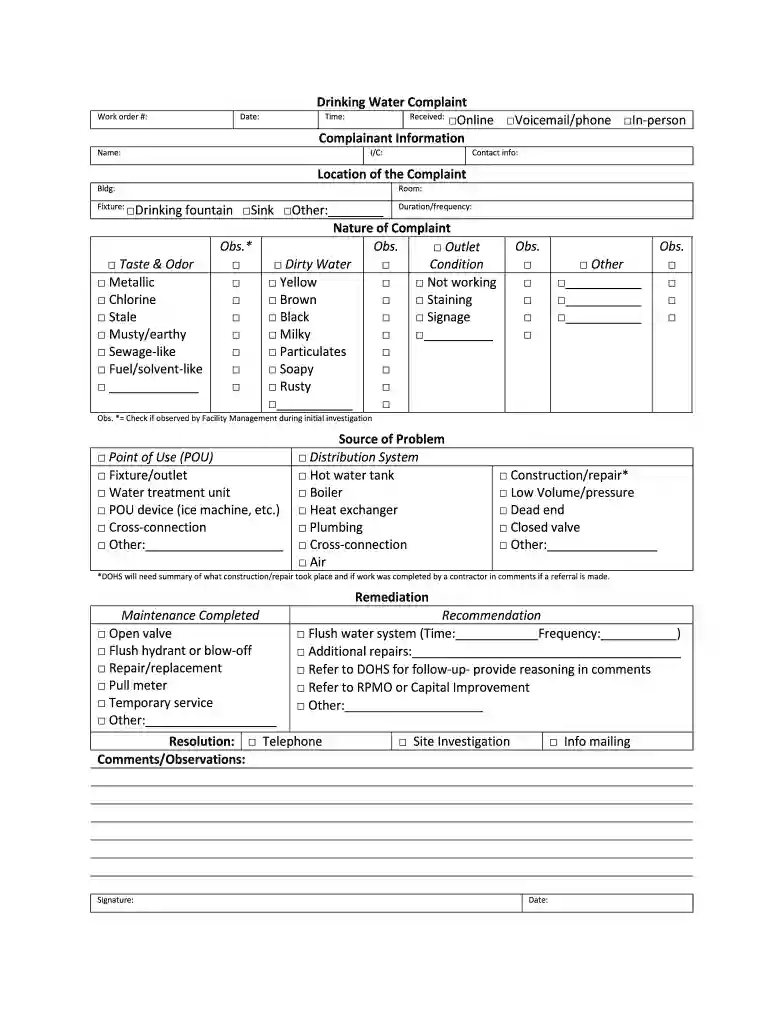
The "Drinking Water Complaints Recommended Form" (DWCRF) serves as an official document utilized by individuals or organizations to report issues concerning drinking water quality. This form is designed to streamline the complaint process by documenting essential details like the nature of the complaint, the location of the issue, and any potential causes. By completing this form, users enable authorities to address water quality issues more efficiently and effectively.
Proper documentation through this form is crucial for maintaining records that aid in identifying trends and recurring problems. These records can assist facility management and water authorities in planning long-term solutions to improve water quality across affected areas.
The primary utility of the form lies in its structured approach to collecting vital information necessary for investigating and resolving water quality complaints. This ensures that all necessary data is captured systematically, facilitating a quicker and more efficient response to address the complaint.
When utilizing the DWCRF, it is important to follow a step-by-step approach to ensure all relevant information is provided. Here's a breakdown of how to effectively use this form:
Complainant Information: Begin by filling out your personal information, including your name, contact details, and any organization you may represent.
Location and Nature of Complaint: Document the specific location where the water issue has been observed and detail the nature of the complaint – whether it's a change in taste, color, odor, or any other concern.
Potential Sources of the Problem: Identify any known or suspected sources of the problem. This may involve nearby industrial activities, recent maintenance works, or natural events that could have affected water quality.
Observations: Provide detailed observations that can assist authorities in understanding the context and severity of the issue.
Completing this form requires attention to detail to accurately capture all necessary data. Here are detailed instructions:
Gather Information: Collect all relevant information regarding the water issue before filling out the form. This includes both subjective observations and objective measurements if available.
Complete Each Section: Ensure that every section of the form is filled out completely. Avoid leaving any parts blank unless they are not applicable.
Review and Submit: Double-check all information for accuracy and completeness before submitting the form. Incorrect or incomplete data can delay the resolution process.
Follow Up: After submission, keep track of any follow-up actions or communications from the relevant authorities to stay informed about the progress of your complaint.
Understanding these terms will help in accurately filling out the DWCRF:
Regulatory standards and complaint processes can vary across states. It's important to familiarize yourself with any state-specific rules that may influence how the form is processed or which agency handles the complaint.
In a small-town community, residents notice a strong chemical odor emanating from their tap water. By using the DWCRF, they document their observations and submit the form to the local water authority. The authority investigates and determines that nearby construction had accidentally compromised a water line, introducing contaminants into the water supply.
In a suburban neighborhood, several households report rusty water. Residents file the DWCRF with evidence, prompting a swift response from the municipality. It is determined that aging pipelines contributed to the issue, leading to infrastructure upgrades that resolved the problem.
This document is generally used by residents, property managers, environmental organizations, and businesses to report drinking water concerns. It ensures those responsible for water safety have the necessary data to act promptly and effectively in rectifying any arising issues. Individuals who routinely monitor water quality or operate within industries relying heavily on water resources also find this form essential.


State and federal laws, including the Safe Drinking Water Act, mandate that water providers ensure the safety of drinking water. Utilizing the DWCRF facilitates legal compliance by formalizing the complaint process.
The form serves as an official record, which can be crucial for legal actions, should the issues escalate to litigation or require governmental intervention. Proper documentation denotes due diligence in addressing water quality concerns.
At DocHub, your data security is our priority. We follow HIPAA, SOC2, GDPR, and other standards, so you can work on your documents with confidence.

This publication is designed to help people interpret drinking water test results. It lists all the major constituents in typical water and theirRead more
Submit inquiries related to other ground water and drinking water topics by using the form below. If youd like to report a complaint or water quality concern,


