Definition and Purpose of AR 300 Compilation Reports
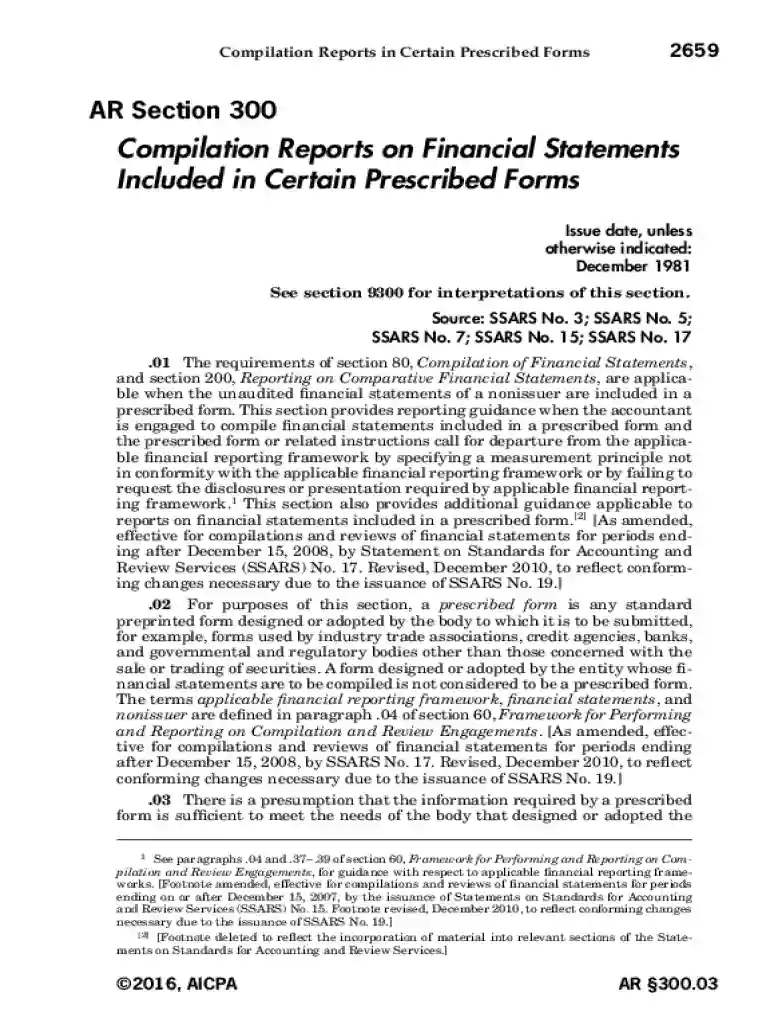
The AR 300 Compilation Reports on Financial Statements establish a framework for accountants to compile financial statements for businesses. This process involves organizing financial information in a structured manner, based on data provided by the management of a business. Notably, these reports do not provide assurance that financial statements are free from misstatements or that they comply with generally accepted accounting principles (GAAP). Instead, they aim to present financial data accurately as per specific requirements while acknowledging deviations from GAAP when necessary.
Key Features of the AR 300 Compilation Reports
- Framework Guidance: Provides detailed requirements for compiling financial statements within prescribed forms.
- Accountant’s Role: Outlines the responsibilities of accountants, focusing on assistance to management rather than assurance services.
- Examples Included: Offers illustrative examples to clarify the application of these reports in practice.
Steps to Complete the AR 300 Compilation Reports
- Collect Financial Data: Gather all necessary financial information from company management, including statements, notes, and additional data required for compilation.
- Understand Framework Deviations: Identify any deviations from standard financial reporting frameworks that may impact the report structure.
- Organize Information: Accurately arrange financial data according to the prescribed format of the AR 300. Ensure clarity and precision in the presentation.
- Draft the Report: Follow guidelines to draft the compilation report. Include necessary narratives and notes as described in the examples provided within AR 300 documentation.
- Review and Finalize: Validate the compiled report with management to confirm accuracy and completeness before recording it as an official document.
Practical Considerations
- Clarifications: Reach out to the management for any queries or clarifications needed during compilation.
- Required Documentation: Keep all supporting documents handy for reference and verification purposes.
Why Use AR 300 Compilation Reports?
Using AR 300 Compilation Reports streamlines the process of financial reporting, providing companies with a structured method of presenting financial data without extensive assurance requirements. By opting for these reports, businesses can achieve:
- Cost Efficiency: Saves resources by minimizing the need for in-depth and costly audits.
- Time Savings: Reduces the time needed to generate financial statements compared to full audit engagements.
- Compliance Ease: Ensures financial presentations are compliant with specific guidelines, simplifying regulatory adherence.
Key Elements of AR 300 Compilation Reports
Effective AR 300 Reports comprise several critical elements designed to provide a comprehensive overview of a company's financial standing:
- Statement of Financial Position: Summarizes assets, liabilities, and equity.
- Statement of Operations: Outlines revenue, expenses, and net profit or loss.
- Accompanying Notes: Offers additional context and explanations regarding financial data and deviations from standard frameworks.
Important Inclusions
- Management’s Input: Must reflect management's assumptions and decisions as per their comprehension of business operations.
- Narrative Clarifications: Should include narrative components to explain any deviations or special reporting items.
Legal Use and Compliance
The AR 300 Compilation Reports operate under the framework established by the Statement on Standards for Accounting and Review Services (SSARS), ensuring adherence to specific guidelines within the United States. Compliance with these standards guarantees that financial statements are prepared correctly, mitigating risk of non-compliance penalties.
Legal Considerations
- Non-Assurance Disclaimer: Reports explicitly state the absence of assurance, which management must understand before using these statements for decision-making.
- Compliance Obligation: Companies using these reports must stay informed about changes to SSARS guidelines and adapt their reporting practices accordingly.
Who Typically Uses AR 300 Compilation Reports?
AR 300 Compilation Reports are primarily utilized by small to medium-sized businesses that require structured financial statements without full audits. Typical users include:
- Private Companies: Aim for organized financial presentations for internal stakeholders or banks.
- Non-Profit Organizations: Need accurate financial data for management and donor reporting without incurring audit expenses.
- Accounting Practitioners: Provide clients with compliant and cost-effective financial report compilation services.
Business Types Benefitting the Most
- Startups: Require initial financial structuring without heavy compliance costs.
- Growing Enterprises: Need transparent financial records to support scaling operations and potential financing.
Examples and Practical Scenarios
For businesses involved in diverse sectors, practical scenarios showcasing the application of AR 300 Compilation Reports illustrate its utility:
- Manufacturing Sector: A manufacturing company may utilize these reports to compile detailed cost reports and financial statements to present to potential investors.
- Service Industry: Service-based entities often seek these reports to document revenue streams and service costs for better financial management.
Case Study Example
- Case Study: A retail firm experiencing rapid growth employs AR 300 Compilation Reports to track its financial position quarterly, ensuring continued transparency and assisting in strategic decision-making associated with expansion.
Important Terms and Their Relevance
Understanding specific terminology is crucial when dealing with AR 300 Compilation Reports:
- Management Representation Letter: Required document where management confirms accuracy of data furnished to accountants.
- GAAP Deviations: Situations that necessitate specific disclosure in the report narrative, detailing variance from conventional financial reporting standards.
Essential Definitions
- Compilation: The process by which an accountant transforms management-provided financial data into formal financial statements.
- SSARS Compliance: Adherence to the Statement on Standards for Accounting and Review Services during report preparation.