




01. Edit your form online
Type text, add images, blackout confidential details, add comments, highlights and more.

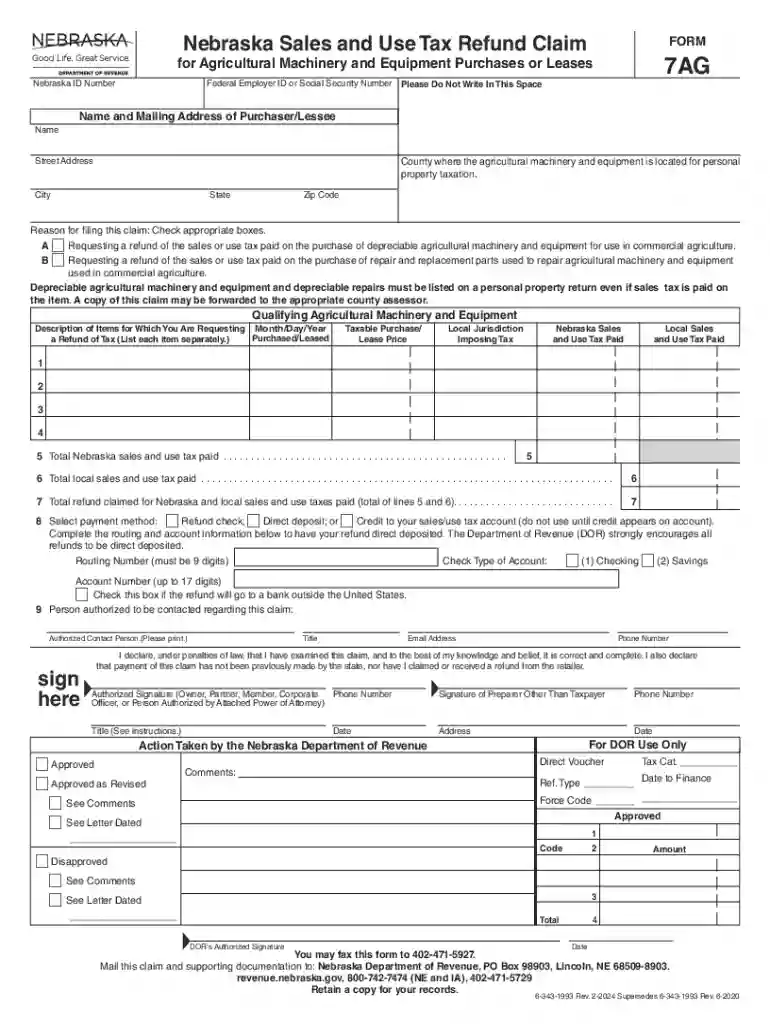
Type text, add images, blackout confidential details, add comments, highlights and more.

Draw your signature, type it, upload its image, or use your mobile device as a signature pad.

Send it via email, link, or fax. You can also download it, export it or print it out.
The Nebraska Sales and Use Tax Refund Claim form, commonly referred to as Form 7AG, serves a crucial role for individuals engaged in commercial agriculture, allowing them to request refunds for overpaid sales or use tax on qualifying items. These include depreciable machinery, repair parts, and certain materials specifically used in the agricultural sector. Understanding this form is essential for farmers and agribusinesses looking to ensure compliance while maximizing their tax returns.
Legally, Form 7AG provides a structured pathway for agricultural entities to seek a refund on taxes paid when purchasing or leasing agricultural machinery and equipment. This form is only applicable for transactions that meet specific criteria set by Nebraska's tax regulations. Legally, adherence to documentation requirements is paramount, ensuring that the claimed refunds are supported by valid purchase records and tax receipts.
Gather Necessary Documentation: Before filling out Form 7AG, collect all purchase invoices, tax receipts, and relevant documentation detailing the items bought or leased and the taxes paid.
Fill Out Purchaser Information: Enter the specific details of the purchaser, including name, address, and tax identification number.
Detail Items Purchased: Accurately list all qualifying items, ensuring each entry includes a description, purchase date, and amount paid.
Calculate Refund Amount: Compute the total sales and use tax paid for eligible items.
Attach Supporting Documentation: All claims must be accompanied by clear copies of supporting documents to validate the refund request.
Submit the Form: Once completed, submit the application via the preferred method, ensuring compliance with submission protocols.
Depreciable Machinery: Equipment whose value decreases over time due to usage, eligible for tax refund claims.
Sales Tax: A tax levied on the sale of goods and services, often refundable under specific agricultural exemptions.
Use Tax: Tax on goods purchased out-of-state but used within the state, applicable under certain conditions for refunds.
To ensure successful submission of Form 7AG, include:
Form 7AG is primarily utilized by individuals and entities involved in commercial agriculture, including:
These participants look to optimize their tax efficiency by reclaiming overpaid taxes on necessary farm operations and expansions.
Nebraska imposes specific regulations governing the eligibility and process for tax refunds on agricultural machinery and equipment. Variations can occur in terms of deductible items and procedural requirements compared to other states, thereby requiring applicants to consult state guidelines meticulously.
Being aware of critical timelines is vital:
Refund Application Deadline: Form 7AG must be filed within three years from the date of overpayment of taxes.
Document Retention: Keep all supporting documents for five years from the submission date, facilitating potential audits and future reference.
Form 7AG is available in both digital and paper formats:
Digital Version: Ideal for quick submission and record-keeping, this version integrates smoothly with tools like QuickBooks for streamlined financial management.
Paper Version: While less convenient, paper submissions are still an option, particularly for those without consistent internet access.
The optimal choice depends on the resources and preferences of the applicant, though digital submissions generally provide faster processing times.
We've got more versions of the for Agricultural Machinery and Equipment Purchases or Leases form. Select the right for Agricultural Machinery and Equipment Purchases or Leases version from the list and start editing it straight away!
At DocHub, your data security is our priority. We follow HIPAA, SOC2, GDPR, and other standards, so you can work on your documents with confidence.



Feb 28, 2024 Leases are flexible, and they can be for long or short terms. The goal is that lease payments should be less than loan payments. Owning farm
Nov 24, 2025 This exemption only applies to purchases, not leases or rentals, of farm machinery. es to the lease or rental of farm equipment and machinery.


