01. Edit your form online
Type text, add images, blackout confidential details, add comments, highlights and more.

Type text, add images, blackout confidential details, add comments, highlights and more.

Draw your signature, type it, upload its image, or use your mobile device as a signature pad.

Send it via email, link, or fax. You can also download it, export it or print it out.
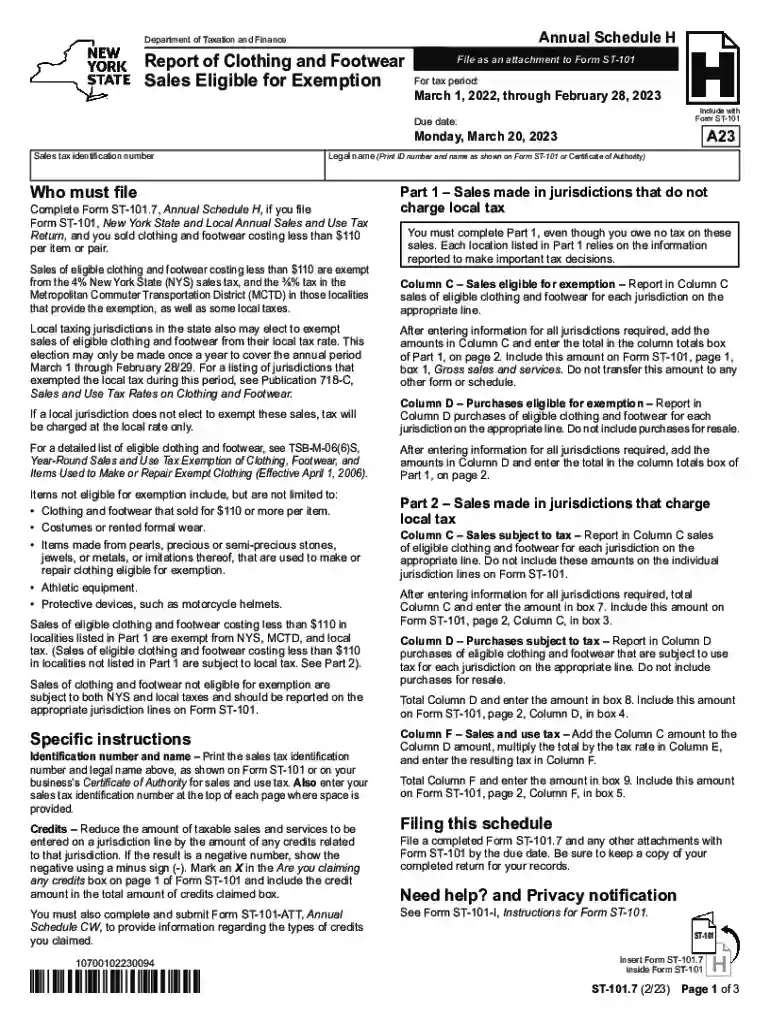
The Form ST-101.7, also known as the Report of Clothing and Footwear Sales, is an official document required by the New York State Department of Taxation and Finance. This form is specifically designed for reporting sales transactions of clothing and footwear that qualify for a tax exemption. These items must be priced under $110 to be eligible for this exemption, and the form helps businesses accurately report and itemize these sales for tax purposes. Understanding whether an item falls within these guidelines is crucial for compliance.
To effectively use Form ST-101.7, retailers need to accurately track the sales of qualifying items throughout the tax period. This involves documenting each sale that is eligible for the exemption, ensuring all transactions are correctly categorized. Retailers must report total sales amounts and the corresponding tax-exempt sales to ensure compliance with state regulations. Retailers should use consistent and thorough record-keeping practices to prevent discrepancies when submitting this form.
Legally, the submission of Form ST-101.7 ensures compliance with the state's tax laws, particularly regarding sales tax exemption for certain clothing and footwear items. Accurate reporting is essential to avoid legal repercussions, such as fines or audits. Businesses must be aware of potential changes in legislation regarding exemptions and ensure all reported items meet the specified criteria.
Failing to properly report sales through Form ST-101.7 can lead to significant penalties. These may include financial fines, interest on overdue taxes, and potential audits by the tax authorities. Businesses need to ensure completeness and accuracy in filing to avoid these penalties.
Form ST-101.7 should be filed in conjunction with Form ST-101 by the deadlines set forth by the New York State Department of Taxation and Finance. The filing period typically covers sales from March 1st to February 28th of the following year, with specific submission deadlines announced annually. It is essential for businesses to monitor these deadlines closely.
An example scenario involves a clothing retail store in New York City. Throughout the year, the store records the sale of various clothing items priced below $110. At the end of the tax period, the store compiles these sales and reports them using Form ST-101.7 to ensure they are accurately reflected as exempt sales. This practice safeguards the store from penalties and ensures compliance with state regulations.
Retail businesses that specialize in selling clothing and footwear are the primary users of Form ST-101.7. These include brick-and-mortar stores, online retailers, and department stores. By filing this form accurately, these businesses can take advantage of tax exemptions, enhancing their economic advantage and simplifying compliance with state tax laws.
The New York State Department of Taxation and Finance issues Form ST-101.7. This agency is responsible for creating guidelines and ensuring retailers comply with tax laws related to exempt sales of clothing and footwear.
New York's tax laws uniquely define the qualifications for tax exemption using this form. It is important to distinguish between state, local, and special district tax rules, as some areas may have additional requirements or exemptions beyond the state-level guidelines. Understanding these intricacies is vital for businesses operating in multiple jurisdictions within New York.
We've got more versions of the Form ST-101 7 Report of Clothing and Footwear Sales form. Select the right Form ST-101 7 Report of Clothing and Footwear Sales version from the list and start editing it straight away!
At DocHub, your data security is our priority. We follow HIPAA, SOC2, GDPR, and other standards, so you can work on your documents with confidence.