




01. Edit your form online
Type text, add images, blackout confidential details, add comments, highlights and more.

Type text, add images, blackout confidential details, add comments, highlights and more.

Draw your signature, type it, upload its image, or use your mobile device as a signature pad.

Send it via email, link, or fax. You can also download it, export it or print it out.
The Massachusetts State Tax system outlines a structured framework for how taxes are assessed on individuals and businesses within the state for the 2 period. This system covers various income brackets, offering clear guidance on the rates applicable to different income levels and the entities responsible for paying these taxes. Understanding these rules ensures compliance and optimal tax planning for residents and businesses alike.
Massachusetts applies a flat income tax rate on personal income. For the tax years 2023 and 2024, the rate remains consistent:
Flat Rate: The flat income tax rate for individuals in Massachusetts is set at 5% of Massachusetts taxable income. This is uncomplicated compared to states with progressive tax rates, making it simpler for taxpayers to calculate their obligations.
Deductions and Credits: Massachusetts offers various deductions and credits that can offset taxable income and reduce the overall tax burden. Common credits include those for childcare expenses, earned income for low-income individuals, and property taxes paid.
The sales and use tax rate in Massachusetts is another essential component to consider:
Standard Rate: A sales tax rate of 6.25% is applied to the sale of most goods and services.
Exemptions: Many food items and clothing purchases under a specific dollar amount are exempt from sales tax. For example, clothing is only taxed if the individual purchase exceeds $175.
Besides state-wide taxes, residents may also encounter local property taxes:
Property Tax Rates: These vary significantly across cities and towns in Massachusetts, as they are determined by local government entities. Property owners should verify rates specific to their locality.
Assessment Process: Property is typically reassessed every few years, and taxes are levied based on the assessed value of the property.
Residents, part-year residents, and certain non-residents who earn income from Massachusetts sources must file a state income tax return. Business entities conducting operations within the state are also obligated to file.
Residents and business entities should be aware of critical tax filing deadlines:
Personal Income Tax: The deadline aligns with federal deadlines, typically April 15. Extensions for filing are available, but any taxes owed must still be paid by the April deadline.
Business Taxes: Vary depending on the business type, but generally align closely with personal income tax deadlines.
Gather Documents: Collect all necessary documents such as W-2s, 1099 forms, and statements of deductions or credits.
Determine Filing Status: Identify whether you qualify as a resident, part-year resident, or non-resident, which affects your filing process.
Calculate Income: Use Massachusetts's flat rate to calculate tax liability on taxable income after adjustments.
File Electronically or by Mail: You can submit your return online through MassTaxConnect or mail a paper return to the Massachusetts Department of Revenue.
Personal Identification: Copy of ID for identification verification.
Income Documentation: W-2s, 1099s, or equivalent documents that report income received during the tax year.
Expense Receipts: Any documentation that supports deductions or credits claimed.
The Massachusetts Department of Revenue (DOR) is responsible for issuing tax forms, guidelines, and overseeing the tax filing process for individuals and businesses. They provide assistance and resources for taxpayers to accurately complete and file their returns.
Failing to file or pay taxes on time can result in penalties and interest charges:
Late Filing Penalty: Generally, 1% of the amount due for each month, up to a maximum of 25%.
Late Payment Penalty: 1% per month of the outstanding tax balance.
Interest Charges: Interest will accrue on any unpaid tax from the date due until paid in full.


Self-Employed Individuals: Must report all income, including earnings not subject to withholding, and may also need to pay estimated taxes throughout the year.
Retirees: Often need to ensure retirement income, such as Social Security or pension payments, is accurately reported, even if some sources are not taxable.
Corporations, LLCs, and Partnerships: Corporations are typically subject to both a corporate excise tax and a net income tax. LLCs might be taxed as corporations, partnerships, or disregarded entities, depending on their setup.
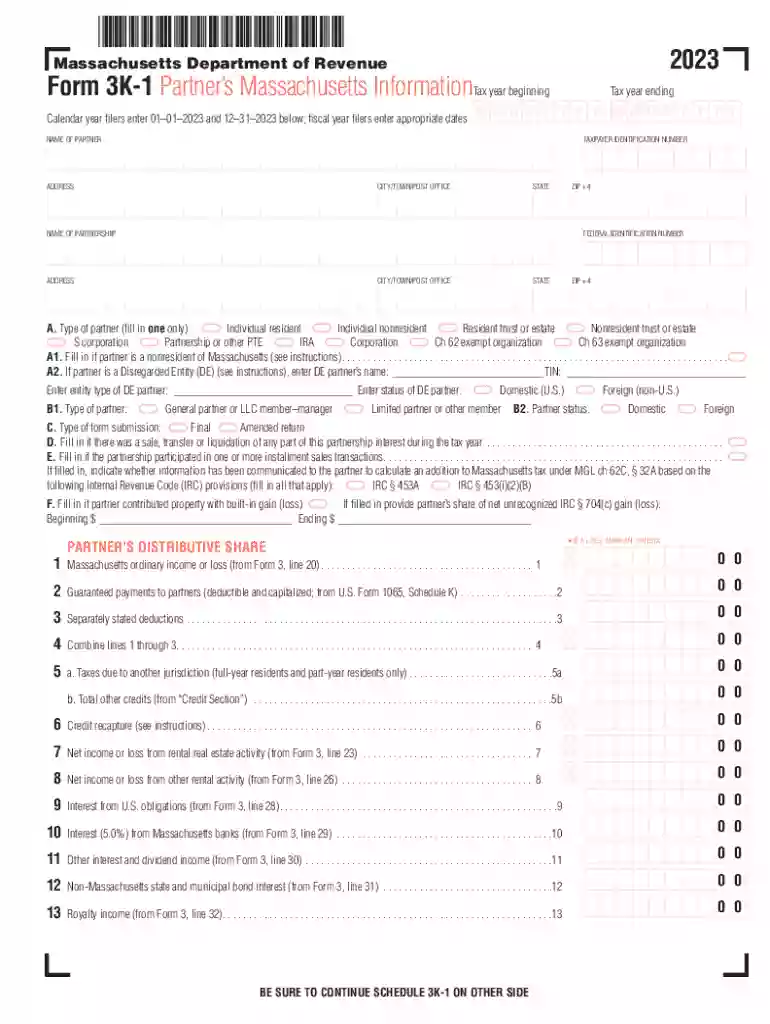
Partnerships: Use forms like Massachusetts Form 3K-1 to report individual partner shares of income and are crucial for tax purposes to reflect proper income distribution.
Using digital tools like TurboTax or QuickBooks can simplify the filing process. These platforms often provide:
Guided Filing: Step-by-step instructions that help ensure compliance with state tax rules.
Integration Features: Allow access and transfer of federal return data, streamlining state return preparation.
These sections collectively offer a robust guide for understanding and managing Massachusetts state taxes effectively. By adhering to state guidelines and deadlines while utilizing proper documentation and resources, residents and businesses can maintain compliance and optimize their tax situations.
We've got more versions of the Massachusetts State Tax: Rates and Who Pays in 2023-2024 form. Select the right Massachusetts State Tax: Rates and Who Pays in 2023-2024 version from the list and start editing it straight away!
| Versions | Form popularity | Fillable & printable |
|---|---|---|
| 2025 | 4.7 Satisfied (56 Votes) | |
| 2024 | 4.9 Satisfied (38 Votes) | |
| 2023 | 4.2 Satisfied (25 Votes) | |
| 2022 | 4.5 Satisfied (44 Votes) | |
| 2020 | 4.8 Satisfied (197 Votes) | |
| 2019 | 4.3 Satisfied (227 Votes) | |
| 2018 | 4.2 Satisfied (56 Votes) | |
| 2017 | 4.1 Satisfied (45 Votes) | |
| 2015 | 4.4 Satisfied (51 Votes) | |
| 2014 | 4 Satisfied (54 Votes) | |
| 2009 | 4 Satisfied (29 Votes) | |
| 2005 | 4 Satisfied (42 Votes) |
At DocHub, your data security is our priority. We follow HIPAA, SOC2, GDPR, and other standards, so you can work on your documents with confidence.

Dec 30, 2025 Tax year 2024: For income exceeding $1,053,750, there is an additional surtax of 4%. Withholding Wages 5.00% Tax year. Rates 0.8% - 16% 15%-50%
Jul 16, 2025 This annual study evaluates effective tax rates (property taxes as a percentage of market value) of 75 large US cities and 50 ruralRead more


