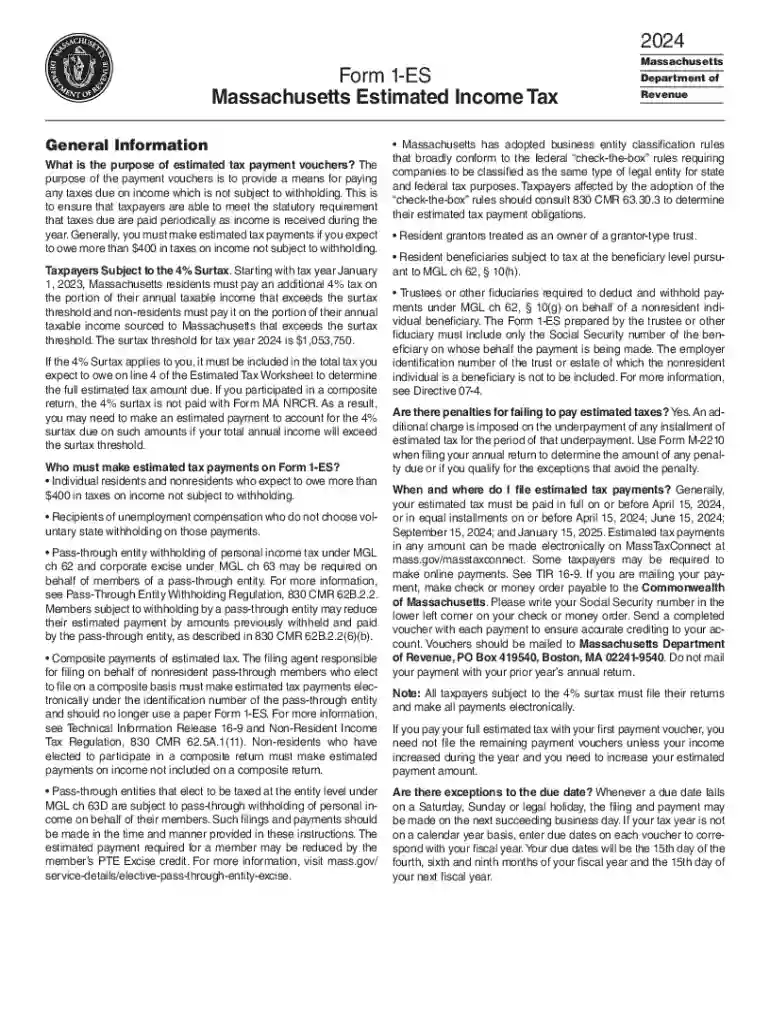
2024 Form 1-ES Estimated Tax Payment Voucher-2026

Get Form
2024 Form 1-ES Estimated Tax Payment Voucher Preview on Page 1

Here's how it works

01. Edit your form online
Type text, add images, blackout confidential details, add comments, highlights and more.

02. Sign it in a few clicks
Draw your signature, type it, upload its image, or use your mobile device as a signature pad.

03. Share your form with others
Send it via email, link, or fax. You can also download it, export it or print it out.

Definition & Meaning

The 2024 Form 1-ES Estimated Tax Payment Voucher is a document used by taxpayers to make estimated tax payments to the IRS. It is specifically for managing income that is not subject to withholding, such as earnings from self-employment, interest, dividends, or rental income. This form helps taxpayers meet their tax obligations by dividing their estimated tax liability into manageable quarterly payments, reducing the risk of underpayment penalties.

Key Elements of the Form

  • Taxpayer Information: Includes personal identification details such as name, address, and Social Security Number.
  • Payment Details: Indicates the payment amount, payment period, and the year for which the taxes are applicable.
  • Voucher Instructions: Provides guidance on filling out the form and where to send it, ensuring compliance with IRS requirements.

How to Use the 2024 Form 1-ES Estimated Tax Payment Voucher

Using the 2024 Form 1-ES involves calculating your estimated taxes and submitting payments in timely intervals. It is principally aimed at individuals and businesses with income streams not covered by regular withholding. By making these payments, taxpayers can more effectively manage their annual tax obligations.

Step-by-Step Use

  1. Calculate Estimated Tax: Determine your expected income, deductions, taxable income, and tax credits for the year.
  2. Fill Out the Form: Enter your calculated estimated tax payment amount for the specified period.
  3. Submit Payment: Mail the voucher with your check or money order to the specified IRS address, or visit the IRS website to make an electronic payment.

Steps to Complete the 2024 Form 1-ES Estimated Tax Payment Voucher

Accurately completing the Form 1-ES is crucial for ensuring proper crediting of your estimated tax payments. Follow these steps to ensure precision:

  1. Personal Information: Write your full name, current address, and Social Security Number.
  2. Tax Year: Specify the year for which you're making the estimated tax payment.
  3. Payment Period: Identify the applicable quarter for the payment, indicating whether it’s the first, second, third, or fourth installment.
  4. Payment Amount: Calculate and record the estimated tax you are paying for the period.
  5. Submission: Detach the voucher and mail it with your payment to the IRS address indicated in the instructions or submit electronically via the IRS portal.

Important Considerations

  • Double-check all personal and payment information to avoid processing delays.
  • Ensure that your check or money order is properly addressed to the U.S. Treasury and includes your Social Security Number and “Form 1-ES” for reference.

Filing Deadlines / Important Dates

Timely payments are essential to avoid penalties. The IRS mandates quarterly payments for estimated taxes. The typical deadlines are:

  1. April 15: For the first-quarter estimate.
  2. June 15: For the second quarter.
  3. September 15: For the third quarter.
  4. January 15 (following year): For the final quarter.

Late Filing Penalties

Failing to file by these deadlines can result in interest and penalties. If you are unable to meet these dates due to unforeseen circumstances, the IRS may provide extensions under specific conditions.

Examples of Using the 2024 Form 1-ES Estimated Tax Payment Voucher

Understanding how different taxpayers might use the 2024 Form 1-ES provides clarity. Here are some examples:

  • Self-Employed Individuals: People running their own businesses often use this form to pay taxes not already withdrawn from paychecks.
  • Freelancers and Contractors: Those with variable income streams utilize the form to manage tax liabilities stemming from multiple clients.
  • Retirees with Investment Income: Seniors drawing retirement income or investment returns need to use this form for non-wage income like dividends or capital gains.

IRS Guidelines

The IRS outlines regulations guiding the usage of the Form 1-ES to promote compliance. Understanding these guidelines helps taxpayers fulfill their responsibilities:

  • Who Must Pay: Taxpayers expecting to owe $1,000 or more beyond any withholding are obliged to make estimated payments.
  • Annualization Method: Offers a means of computing estimated tax where income is not earned uniformly across the year, allowing flexibility for seasonal income earners.

Penalties for Non-Compliance

Non-compliance with the IRS's estimated tax payment requirements can lead to several penalties:

  • Underpayment Penalties: Applied if the total estimated tax payments during the year are insufficient.
  • Late Payment Penalties: Incurred on payments made past the due date without an approved extension.
  • Inaccurate Payments: Penalties could also result if payments are calculated improperly or using outdated methods.

Mitigating Penalties

To minimize the risk of penalties, ensure payments are accurately calculated and submitted on time. Engage with tax professionals if necessary to ensure compliance.

Digital vs. Paper Version

In today’s digital age, taxpayers have the option to choose between digital and paper filing of the Form 1-ES, each with its benefits:

  • Digital Filing: Convenient and faster, with immediate confirmation upon submission. Electronic payments can be made through the IRS Direct Pay or EFTPS.
  • Paper Filing: Traditional method for those preferring physical submission. It requires mailing the printed voucher with necessary payments.

Pros and Cons

  • Paper: Tangible record-keeping but slower and with the possibility of mailing delays.
  • Digital: Environmentally friendly and reduces the chance of error due to misplacement, yet requires internet access.

Each taxpayer needs to evaluate their personal situation and technical comfort level when deciding on the submission method.

Required Documents

Filing estimated taxes efficiently requires organization and preparedness. Appropriate documentation enhances accuracy:

Necessary Documents

  • Prior Year Tax Return: Offers insights into expected income, deductions, and credits.
  • Current Income Statements: Relevant for calculations, especially if dealing with non-uniform income streams.
  • Expense Records: Important for calculating total income and applicable deductions.

Documentation Tips

  • Organize records into physical or digital files readily accessible for quarterly reviews.
  • Review and update financial forecasts regularly to reflect changes in income or deductions.
be ready to get more

Complete this form in 5 minutes or less

Get form

Got questions?

We have answers to the most popular questions from our customers. If you can't find an answer to your question, please contact us.
Contact us
You may send estimated tax payments with Form 1040-ES by mail, or you can pay online, by phone or from your mobile device using the IRS2Go app. You can also make your estimated tax payments through your online account, where you can see your payment history and other tax records. Go to IRS.gov/account.
California: Internal Revenue Service, PO Box 802501, Cincinnati, OH 45280-2501.
Follow these steps to print blank estimate vouchers. Go to the. Est. screen in the. Payments. Select the. Print estimate filing instructions with blank amounts with Code 4. field to print the estimate filing instructions as if the estimates were calculated. The filing instructions will print with blank amount fields.
To avoid penalties, the paymentby check or money order accompanied by the correct IRS vouchermust be postmarked by the due date. Or online payments can be made without a voucher.
Answer: Generally, if you determine you need to make estimated tax payments for estimated income tax and estimated self-employment tax, you can make quarterly estimated tax payments or pay all of the amount due on the first quarterly payment due date. Special rules apply to farmers and fishermen.

Security and compliance

At DocHub, your data security is our priority. We follow HIPAA, SOC2, GDPR, and other standards, so you can work on your documents with confidence.

Learn more
ccpa2
pci-dss
gdpr-compliance
hipaa
soc-compliance
be ready to get more

Complete this form in 5 minutes or less

Get form

People also ask

You may get these vouchers if youre self-employed or had an uncharacteristic spike in your income this year. For example, you sold stock or took a large distribution from your retirement plan.
The IRS uses the latest encryption technology making electronic payments safe and secure. Its quick, easy, and much faster than mailing in a check or money order.
Relying on regular mail without tracking is risky. If a tax return isnt received, it may be considered delinquent, leading to penalties. Certified Mail or electronic filing provide confirmation of receipt and/or filing. E-filing is faster, more accurate, and delivers instant receipt confirmation.

Related links